From Fruit Salad to Baked Bread: Understanding Complex Systems for Behaviour Change

New perspectives from my doctoral research, “Complex Systems and Behaviour Change: Bridging Far Away Lands.”

On May 16, 2025, I finally defended my doctoral dissertation – a side-project in the making for the last 9 years or so. I was pretty confident that this would have happened two years ago already when I submitted a rogue version of the dissertation summary for pre-examination. It was titled “Understanding and Shaping Complex Social Systems: Lessons from an emerging paradigm to thrive in an uncertain world”, which is also the name of a course I later started teaching in the New England Complex Systems Institute. The preprint was quickly downloaded almost 1000 times, and people reached out to me to thank for the clear exposition. But this version turned out to be a bit too rogue for one of the pre-examiners, and I rewrote the whole thing in 2024 – to be much more technical, and stylistically more conventional.

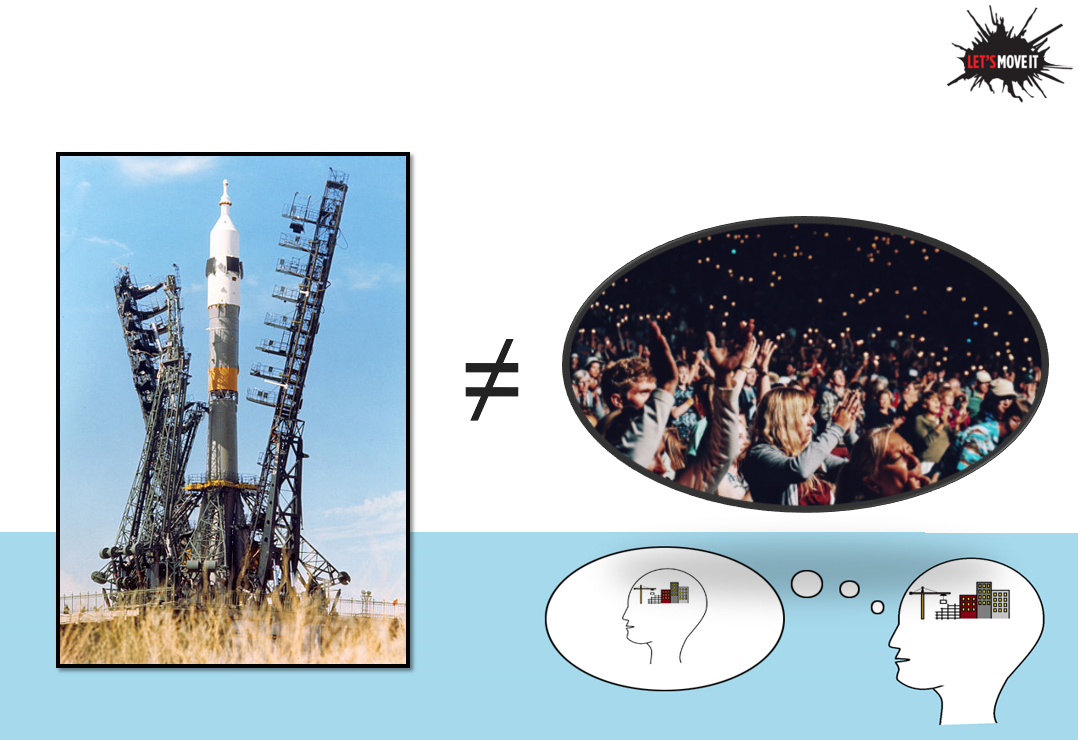
The defence was a success and here we are, the dissertation finally accepted by the academic establishment. Published summary can be downloaded here. The implicit promise is that after reading the work, you’ll be able to understand this cartoon, which you might recognise to have a relationship with the cover image:

As is traditional in the Finnish system, I began the occasion with a Lectio Praecursoria – an introductory speech. This talk introduced the groundwork for my research, exploring the often-overlooked connections between two seemingly distant scientific fields: complex systems and behaviour change.

This blog post adapts that initial speech, inviting you to explore these ideas with me.

The Core Idea: Why We Need to Rethink Behaviour Change

The research I present explores the intersection of two scientific domains that might seem, at first glance, quite distant. But what I want to do is share why building bridges between complex systems and behaviour change is not merely an academic curiosity, but, as I argue in this work, a vital step towards deepening our understanding of human action in our increasingly interconnected world, and ultimately, towards building a more robust basic science of behaviour change. [Side note: you can find my perspective to what behaviour change is NOT here, and connections to risk management here and here.]

The “Fruit Salad vs. Bread” Analogy: Understanding Different Types of Systems

To begin, let us talk about the difference between making fruit salad and baking bread. I am well aware of how ludicrous this sounds, but I believe that confusing these two processes consistently causes well-meaning efforts, particularly those aimed at changing behaviour, to stumble. So please bear with me.

Imagine making fruit salad for a bunch of children. You gather fruits you enjoy – perhaps pineapple, peach, and cherries. You’re fairly confident that if you like them separately, you’ll like them together. You chop them, combine them, and serve them. Now, if a child finds that cherries look too strange to be edible – and leaves them behind – it’s no catastrophe. They can still consume the pineapple and peach, which every reasonable person enjoys. The uneaten cherries can be consumed by someone else later. In fruit salad, we can combine ingredients, analyse the parts somewhat independently, and predict the outcome of the whole with reasonable certainty. With many ingredients, fruit salad can become complicated – a word whose origins (as pointed out by Dave Snowden) can be taken to mean “folded.” And what has been folded, can often also be unproblematically unfolded.

Now, think about baking bread. You combine yeast, flour, water, and salt. You’ve heard that olive oil is healthy, so you add a bit of that in. You mix, knead, let it rise, bake. The final loaf emerges. But what if the children dislike the taste of olive? You cannot simply remove the oil. Or what if you put in too much salt? The ingredients have interacted, transformed. The bread is an emergent product, something entirely new, fundamentally different from the mere sum of its parts. The whole portion intended for the children, not just the offending component, might have to be passed to an omnivorous family member. This process is better described not as complicated, but as complex, a word with roots that can be interpreted as “entangled” or “interwoven.”

Unlike with folding, what is interwoven cannot easily be disentangled without fundamentally changing its nature.

The Two Key Disciplines: Behaviour Change and Complex Systems

With this analogy in mind, let’s turn to the disciplines central to my research.

Behaviour change science is an inherently interdisciplinary field drawing from psychology, sociology, public health, and more. It strives to understand the web of factors – personal, social, environmental – that shapes our actions. Its goal is to help foster changes needed to tackle major societal challenges: from noncommunicable diseases (entailing, for example, physical activity behaviours) and sustainable work-life (entailing, for example, job crafting behaviours) to climate action and pandemic preparedness (entailing risk management behaviours). Human action is a core thread in all these pressing issues.

The other discipline central to this work is complex systems science. It originally grew out of physics, chemistry, and biology, but its principles increasingly reach into the psychological and social world. It studies systems composed of many interacting parts, where these interactions often dominate the system’s overall behaviour. A key insight is that the relationships between components can be more critical than the components themselves in determining the system’s properties. Think of water: ice, liquid, and steam involve the same H₂O molecules, but their differing interconnectivity leads to vastly different behaviours. Steam can make a sauna feel warm; ice can make swimming difficult afterwards. But the components remain the same.

Are We Using Fruit-Salad Tools for Bread-Like Problems?

When it comes to systems, some are more component-dominant, like fruit salad, while others are more interaction-dominant, like bread. My research argues that many phenomena central to behaviour change science – like motivation dynamics, the spread of social norms, or how people respond to interventions – are far more like bread than fruit salad. They occur as parts of complex, interaction-dominant systems.

The main contributions of my dissertation relate to the development of basic science. Early theories in behaviour change were driven by practitioners aiming to understand issues they faced. And practitioners are often very good at working with complexity, although their terminology to describe the phenomena at play might sometimes be limited. But still, many of the quantitative tools that were relied upon in developing these theories implicitly treated behaviour change phenomena like fruit salad. For instance, while linear regression analysis can incorporate simple interaction terms to account for some forms of interdependence, its main usage is to assign values to variables such as norms, intentions, and attitudes, assuming they are independent from each other – implying separability. Furthermore, there’s a common, often implicit, assumption that findings derived from group-level data directly translate to understanding how individuals change over time.

So, the central question becomes: If behaviour change is often entangled and emergent like bread dough, should our primary tools be those best suited for slicing separable fruit?

Beyond Linearity: Embracing the Complexity of Change

I argue that this potential mismatch – analysing bread with fruit salad tools – can hinder our understanding of behaviour change as a complex evolving process. Complex systems science suggests that variability, which might look like messiness or error from a purely linear perspective, is often not just noise; it can be the inherent signature of the dynamic system itself.

A key characteristic of these systems, which I investigated conceptually and empirically, is non-linearity. Imagine pushing a boulder near a hilltop:

You push a little, the boulder moves a little.

You push a little, the boulder moves a little.

You push a little… and the boulder tumbles dramatically into a new valley.

Perhaps now scientists rush to the scene to investigate what was distinct in your technique for the last push. And they will inevitably find results. But the magic was not in the push, but the relationship between the push, the boulder’s position, and the landscape. This kind of abrupt, disproportionate change is known as a critical transition.

Mapping Change: The Power of Attractor Landscapes

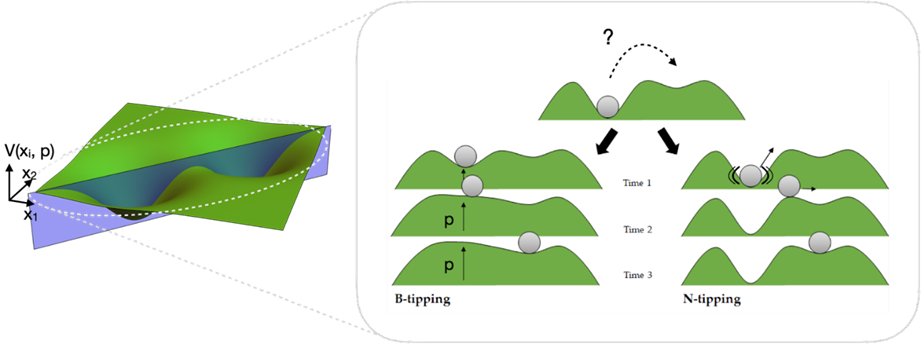
Complex systems science offers a powerful conceptual tool to map transition dynamics: the attractor landscape. Imagine a pool table with a single billiard ball. Each position on the table represents a possible state for the system, and the current status is represented by the location of the billiard ball. Now imagine the surface isn’t flat, but contains hills and valleys. The valleys represent stable patterns – the attractors, collections of similar states that “trap” the ball. It’s easy for the ball to settle into a valley; it requires more effort or perturbation to push it out. The ridges between valleys are called tipping points.
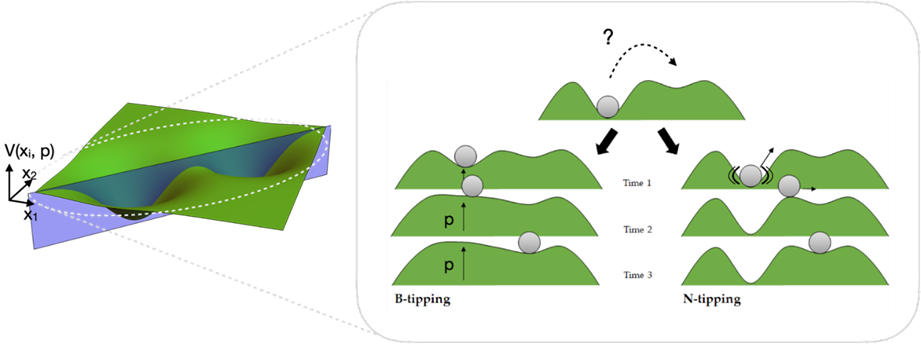
A slice of an attractor landscape showing two major ways systems can shift abruptly (from an article included in the dissertation)

Think of smoking, where dispositions in the North Atlantic world shifted gradually if at all for many decades. Imagine this as a landscape: one valley where smoking is socially acceptable, and another where it is frowned upon. There was little change for a long time, until a tipping point was reached, leading to widespread disapproval and significant policy changes. Pushing the system over the ridge requires effort or a significant nudge, but once crossed, it naturally settles into a new attractor valley, a new stable pattern. However, this landscape isn’t necessarily static; it can transform and be reshaped. Think of this like the hills and valleys of the pool table rising and falling over time.

Notice how different this landscape representation is from conventional flowcharts suggesting neat, linear causes and effects. It shifts focus towards understanding the system’s dispositions, its underlying tendencies and stabilities. It encourages a focus on nurturing the conditions, tending the substrate, working the soil, from which desired behaviours – in deeper, more stable valleys – can emerge, and sustain themselves more naturally.

Evidence in Action: From Work Motivation to Public Health

In my research, I used analytical techniques adapted from dynamical systems theory to investigate empirical evidence for such attractor states and shifts within fine-grained, moment-to-moment work motivation data. I also explored its applicability to societal-level data on COVID-19 protective behaviours. This work suggests the landscape metaphor is not just a useful theoretical vehicle; these patterns can be observed and studied in real-world behaviour change contexts.

In addition to non-linearity, some of the patterns of complex systems I examined in this research were “non-stationarity” and “non-ergodicity”. In my work, I clarify these terms in the behaviour change context and demonstrate how to study them empirically in time series data, with methods such as cumulative recurrence network analysis.

The Key Takeaway: Complexity as a Feature, Not a Bug

In essence, the core message of this work is that the bread-like complexity of human behaviour change isn’t just noise or a problem to be simplified away. It’s a fundamental characteristic we must embrace and understand scientifically if we want our science to accurately reflect the phenomena it studies. Complex systems science provides concepts and tools that acknowledge interdependence, emergence, and context-sensitivity of change phenomena. And we aim not to eliminate this complexity, but to enlist it.

Looking Ahead: Building a Bridge to a More Robust Science of Human Action

By building bridges between behaviour change science and complex systems science, the research presented here argues that a complex systems perspective can help us build a more robust and realistic science of human action – one that recognises behaviour not just as a collection of separable ingredients like a fruit salad, but as an emergent, interwoven process like baking bread.

This, I believe, is crucial. It is crucial for developing a science better equipped to understand the intricate dynamics of behaviour change. It is crucial for us to seize the opportunities that arise when we learn to converse with complex systems, instead of just trying to push them around. And it is crucial for navigating the critical policy challenges of our time, which invariably involve understanding and enabling human action.


What are your thoughts? Leave a comment or reach out. My current research interests mainly revolve around risk management (see paper described here) – particularly, understanding and shaping communities’ capacities to respond, recover, and adapt from shocks. I’m a 72hours.fi trainer, and would be happy to collaborate in e.g. projects to make the EU’s new preparedness strategy a feasible reality.
Picture of me doing a sound check before the doctoral defense. It was held in Zoom as I was in Germany, the chair was in Finland, and the opponent in the U.S. 😅

Affordance Mapping to Manage Complex Systems: Planning a Children’s Party

I’ve recently followed with interest Dave Snowden’s development of “Estuarine Mapping”, also known as “Affordance Mapping”. The process is based on a complex systems framework to design and de-risk change initiatives (see link in the end of this post). After taking part in training sessions and facilitating some mapping exercises with groups, I found myself in want of a metaphor that didn’t require an understanding of coastal geography.

Enter the world of children’s parties. Snowden has a famous anecdote about organising a party for kids, which brilliantly illustrates the folly of applying traditional management techniques to complex systems. Inspired by this tale, I’ve reimagined it here as a simplified depiction of the Affordance Mapping process. So here we go.

Picture yourself tasked with organising a birthday bash for a group of energetic seven-year-olds. But instead of reaching for a conventional party-planning checklist, you decide to employ the Affordance Mapping process. What would you do?

First, you’d start by surveying the party landscape. You’d identify all the elements that could influence the party – from the near-immovable dining table to the ever-shifting moods of the kids. We’ll call these our party elements.

Next, you’d create a map of these elements. On one axis, you’d have how much energy it takes to change each element – moving the dining table would be high energy, while changing the music playlist would be low. On the other axis, you’d have how long it takes to make these changes – getting pizza delivered, or setting up a bouncy castle might take an hour, while changing a game rule could be instant.

Now, you’d draw a line in the top right corner. Everything above this line is beyond your control – things you absolutely can’t change, like the fact that Tommy’s allergic to peanuts. You’d also draw a second line for things that are outside your control, but amenable in collaboration with other parents, like how the party should end by 6 PM. You’d also mark a zone in the bottom left corner, for elements that change too easily and might need stabilising, like the kids’ attention spans or the volume level.

The result might look something like this:

The exciting part is the middle area. Here’s where you can actually make changes to improve the party; the things you can manage. But you can also try to make some elements more manageable via (de)stabilisation efforts, or remove some altogether.

For example, you might decide to:

  1. Keep some elements as they are (the classic musical chairs game)
  2. Remove others that aren’t fun (the complicated crafts project your spouse found on Pinterest)
  3. Modify some to make them more enjoyable (have kids organise themselves into a line arranged by height, when moving outdoors after the cake is done with)

You’d come up with small experiments to test these ideas. Maybe you’ll try introducing a new party game like “freeze dance” to alleviate boredom in waiting for transitions from one activity to the next, or rearranging the gift-opening area. You’d also think about how changing one element might affect others – will having a water balloon toss right before snack time lead to damp clothes?

Finally, you’d plan how to amplify emergent positive side-effects, and mitigate negative ones. You’ll also redraw your party map before next year’s party. This way, you’re always working towards a more fun and dynamic party, understanding that some elements will always be shifting (like the kids’ favorite songs) while others stay constant (like the need for cake).

Technical note. The items on the map, in the lingo of the complex systems philosopher Alicia Juarrero, represent “constraints“; things that modulate a system’s behaviour. In complex systems, these are intertwined in such deep ways, that their effects are seldom amenable to an analysis of linear causality. To change a system’s macro-level state, you execute multiple parallel micro-interventions that aim to affect these constraints. For a recent open access book chapter outlining the rationale, see here: As through a glass darkly: a complex systems approach to futures.

What Behaviour Change Science is Not

Due to frequent misconceptions about the topic, I wanted to outline a via negativa description of this thing called behaviour change science: in other words, what is it not? This is part of a series of posts clarifying the perspective I take in instructing a virtual course on behaviour change in complex systems at the New England Complex Systems Institute (NECSI). The course mixes behaviour change with complex systems science along with practical collaboration tools for making sense of the world in order to act in it.

Behaviour change science refers to an interdisciplinary approach, which often hails from social psychology, and studies changing human behaviour. The approach is motivated by the fact that many large problems we face today – be they about spreading misinformation, preventing non-communicable diseases, taking climate action, or preparing for pandemics – contain human action as major parts of both the problems and their solutions.

Based on many conversations regarding confusions around the topic, there is a need to clarify five points.

First, “behaviour change” in the current context is understood in a broad sense of the term, synonymous with human action, not as e.g. behaviourism. As such, it encompasses not only individuals, but also other scales of observation from dyads to small groups, communities and society at large. Social ecological models, for example, encourage us to think in such a multiscale manner, considering how individuals are embedded within larger systems. Methods for achieving change tend to differ for each scale; e.g. impacting communities entails different tools than impacting individuals (but we can also unify these scales). And people I talk to in behaviour change, understand action arises from interaction (albeit they may lack the specific terminology).

Second, the term intervention is understood in behaviour change context in a broader sense, than “nudges” to mess with people’s lives. A behaviour change intervention depicts any intentional change effort in a system, from communication campaigns to community development workshops and structural measures such as regulation and taxation. Even at the individual level, behaviour change interventions do not need to imply that an individual’s life is tampered with in a top-down manner; in fact, the best way to change behaviour is often to provide resources which enable the individual to act in better alignment with goals they have. Interventions can and do change environments that hamper those goals, or provide social resources and connections, which enable individuals to take action with their compatriots.

Third, behaviour change is not an activity taken up by actors standing outside the system that’s being intervened upon. Instead, best practices of intervention design compel us to work with stakeholders and communities when planning and implementing the interventions. This imperative goes back to Kurt Lewin’s action research, where participatory problem solving is combined with research activities. Leadership in social psychology is often defined not as the actions of a particular high-ranking role, but those available to any individuals in a system. Behaviour change practice is the same. To exaggerate only slightly: “Birds do it, bees do it, even educated fleas do it”.

Fourth, while interventions can be thought of as “events in systems”, some of which produce lasting effects while others wash away, viewing interventions as transient programme-like entities can narrow our thinking of how enablement of incremental, evolutionary, bottom-up behaviour change could optimally take place. Governance is, after all, conducted by local stakeholders in constant contact with the system, with larger leeway to adjust actions without fear of breaking evaluation protocol, and hopefully “skin in the game” perhaps long after intervention designers have moved on.

Fifth, nothing compels an intervention designer to infuse something novel into a system. For example, reverse translation studies what already works in practice, while aiming to learn how to replicate success elsewhere. De-implementation, on the other hand, studies what does not work, with the goal of removing practices causing harm. In fact, “Primum non nocere”; first, do no harm, is the single most important principle for behaviour change interventions .

Making sense of human action

Understanding and influencing human behavior is usually not a simple endeavor. Behaviors are shaped by a multitude of interacting factors across different scales, from the individual to the societal, and occur within systems of systems. Developing effective behavior change interventions requires grappling with this complexity. The approach taken in traditional behaviour change science uses behaviour change theories to make this complexity more manageable. I view these more akin to heuristic frameworks with practical utility – codification attempts of “what works for whom and when” – rather than theories in the natural science sense.

If you want a schematic of how I see behaviour change science, it might be something like the triangle below. It’s a somewhat silly representation, but what the triangle tries to convey, is that complex systems expertise sets out strategic priorities: Which futures should we pursue, and what kinds of methods make sense to get us going (key word is often evolution).

Behaviour change science, on the other hand, is much more tactical, offering tools and frameworks to understand how to make things happen closer to where the rubber hits the road.

But we will also go nowhere, unless we can harness collective intelligence of stakeholders and organisation / community members. This is why collaboration methods are essential. I will teach some of the ones I’ve found most useful in the course I mentioned in the intro.

If you want to learn more about the intersection of complex systems science and behaviour change, have a look at my Google Scholar profile, or see these posts:

The Shape of Change to Come

Understanding and shaping complex social psychological systems: Lessons from an emerging paradigm to thrive in an uncertain world” is the working title of my recently submitted dissertation on human action and change therein, which I’ve been working on as a side project. This is an executive summary (or a teaser trailer if you like) for non-academic readers. A pre-print can be found here.

“the  totality is not,

as it were, a mere heap,

but the whole is something

besides the parts”

– Aristotle

In an ever-evolving world, the role of human behaviour in addressing pressing challenges cannot be overstated. Complex issues like climate change, pandemic response, and psychosocial well-being all hinge on human actions. Thus, understanding and steering positive behaviour change is of paramount importance. Traditionally, behaviour change research uses a decomposition-based approach, dissecting behaviours pertaining to societal problems into smaller parts and addressing each one separately. To get the picture, imagine a designer focused on building an engine part by part, fine-tuning each piece before fitting them together. This method works when we can clearly map out the pieces, their interactions are limited, and their effects are well understood. This is the domain of the decomposition-minded planning; the “ordered regime”, so to say.

However, human behaviour often does not always exist in such neatly compartmentalised contexts. Instead, it often operates within complex, dynamic systems where the individual pieces continually interact, mutually influencing each other in unpredictable ways. Consider a forest, for example. It’s not just about individual trees; the entire ecosystem, with its array of flora and fauna, weather patterns, and soil conditions, all contribute to the forest’s health. You can not simply study a single tree to understand the whole forest. This ecosystem view is the realm of the complexity-minded designer, who acknowledges that problems may not be easily separated but are woven into a larger, interconnected tapestry; the “complex regime”.

The current work suggests that an awareness of these so-called complex systems can enhance our approach to behaviour change. It argues that we are all active participants in our environments, capable of self-determination and self-organisation. Our behaviour is not just the result of isolated influences; instead, it often emerges from an ongoing web of interdependencies. A small action today can lead to major impacts tomorrow, and long periods of apparent stability can suddenly be disrupted by bursts of rapid change. This inherently unpredictable nature of complex regimes means that past data can not always guide us in the future. 

To navigate these complex systems, we need a new kind of designer: the evolutionary-minded designer. This designer harnesses the power of evolution, creating a wide range of possible solutions and allowing the system to select the most appropriate ones. The goal is to create flexible, adaptive systems that are resilient in the face of change and uncertainty – not just solutions, which rely on correct prediction of the specifics of the future. 

The work presented in this dissertation provides concepts and tools to initiate this approach. It includes a compendium of self-management techniques to empower individuals, and proposes a model of behaviour change as an interconnected network of processes, rather than a series of isolated, static entities. It also discusses how traditional linear models may fail in the face of complex systems and suggests ways of understanding and influencing behaviour change, which may help bridge the gap between social psychology and complex systems science.

In a world that’s increasingly complex and interconnected, our approach to behaviour change must adapt. By embracing complexity, we can better equip ourselves to face the challenges of the future. Rather than trying to oversimplify these complex problems, we should recognize and leverage the inherent richness and unpredictability of human behaviour – where it exists – aiming to develop responsive, adaptable strategies that foster positive change in this uncertain world.


Further reading

All of this will be explained in due time, but if you’re dying to hear more, have a look at this post or these readings (particularly the last one):

Heino, M. T. J., & Hankonen, N. (2022). Itsekontrolli on yhteisöponnistus: Systeemisiä näkökulmia käyttäytymisen muutokseen. In E. Mäkipää & M. Aalto-Kallio (Eds.), Muutosten tiet kietoutuvat yhteen (Vol. 2022, pp. 69–79). https://content-webapi.tuni.fi/proxy/public/2022-09/muutostentiet_heino-hankonen_v4.pdf

Heino, M. T. J., Knittle, K., Noone, C., Hasselman, F., & Hankonen, N. (2021). Studying Behaviour Change Mechanisms under Complexity. Behavioral Sciences, 11(5), Article 5. https://doi.org/10.3390/bs11050077

Heino, M. T. J., Proverbio, D., Marchand, G., Resnicow, K., & Hankonen, N. (2022). Attractor landscapes: A unifying conceptual model for understanding behaviour change across scales of observation. Health Psychology Review, 0(ja), 1–26. https://doi.org/10.1080/17437199.2022.2146598

Bar-Yam, Y. (2006). Engineering Complex Systems: Multiscale Analysis and Evolutionary Engineering. In D. Braha, A. A. Minai, & Y. Bar-Yam (Eds.), Complex Engineered Systems: Science Meets Technology (pp. 22–39). Springer. https://doi.org/10.1007/3-540-32834-3_2

Siegenfeld, A. F., & Bar-Yam, Y. (2020). An Introduction to Complex Systems Science and Its Applications. Complexity, 2020, 6105872. https://doi.org/10/ghthww

At-tractor what-tractor? Tipping points in behaviour change science, with applications to risk management

Back in 2020, our research group was delivering the last of five symposia included in a project called Behaviour Change Science and Policy (BeSP). I was particularly excited about this one because the topic was complexity, and the symposia series brought together researchers and policy makers interested in improving the society – without making things worse by assuming an overly narrow view of the world.

I had a particular interest in two speakers. Ken Resnicow had done inspiring conceptual work on the topic already back in 2006, and had been an influence on both me and my PhD supervisor (and BeSP project lead) Nelli Hankonen, in her early career. Sadly, the world hadn’t yet been ready for an extensive uptake of the ideas, and much of the methodological tools were inaccessible (or unsuitable) to social scientists. The other person of particular interest, Daniele Proverbio, on the other hand, was a doctoral researcher with training in physics and systems biology; I had met him by chance at the International Conference on Complex Systems, which I probably wouldn’t have attended, had it not been held online due to COVID. He was working on robust foundations and real-world applications of systems with so-called tipping points.

I started writing a paper with Ken, Daniele, Nelli and Gwen Marchand, who was also speaking at the symposium, as she had been working extensively on complexity in education. The paper started out as an introduction to complexity for behaviour change researchers, but as I took up a position in the newly founded behavioural science advisory group at the Finnish Prime Minister’s Office late 2020, the whole thing went to a back burner. It wasn’t just that, though. Being a scholar of motivation, I knew that being bored of your own words is a major warning sign, and things you prefer not to eat, you shouldn’t feed to others. So I didn’t touch the draft for over a year.

Meanwhile, I finished a manuscript which started out as a collection of notes from arguments about study design and analysis within our research group, when we were doing a workplace motivation self-management / self-organisation intervention. The manuscript demonstrated, how non-linearity, non-ergodicity and interdependence can be fatal for traditional methods of analysis. It was promptly rejected from Health Psychology Review, the flagship journal of the European Health Psychology Society – on the grounds that linear methods can solve all the issues, which was exactly the opposite of manuscript’s argument. That piece was later published in Behavioural Sciences, outlining the foundations of complex systems approaches in behaviour change science.

As the complexity fundamentals paper had now been written, I wasn’t too keen on continuing on our BeSP piece, before I was hit by a strange moment where everything I had dabbled with (and discussed with Daniele) for the previous year sort of came together. I re-wrote the entire paper in a very short time, partly around analysis I had started due to natural curiosity with no particular goal in mind.

This is non-linearity in action: instead of “productively” writing a little every day, you write nothing for a very long time, and then everything at once. And this is not a pathology – except in the minds of people who think everything in life should follow a pre-planned process of gradual fulfillment. I’ve spent decades trying to unlearn this, so I should know.

The paper turned out very non-boring to me, and I was particularly happy the aforementioned flagship journal (the one which rejected the earlier piece) accepted it with no requests for edits – despite being based on the same underlying ideas as the earlier one.

Graphical abstract of the attractor landscapes paper; courtesy of Daniele Proverbio. Describes two types of tipping points in systems with attractors.
Graphical abstract of the attractor landscapes paper; courtesy of Daniele Proverbio.

Implications to risk management

The theory underlying attractor landscapes and tipping points, points to two important issues in risk management. Firstly, large changes need not be the result of large events, but small pushes can suffice, when the system resides in a shallow attractor or on the top of a “hill” in the landscape. Secondly, the fact that earlier events have not caused large-scale behaviour change, does not imply that they continue not do so in the future. This is a mistake constantly made by Finnish doctors and epidemiologists throughout the pandemic, e.g. about people’s unwillingness to take up masks – we could stop COVID, for example, but don’t do so because people have been told this attractor is inescapable.

In a recent training for public servants, we experimented with conveying these ideas to non-scientists – lots of work to be done, but some did find it an enlightening escape from conventional linear thinking.

To sum up, some personal takeaways (your mileage may vary):

  1. The quality of motivation you experience when working on something boring is information: there might be a better idea, one actually worth your time, which gets trampled as you muddle through something less attractive. Same applies to health behaviours.
  2. Remain able to seize opportunities when they arise: steer clear of projects with deadlines, and milestones in particular. They coerce you to finish what you started, instead of dropping it for a time and starting anew much later.

The astute reader may have noticed, that I did not explain the damned attractors in this post at all. You’ll find all you need here:

What Does “Behaviour Change Science” Study?

This is an introductory post about this paper. The paper introduces to the object of study in “behaviour change science”, i.e. complex systems – which include most human systems from individuals to communities and nations.

In a health psychology conference many years ago (when we still travelled for that sort of thing), I wandered into the conference venue a bit late, and the sessions had already started. There was just one other person in the hallways, looking a bit lost. I was scared to death of another difficult-to-escape presentation cavalcade about how someone came up with p-values under 0.05, so I made some joke about our confusion and ended up preventing his attendance, too. Turned out he was a physicist recently hired in a behavioural medicine research group, sent to the conference to get his first bearings about the field. Understandably, he was confused with a hint of distraught: “I don’t understand a word about what these people talk about. And I’ve been to several sessions already without having seen a single equation!” (nb. if you don’t think this is funny, you’re probably not a social scientist.)

Given that back then I was finding my first bearings on network science, we had a lot to talk about during the rest of the conference. I don’t remember much about the conference, but I remember him making an excellent point about learning: The best way to learn anything is to talk to someone who’s just learned about the thing. While not yet mega-experts, they still have an idea of where you stand, and can hence make things much more understandable than those, who already swim in a sea of concepts unfamiliar to you.

In a recent paper about behaviour change as a topic of research, we tried to do exactly this. I know I’m crossing the chasm where I’m not yet the mega-expert, but am already losing the ability to see what people in my field find hard to grasp. I presented the paper in a research seminar and people found it quite challenging, but on the other hand, I’ve never seen such ultra-positivity from reviewers. So maybe it’s helpful to some.

This impeccably written manuscript provides a thorough, state-of-the-art review of complex adaptive systems, particularly in the context of behavior change, and it does an excellent job explaining difficult concepts.

– Reviewer 2

Here’s a quick test to see if it might be valuable to you. Have a look at this table, and if you think all is clear, you can skip the piece with good conscience:

I also made a video introduction to the topic. If you’re in a rush, you can just run through a pdf of the slides.

If you’re in an even bigger rush, the picture below gives a quick synopsis. To find out more, check out this post. You might also be interested in What Behaviour Change Science is Not.

Complexity perspectives on behaviour change interventions

I had the great pleasure to be involved in organising a symposium on the topic of my dissertation. Many if not most societal problems are both behavioural and complex; hence the speakers’ backgrounds varied from systems science, and psychology to social work and physics. Below is a list of video links along with a short synopsis of the talks. See here for other symposia in the Behaviour Change Science and Policy series.

A live-tweeting thread on 1st day here, 2nd day (not including presentations by me, Nanne Isokuortti or Ira Alanko) here. See here for the official web page, and here for the YouTube playlist!

Nelli Hankonen: Opening words & introduction to the Behaviour Change Science & Policy (BeSP) project

  • See here for videos of previous symposia (I: Intervention evaluation & field experiments; II: Behavioural insights in developing public policy and interventions; III: Reverse translation: Practice-based evidence; IV: Creating real-world impact: Implementation and dissemination of behaviour change interventions)

Marijn de Bruijn: Integrating Behavioural Science in COVID-19 Prevention Efforts – The Dutch Case

  • Behaviour change efforts for COVID-19 protective behaviours are operations on a complex system’s user experience: A virus is the problem, but behaviour is the solution.
  • Knee-jerk communication responses of health officials can be improved upon by using methods derived from what works in real-world behavioural science interventions.
  • Protective behaviours entail feedback dynamics: for example, crowding leads to difficulty maintaining distance, which leads to perceiving that others don’t consider it important, which leads to more crowding, etc.

Nelli Hankonen: Why is it Useful to Consider Complexity Insights in Behaviour Change Research?

  • Complexity-informed approaches to intervention have been around for a long time, but only recently analytical methodology has become widely available.
  • There are important differences between “complicated” and “complex” behavioural interventions.
  • By not taking the complexity perspective into account, we may be missing opportunities to properly design interventions.

Olli-Pekka Heinonen: Complexity-Informed Policymaking

  • If a civil servant wants to be effective, maximum control doesn’t work – even what constitutes “progress” can be difficult to ascertain.
  • Systems, such as the society, move: what worked yesterday, might not work today.
  • Hence continuous learning, adaptation and experimenting are not optional for societal decision-making.

Gwen Marchand: Complexity Science in the Design and Evaluation of Behaviour Interventions

  • What does it mean to define behavior and behavior change from a complex systems perspective?
  • Focal units and well-defined timescales are key considerations for design and research of intervention 
  • Context acts to constrain and afford possible states for behavior change related to intervention

Jari Saramäki: How do Behaviours, Ideas, and Contagious Diseases Spread Through Networks?

  • People are embedded in networks that influence their behaviour and health
  • Network structure – how the networks’ links are organized – strongly affects this influence
  • Interventions that modify network structure can be used to promote or hinder the spread of influence or contagion.

Matti Heino: Studying Complex Motivation Systems – Capturing Dynamical Patterns of Change in Data from Self-assessments and Wearable Technology

  • Analysis of living beings involves addressing interconnected, turbulent processes that vary across time.
  • Recruiting less individuals and collecting more data on fewer variables, may be a considerably beneficial tradeoff to better understand dynamics of a psychological phenomenon.
  • Methods to deal with such data include building networks of networks (multiplex recurrence networks) and assessing early warning signals of sudden gains or losses.

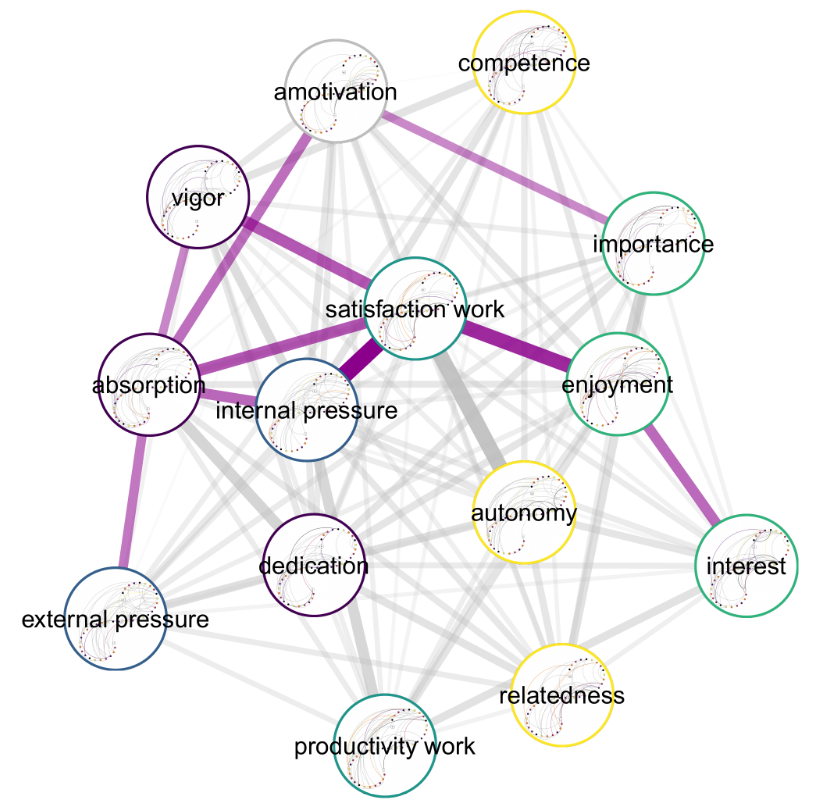
If you’re interested in the links, download my slides here. I actually forgot to show what a multiplex network of variables combined from several theories looks like (you don’t condition on all other variables, so you can combine stuff from different frameworks without the meaning of the variables changing, as in a regression-based analysis). Anyway, it looks like this:

A single person’s multiplex recurrence network, i.e. a network of recurrence networks of work motivation variables queried daily for 30+ days. Colored connectors are relationships which can’t be attributed to randomness.

Nanne Isokuortti: From Exploration to Sustainment – Understanding Complex Implementation in Public Social Services

  • Illustrate the complexity in an implementation process with a real-world case example
  • Introduce Exploration, Preparation, Implementation, and Sustainment (EPIS) Framework
  • Provide suggestions how to aid implementation in complex settings

Ira Alanko: The AuroraAI Programme

  • The Finnish public sector is taking active steps to utilise AI to make using of  services easier
  • AI has opened a window for a systemic shift towards human-centricity in Finland
  • The AuroraAI-network is a collection of different components, not a platform or collection of chatbots

Daniele Proverbio: Smooth or Abrupt? How Dynamical Systems Change Their State

  • Natural phenomena don’t necessarily follow smooth and linear patterns while evolving.
  • Abrupt changes are common in complex, non-linear systems. These are arguably the future of scientific research.
  • There exist a limited number of transition classes. Understanding their main drivers could lead to useful insights and applications.

Ken Resnicow:  Behavior Change is a Complex Process. How does that impact theory, research and practice?

  • Behavior change is a complex, non linear process.
  • Sudden change is more enduring than gradual change.
  • Failure to replicate prior interventions can be understood from a complexity lens.

(nb. on the last talk: personally, I’m not a huge fan of mediation analysis, moderated or otherwise. Stay tuned for an interview where I discuss the topic at some length with Fred Hasselman)

Notes from the symposium by Grace Lau

The Power of Inflexibility in Improving Science and Fighting COVID-19

UPDATE: This post was originally written in April 2020, and has been reviewed for ongoing relevance in March 2025. At the time of writing, masks were in short supply and a point of contention. This is not true any more (see 1, 2), and although any mask is better than no mask, FFP2/FFP3 (N95/N99) are recommended—due to what has become mainstream about the science of airborne contagion (3, 4, 5, 6). I have retained the references to cloth masks in the paragraph “Lowering the cost of Coronavirus safety”, as well as to the now-silly 6 feet / 2m distance rule, for the sake of historical reference.

In case you’re new to this blog, you might not be aware of the ongoing crisis of confidence—also known as the Replication Crisis—in social and life sciences, including but not limited to psychology, medicine and economics. (To learn more, see weeks I-II of my course Critical Appraisal of Research Methods and Analysis.)

In short, major problems include:

  • Less than half (exact number depending on the field) of studies can be replicated
  • Way too few studies can be computationally reproduced, that is, getting the same results from the same data and same analysis code
  • Research tends to ignore context, making generalisability difficult
  • Published studies are reported intransparently, so it’s hard to tell what was actually done – and if p-hacking practices were used (e.g. the results were cherry picked from a large pool of random data)
  • … etc.

There are several initiatives to address these concerns, but where do they spring from, and how can we eventually fix science in large scale? I’m going to suggest a solution which will rub a lot of people the wrong way. Incidentally, it is the same tool we need to fight the Coronavirus. But first, we need to understand Nassim Taleb’s presentation of the minority rule.

The basic idea is, that under particular conditions, once a stubborn niche population reaches a small level such as 3-4% of the total population, the majority will have to submit to the preferences of the minority. For example, consider a children’s party, where the organiser needs to make the decision on whether to offer milk products, as some of the guests are lactose-intolerant. Let us call these the inflexible ones: They would suffer great harm from milk products, so they avoid them. The majority of the guests, the flexible ones, can consume both lactose-free products, as well as those which contain milk. Given that the lactose-free supplies are easily available and of not significantly inferior quality, it makes the organiser’s (as well as those party guests who are inflexible) life much easier to serve no milk products at all.

As another example, during my previous life as a business person, I did a degree where my peers were about 50% Finnish, and 50% other nationalities ranging all the way from Russia to Peru. Us Finns spoke Finnish with each other, but whenever a non-Finnish person entered the group, we switched to English. The proportion of non-Finnish speakers was irrelevant, whenever it was above 0%.

So, an inflexible minority can drastically affect how the majority acts. But the infexibility can also stem from one’s worldview; if you had to decide on a daytime activity with a bunch of friends during Ramadan, and one of them was Muslim, you wouldn’t go to a steak house.

What does this mean for improving science and weakening the Coronavirus?

  • In order to promote good research, transparency advocates need to be inflexible about questionable research practices. To the point that they lose potential career opportunities – although they may, in turn, gain better ones as they can work with likeminded people.
  • In order to smash COVID-19, citizens need to be inflexible about risk behaviours. To the point that some people consider them overzealous and rigid – although it may not matter, if it leads to surviving the crash.

Both of these causes have a very important fractal, or multiscale component: Much of the action is not top-down but happens bottom-up; the individual reels in their family (or immediate research group), who then become norm-setters in their apartment building/neighbourhood (or scientific society of their research area), who again affect local governance (or scientific discipline).

But there are at least three crucial success factors for the behaviour change effect to work:

  1. The inflexible group needs to be spatially spread widely, instead of being confined in particular geographic (or intellectual) pockets, in which case the majority can just isolate and ignore them.
  2. The cost of aligning with the inflexible group needs to be small for the flexible group. For minority members to change behaviour, therefore, it may be necessary to take up some of its costs to the majority – at least initially. The other option is to move steps that are so small they are almost imperceptible.
  3. Crucially, the inflexible group… Does. Not. Budge. People always tend to say that one “must not be so strict”, but there is a reason it is not okay to steal, murder, or cheat upon your spouse “just a bit”. If the inflexibles are perceived to be flexible, after all, the majority can expect to dominate over them.

no_stretching_alora-griffiths-WX7FSaiYxK8-unsplash
No rest for the wicked, and no stretching for the inflexible! (Photo: Alora Griffiths on Unsplash)

For our case examples, spatial spread is mostly taken care of: The internet has done much to allow for the minority members to connect, while being perhaps the only ones in their own immediate vicinity passionate about their cause. So I’ll address #2-#3.

Lowering the cost of transparency: In the scientific transparency scene, this means the minority representatives need to spend tons of time learning about transparent research practices (e.g. pre-registration and data sharing, the TOP Factor, etc.). This knowledge they can then either disseminate to the rest of their research group, or act as the person who does most of the heavy lifting required in reporting reproducible work.

Lowering the cost of Coronavirus safety: The anti-Coronavirus advocates, on the other hand, need to make information easily available (as they do in endcoronavirus.org), share it, and translate it – both literally and figuratively. An example would be sharing research studies, ways to make and wear masks correctly, or how to acquire them (if you’re in Finland, check this out to have masks made for you, while donating some to healthcare workers). They may also need to learn about technicalities of video conferencing and other solutions, so that they can readily teach their peers after refusing face-to-face meetings.

Not budging in research transparency: The research transparency people obviously need to refuse co-authoring papers which contain p-hacking, hyperbole or other ways of distorting the findings to improve chances of publication. They need to refuse projects which do not plan to share analysis code (and data, within privacy constraints), ask about transparency before peer reviewing, and walk away from papers where the first author insists on presenting exploratory hypotheses as confirmatory ones, or is not willing to properly discuss constraints to generalisability, model assumptions (stationarity, homogeneity, independence, interference, ergodicity… see here if these are strange words) and sensitivity analyses.

Not budging in Coronavirus safety: The anti-Coronavirus folks need show example by performing hand hygiene, self-isolating, wearing masks, social distancing, and taking their kids off school/daycare – but also making sure their family does the same. In addition, they need to speak out when they see their friends or neighbours acting out risk behaviours, such violating the 2-meter (6-feet) physical distance requirement. They need to make it clear they are only available for meetings via video conferencing, which they’re happy to help setting up.

Remaining steadfast and vocal is not for everyone, and calling out behaviour you perceive to be wrong, can be extremely anxiety-provoking. That’s also why one needs to start with those closest to them. And it is hard to be inflexible in the beginning, when the majority norms are against you and everyone is expected to play along. The “happy” news is, that not everyone needs to be inflexible – just the small minority. (I’m putting happy in quotes, because the minority rule can be leveraged to gradually promote any fascist ideology the majority is foolish enough to tolerate.)

Hence, if you’re the type of person who feels strongly enough to be inflexible about these things, perhaps you can feel comforted by the idea that you don’t need to convert the majority: The stubborn few can create the critical mass and change the world.

Pathways and complexity in behaviour change research

These are slides of a talk given at the Aalto University Complex Systems seminar. Contrasts two views to changing behaviour; the pathway view and the complexity view, the latter being at its infancy. Presents some Secret Analysis Arts of Recurrence, which Fred Hasselman doesn’t want you to know about. Includes links to resources. If someone perchance saw my mini-moocs (1, 2) and happened to find them useful, drop me a line and I’ll make one of this.

Lifestyle factors are hugely relevant in preventing disease in modern societies; unfortunately people often fail in their attempts to change health behaviour – both their own, as well as that of others’. In recent years, behaviour change design has been conceived as a process where one identifies deficiencies in factors influencing the behaviours (commonly called “determinants”). Complexity thinking suggests putting emphasis on de-stabilisation instead.

The perspective taken here is mostly at the idographic level. At the time of writing, we have behaviour change methods to affect e.g. skills, perceived social norms, attitudes and so forth – but very little on general de-stabilisation of the motivational system as an important predictor of change.

Perspectives are welcome!

ps. Those of you to worry about brainwashing and freedom of thought: Chill. Stuff that powerful doesn’t really exist, and if it did, marketers would know about it and probably rule the world. [No, they don’t rule the world, I’ve been there]

pps. Forgot to put it in the slides, but this guy Merlijn Olthof will perhaps one day tweet about his work about destabilisation in psychotherapy contexts. Meanwhile, you can e.g. be his 10th Twitter follower, or keep checking his Google Scholar profile, as there’s a new piece coming out soon!

Complexity considerations for intervention (process) evaluation

For some years, I’ve been partly involved in the Let’s Move It intervention project, which targeted dysfunctional physical activity and sedentary behaviour patterns of older adolescents, by affecting their school environment as well as social and psychological factors.

I held a talk at the closing seminar; it was live streamed and is available here (on stage starting from about 1:57:00 in the recording). But if you were there, or are otherwise interested in the slides I promised, they are now here.

For a demonstration of non-stationary processes (which I didn’t talk about but which are mentioned in these slides), check out this video and an experimental mini-MOOC I made. Another blog post touching on some of the issues is found here.


blogiin kuva