Evidence is in the Past, Risk is in the Future: On Tail Events and Foresight

Context: This post outlines a manuscript in preparation and exhibits some of its visualisations, partly also presented at the European Public Health Conference (November 2025). If a blog format isn’t your poison, you can also see this video or this one-pager (conference poster).


It’s April 2025. Red Eléctrica, the electricity grid provider for the Iberian Peninsula, declares: “There exists no risk of a blackout. Red Eléctrica guarantees supply.”

Twenty days later, a massive blackout hits Portugal, Spain, and parts of France.

What the hell happened?

To understand this, we need to talk about ladders.

The Ladder Thought Experiment

Let’s take an example outlined in the wonderful article An Introduction to Complex Systems Science and Its Applications: Imagine 100 ladders leaning against a wall. Say each has a 1/10 probability of falling. If these ladders are independent, the probability that two fall together is 1/100. Three falling together: 1/1000. The probability of all 100 falling simultaneously becomes astronomically small – negligible, essentially zero.

Now tie all the ladders together with rope. You’ve made any individual ladder safer (less likely to fall on its own), but you’ve created a non-negligible chance that all might fall together.

This is cascade risk in interconnected systems.

Two Types of Risk

From a society’s perspective, we can understand risks as falling into one of two categories:

Modular risks (thin-tailed) don’t endanger whole societies or trigger cascades. A traffic accident in Helsinki won’t affect Madrid or even Stockholm. These risks have many typical precedents, slowly changing trends, and are relatively easy to imagine. We can use evidence-based risk management because we have large samples of past events to learn from.

If something is present daily but hasn’t produced an extreme for 50 years, it probably never will.

Cascade risks (fat-tailed) pose existential threats through domino effects. Pandemics, wars, and climate change fall here. They’re abstract due to rarity, with few typical precedents – events tend to be either small or catastrophic, with little in between.

If something hasn’t happened for 50 years in this domain, we might have just been lucky, and it might still hit us with astronomical force.

Consider these examples:

  • Workplace injuries
  • Street violence
  • Non-communicable diseases
  • Nuclear plant accidents
  • Novel pathogens
  • War

Before reading on, give it a think. Which are modular? Which are cascade risks?

I’d say most workplace injuries and street violence are modular (unless caused by organised crime or systemic factors like pandemics). Non-communicable diseases are also modular, although can be caused by systemic issues. Mega-trends perhaps, but you wouldn’t expect a year when they suddenly doubled, or became 10-fold.

Novel pathogens and wars are cascade risks that spread across borders and trigger secondary effects. These are the ladders tied together with a rope. Nuclear plants kind of depend; nowadays people try to build many modular cores instead of one huge reactor, so that failure of one doesn’t affect the failure of others. But as the mathematician Raphael Douady put it: “Diversifying your eggs to different baskets doesn’t help, if all the baskets are on board of Titanic” (see Fukushima disaster).

Is That a Heavy Tail, or Are You Just Happy to See Me?

Panels A) and B) below show pandemic data (data source, image source, alt text for details) – with casualties rescaled to today’s population. The Black Death around the year 1300 caused more than 2.5 billion deaths in contemporary terms. Histograms on the right show the relative number of different-sized events. The distribution shows tons of small pandemics and a few devastating extremes, with almost nothing in between (panel A, vertical scale in billions). We see a similar shape even when we get rid of the two extreme events (panel B, vertical scale in millions).

Panel A: “Paretian” dynamics of a systemic risk, illustrated by casualties from pandemics with over 1000 deaths, rescaled to contemporary population, with years indicating the beginning of the pandemic (Data from Cirillo & Taleb, 2020; COVID-19 deaths are presented until June 2024 according to model by The Economist & Solstad, S., 2021). Panel B: Same as panel A, zooming into the events with less than 1B deaths. This illustrates how the variance remains vast, even when the scale of events is much smaller. Panel C: Casualties from traffic accidents in Finland, illustrating the dynamics of a “thin-tailed”, localised risks. In this case, it would not be reasonable to expect a sudden increase to 10 000 casualties, whereas in the prior examples such jumps are an integral part of the occurrence dynamic.

Compare this to Panel C), Finnish traffic fatalities. Deaths cluster together predictably. You wouldn’t expect 10 000 road deaths in a single year – even 2 000 would be shocking.

Moving from observations to theory: The figure below compares mathematical “heavy-tailed” distributions to “thin-tailed” distributions. Heavy-tailed distributions depict:

  • Many more super-small events than thin-tailed distributions: Look at the very left side of the left panel below, where red line is above the blue one
  • Fewer mid-size events: Look at the middle portion of the left panel below, where blue line is higher than red
  • Extreme events of a huge magnitude that remain plausible: Look at the inset, which zooms into the tail (in thin-tailed distributions, mega-extremes are practically impossible like the ladders without a rope)

When we look at the right panel of the image above, thin-tailed distributions (like traffic deaths) should drop suddenly when plotted on a logarithmic scale. Fat-tailed distributions (like pandemics) should create a straight line, meaning very large events remain statistically plausible.

Or, at least that’s the theory, based on mathematical abstraction. Let’s see what the real data shows.

And here we go: The tail of actual pandemics looks like a straight line, while the tail of traffic deaths curves down like an eagle’s beak. Pretty neat, huh?

Evidence Lives in the Past, Risk Lives in the Future

In the interests of time, I’m going to skip a visualisation you see in the video (26:45). Main point is that for thin-tailed modular risks, we extrapolate from past data. For heavy-tailed cascade risks, we must form plausible hypotheses from current, weak, and incomplete signals.

This is the difference between induction (everything that happened before has these features, so future events will too) and abduction (reasoning to the most sensible course of action given limited information). All data is data from the past, and if the past isn’t a good indicator of the future, we need different ways of acting:

The mantra of resilience is early detection, fast recovery, rapid exploitation.
Dave Snowden

We need to detect weak signals early. The longer we wait, the bigger the destruction.

A Practical (piece of a) Solution: Participatory Community Surveillance Networks

In our research group, we’re developing networks of trusted survey respondents who participate regularly (see article), akin to the idea of “citizen sensor networks” also presented in the EU field guide Managing complexity (and chaos) in times of crisis. With such a network in place, during calm times, you can collect experiences and feedback on policy decisions. When crisis hits, you can pivot to gain rich real-time data from the field.

Why? Because nobody can see everything, and we see what we expect to see. If you don’t believe me, see if you can solve this mystery.

Given enough eyeballs, all bugs are shallow
– Eric S. Raymond

The process:

  1. Set up a network of trusted responders
  2. Collect experiences continuously
  3. Pivot when crisis takes place to gather data on how the disruption shows up in lived experience
  4. Avoid the trap of post-emergency mythmaking, and do a “lessons learnt” analysis with data collected during the disruption

Example: Inhabitant Developer Network

We developed an idea in a Finnish town, where new inhabitants would join the network as part of a “welcome to town” package. We could ask:

  • “What’s better here than where you lived before?” → relay to marketing
  • “What’s worse here than where you lived before?” → relay to development

When crisis occurs, we could pivot, asking about how the disruption shows up in people’s lived experience:

  • “What happened?”
  • “Give your description a title”
  • “How did this affect things important to you?”
  • “How well did you do during and after?” (1-10 scale)
  • “How prepared were you?” (1-10 scale)
  • … etc.

Respondents self-index these experiential snippets with quantitative indicators, giving us both qualitative richness and quantitative patterns. We can then e.g. examine situations where people were well-prepared but didn’t do well, or did well despite being unprepared – and filter e.g. by tags like rescue service involvement. This gives us rich data from the field to inform local decision makers.

From Experiences to Action

The beauty of collecting people’s lived experience is that they can later be used for citizen or whole-of-workforce engagement workshops. You can ask Dave Snowden’s iconical question: “How could we get more experiences like this, and fewer like those?”

This question holds an outcome “goal” lightly, allowing journeys to start with direction rather than rigid destination. It is understandable regardless of education level, and gives communities agency in developing solutions. This approach enables:

Anticipation: Use tailedness analysis as a diagnostic; use networks to detect weak signals before they explode.

Formulation: Design adaptive interventions with the community – interventions that are change instead of being fragile to the first unexpected shock.

Adoption: Build agency, legitimacy and buy-in through participatory processes. People support what they own or help create.

Implementation & Evaluation: Monitor in real-time, learn continuously, act accordingly. No more waiting six months for a report, or getting a quantitative result (“life satisfaction fell from 3.9 to 3.2”) only to need another research project to learn why: You can just look at the qualitative data to understand context.

Why This Matters

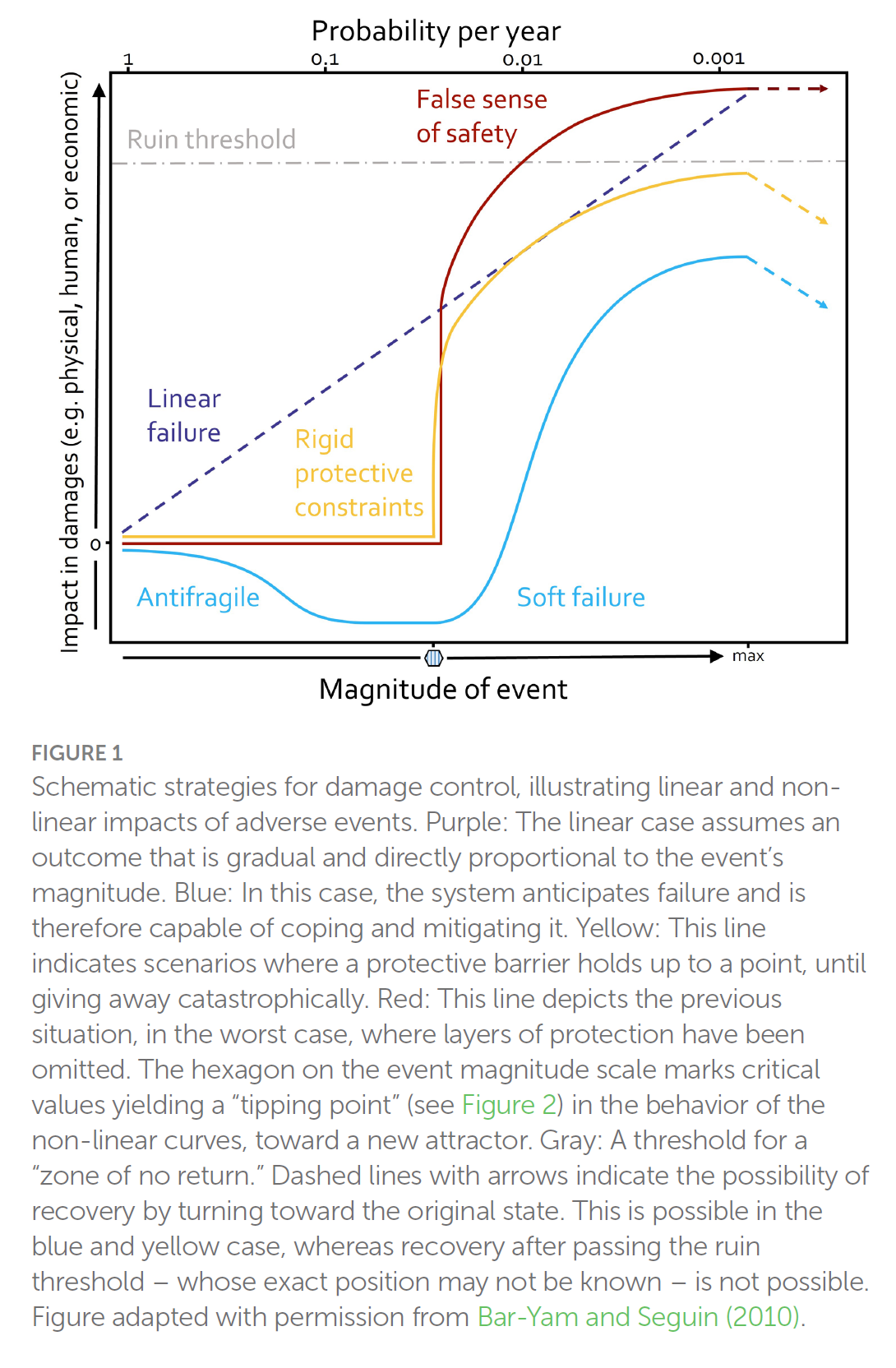
When Red Eléctrica declared “there exists no risk,” they were thinking in a thin-tailed world where past data predicts future outcomes. But interconnected systems – like them tied-together ladders – create heavy-tailed risks. For cascade risks, precaution matters more than proof. If you face an existential risk and fail, you won’t be there to try again.

As Nassim Nicholas Taleb puts it: Risk is acceptable, ruin is not (more in this post). And no individual human is capable of understanding our modern, interconnected environments alone.

Bring forth the eyeballs.


Related Posts

From Fruit Salad to Baked Bread: Understanding Complex Systems for Behaviour Change – Why treating behaviour change like assembling fruit salad instead of baking bread leads well-meaning efforts to stumble.

From a False Sense of Safety to Resilience Under Uncertainty – On disaster myths, attractor landscapes, and why intervening on people’s feelings instead of their response capacity is dangerous.

“Mistä tässä tilanteessa on kyse?”: Henkisestä kriisinkestävyydestä yhteisölliseen kriisitoimijuuteen (In Finnish) – From individual resilience to collective crisis agency: reflections from Finland’s national security event.

Riskinhallinta epävarmuuden aikoina: Väestön osallistaminen varautumis- ja ennakointimuotoiluun (In Finnish) – Risk management under uncertainty through participatory anticipatory design.


For deeper exploration of these concepts, I recommend Nassim Nicholas Taleb’s books: Fooled by Randomness, The Black Swan, and Antifragile, as well as the aforementioned EU field guide Managing complexity (and chaos) in times of crisis.

From Fruit Salad to Baked Bread: Understanding Complex Systems for Behaviour Change

New perspectives from my doctoral research, “Complex Systems and Behaviour Change: Bridging Far Away Lands.”

On May 16, 2025, I finally defended my doctoral dissertation – a side-project in the making for the last 9 years or so. I was pretty confident that this would have happened two years ago already when I submitted a rogue version of the dissertation summary for pre-examination. It was titled “Understanding and Shaping Complex Social Systems: Lessons from an emerging paradigm to thrive in an uncertain world”, which is also the name of a course I later started teaching in the New England Complex Systems Institute. The preprint was quickly downloaded almost 1000 times, and people reached out to me to thank for the clear exposition. But this version turned out to be a bit too rogue for one of the pre-examiners, and I rewrote the whole thing in 2024 – to be much more technical, and stylistically more conventional.

The defence was a success and here we are, the dissertation finally accepted by the academic establishment. Published summary can be downloaded here. The implicit promise is that after reading the work, you’ll be able to understand this cartoon, which you might recognise to have a relationship with the cover image:

As is traditional in the Finnish system, I began the occasion with a Lectio Praecursoria – an introductory speech. This talk introduced the groundwork for my research, exploring the often-overlooked connections between two seemingly distant scientific fields: complex systems and behaviour change.

This blog post adapts that initial speech, inviting you to explore these ideas with me.

The Core Idea: Why We Need to Rethink Behaviour Change

The research I present explores the intersection of two scientific domains that might seem, at first glance, quite distant. But what I want to do is share why building bridges between complex systems and behaviour change is not merely an academic curiosity, but, as I argue in this work, a vital step towards deepening our understanding of human action in our increasingly interconnected world, and ultimately, towards building a more robust basic science of behaviour change. [Side note: you can find my perspective to what behaviour change is NOT here, and connections to risk management here and here.]

The “Fruit Salad vs. Bread” Analogy: Understanding Different Types of Systems

To begin, let us talk about the difference between making fruit salad and baking bread. I am well aware of how ludicrous this sounds, but I believe that confusing these two processes consistently causes well-meaning efforts, particularly those aimed at changing behaviour, to stumble. So please bear with me.

Imagine making fruit salad for a bunch of children. You gather fruits you enjoy – perhaps pineapple, peach, and cherries. You’re fairly confident that if you like them separately, you’ll like them together. You chop them, combine them, and serve them. Now, if a child finds that cherries look too strange to be edible – and leaves them behind – it’s no catastrophe. They can still consume the pineapple and peach, which every reasonable person enjoys. The uneaten cherries can be consumed by someone else later. In fruit salad, we can combine ingredients, analyse the parts somewhat independently, and predict the outcome of the whole with reasonable certainty. With many ingredients, fruit salad can become complicated – a word whose origins (as pointed out by Dave Snowden) can be taken to mean “folded.” And what has been folded, can often also be unproblematically unfolded.

Now, think about baking bread. You combine yeast, flour, water, and salt. You’ve heard that olive oil is healthy, so you add a bit of that in. You mix, knead, let it rise, bake. The final loaf emerges. But what if the children dislike the taste of olive? You cannot simply remove the oil. Or what if you put in too much salt? The ingredients have interacted, transformed. The bread is an emergent product, something entirely new, fundamentally different from the mere sum of its parts. The whole portion intended for the children, not just the offending component, might have to be passed to an omnivorous family member. This process is better described not as complicated, but as complex, a word with roots that can be interpreted as “entangled” or “interwoven.”

Unlike with folding, what is interwoven cannot easily be disentangled without fundamentally changing its nature.

The Two Key Disciplines: Behaviour Change and Complex Systems

With this analogy in mind, let’s turn to the disciplines central to my research.

Behaviour change science is an inherently interdisciplinary field drawing from psychology, sociology, public health, and more. It strives to understand the web of factors – personal, social, environmental – that shapes our actions. Its goal is to help foster changes needed to tackle major societal challenges: from noncommunicable diseases (entailing, for example, physical activity behaviours) and sustainable work-life (entailing, for example, job crafting behaviours) to climate action and pandemic preparedness (entailing risk management behaviours). Human action is a core thread in all these pressing issues.

The other discipline central to this work is complex systems science. It originally grew out of physics, chemistry, and biology, but its principles increasingly reach into the psychological and social world. It studies systems composed of many interacting parts, where these interactions often dominate the system’s overall behaviour. A key insight is that the relationships between components can be more critical than the components themselves in determining the system’s properties. Think of water: ice, liquid, and steam involve the same H₂O molecules, but their differing interconnectivity leads to vastly different behaviours. Steam can make a sauna feel warm; ice can make swimming difficult afterwards. But the components remain the same.

Are We Using Fruit-Salad Tools for Bread-Like Problems?

When it comes to systems, some are more component-dominant, like fruit salad, while others are more interaction-dominant, like bread. My research argues that many phenomena central to behaviour change science – like motivation dynamics, the spread of social norms, or how people respond to interventions – are far more like bread than fruit salad. They occur as parts of complex, interaction-dominant systems.

The main contributions of my dissertation relate to the development of basic science. Early theories in behaviour change were driven by practitioners aiming to understand issues they faced. And practitioners are often very good at working with complexity, although their terminology to describe the phenomena at play might sometimes be limited. But still, many of the quantitative tools that were relied upon in developing these theories implicitly treated behaviour change phenomena like fruit salad. For instance, while linear regression analysis can incorporate simple interaction terms to account for some forms of interdependence, its main usage is to assign values to variables such as norms, intentions, and attitudes, assuming they are independent from each other – implying separability. Furthermore, there’s a common, often implicit, assumption that findings derived from group-level data directly translate to understanding how individuals change over time.

So, the central question becomes: If behaviour change is often entangled and emergent like bread dough, should our primary tools be those best suited for slicing separable fruit?

Beyond Linearity: Embracing the Complexity of Change

I argue that this potential mismatch – analysing bread with fruit salad tools – can hinder our understanding of behaviour change as a complex evolving process. Complex systems science suggests that variability, which might look like messiness or error from a purely linear perspective, is often not just noise; it can be the inherent signature of the dynamic system itself.

A key characteristic of these systems, which I investigated conceptually and empirically, is non-linearity. Imagine pushing a boulder near a hilltop:

You push a little, the boulder moves a little.

You push a little, the boulder moves a little.

You push a little… and the boulder tumbles dramatically into a new valley.

Perhaps now scientists rush to the scene to investigate what was distinct in your technique for the last push. And they will inevitably find results. But the magic was not in the push, but the relationship between the push, the boulder’s position, and the landscape. This kind of abrupt, disproportionate change is known as a critical transition.

Mapping Change: The Power of Attractor Landscapes

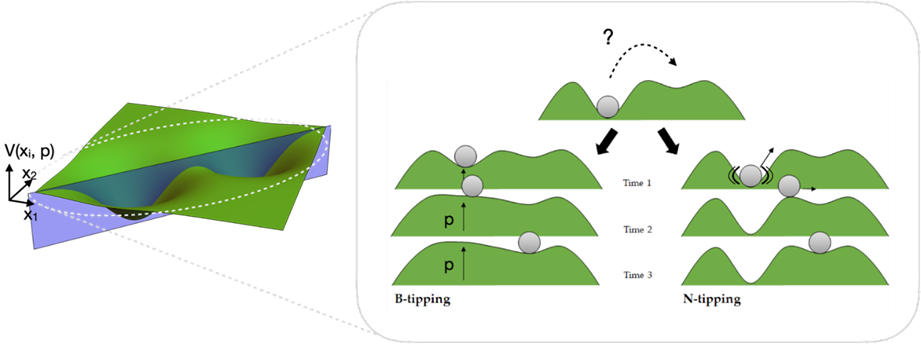
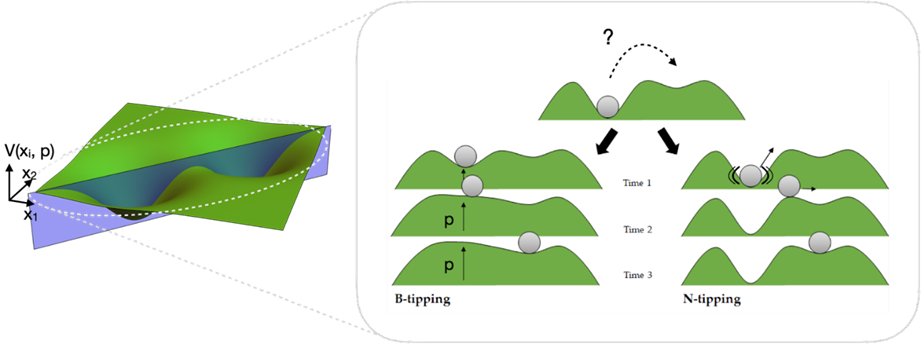
Complex systems science offers a powerful conceptual tool to map transition dynamics: the attractor landscape. Imagine a pool table with a single billiard ball. Each position on the table represents a possible state for the system, and the current status is represented by the location of the billiard ball. Now imagine the surface isn’t flat, but contains hills and valleys. The valleys represent stable patterns – the attractors, collections of similar states that “trap” the ball. It’s easy for the ball to settle into a valley; it requires more effort or perturbation to push it out. The ridges between valleys are called tipping points.

A slice of an attractor landscape showing two major ways systems can shift abruptly (from an article included in the dissertation)

Think of smoking, where dispositions in the North Atlantic world shifted gradually if at all for many decades. Imagine this as a landscape: one valley where smoking is socially acceptable, and another where it is frowned upon. There was little change for a long time, until a tipping point was reached, leading to widespread disapproval and significant policy changes. Pushing the system over the ridge requires effort or a significant nudge, but once crossed, it naturally settles into a new attractor valley, a new stable pattern. However, this landscape isn’t necessarily static; it can transform and be reshaped. Think of this like the hills and valleys of the pool table rising and falling over time.

Notice how different this landscape representation is from conventional flowcharts suggesting neat, linear causes and effects. It shifts focus towards understanding the system’s dispositions, its underlying tendencies and stabilities. It encourages a focus on nurturing the conditions, tending the substrate, working the soil, from which desired behaviours – in deeper, more stable valleys – can emerge, and sustain themselves more naturally.

Evidence in Action: From Work Motivation to Public Health

In my research, I used analytical techniques adapted from dynamical systems theory to investigate empirical evidence for such attractor states and shifts within fine-grained, moment-to-moment work motivation data. I also explored its applicability to societal-level data on COVID-19 protective behaviours. This work suggests the landscape metaphor is not just a useful theoretical vehicle; these patterns can be observed and studied in real-world behaviour change contexts.

In addition to non-linearity, some of the patterns of complex systems I examined in this research were “non-stationarity” and “non-ergodicity”. In my work, I clarify these terms in the behaviour change context and demonstrate how to study them empirically in time series data, with methods such as cumulative recurrence network analysis.

The Key Takeaway: Complexity as a Feature, Not a Bug

In essence, the core message of this work is that the bread-like complexity of human behaviour change isn’t just noise or a problem to be simplified away. It’s a fundamental characteristic we must embrace and understand scientifically if we want our science to accurately reflect the phenomena it studies. Complex systems science provides concepts and tools that acknowledge interdependence, emergence, and context-sensitivity of change phenomena. And we aim not to eliminate this complexity, but to enlist it.

Looking Ahead: Building a Bridge to a More Robust Science of Human Action

By building bridges between behaviour change science and complex systems science, the research presented here argues that a complex systems perspective can help us build a more robust and realistic science of human action – one that recognises behaviour not just as a collection of separable ingredients like a fruit salad, but as an emergent, interwoven process like baking bread.

This, I believe, is crucial. It is crucial for developing a science better equipped to understand the intricate dynamics of behaviour change. It is crucial for us to seize the opportunities that arise when we learn to converse with complex systems, instead of just trying to push them around. And it is crucial for navigating the critical policy challenges of our time, which invariably involve understanding and enabling human action.


What are your thoughts? Leave a comment or reach out. My current research interests mainly revolve around risk management (see paper described here) – particularly, understanding and shaping communities’ capacities to respond, recover, and adapt from shocks. I’m a 72hours.fi trainer, and would be happy to collaborate in e.g. projects to make the EU’s new preparedness strategy a feasible reality.

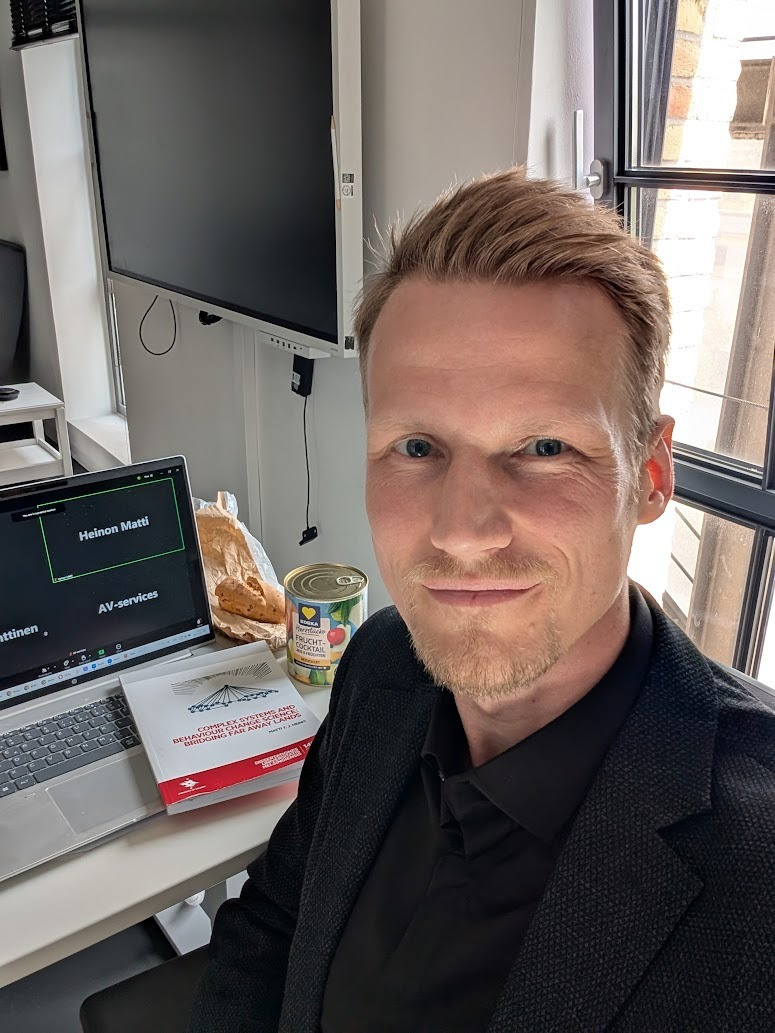
Picture of me doing a sound check before the doctoral defense. It was held in Zoom as I was in Germany, the chair was in Finland, and the opponent in the U.S. 😅

New paper: From a False Sense of Safety to Resilience Under Uncertainty

Understanding how people act in crises and how to manage risk is crucial for decision-makers in health, social, and security policy. In a new paper published in the journal Frontiers in Psychology, we outline ways to navigate uncertainty and prepare for effective crisis responses.

The paper is part of a special issue called From Safety to Sense of Safety. The title is a play on this topic, which superficially interpreted can lead to a dangerous false impression: that we ought to intervene on people’s feelings instead of the substrate from which they emerge.

Nota bene: In June 2024, this topic is part of an online course for the New England Complex Systems Institute, and have some discount codes for friends of this blog. Do reach out!

The Pitfall of a False Sense of Safety

In the paper we first of all argue that we should understand so-called disaster myths, a prominent one being the myth of mass panic. This refers to the idea that people tend to lose control and go crazy during crises when they worry or fear too much, which implies we need to intervene on risk perceptions. But in fact, no matter what disaster movies or news reports show you, actual panic situations are rare. During crises, people tend to act prosocially. Hence, decision-makers should shift their focus from mitigating fear and worry – potentially leading to a false sense of safety – towards empowering communities to autonomously launch effective responses. This approach fosters resilience rather than complacency.

Decision Making Under Uncertainty: Attractor Landscapes

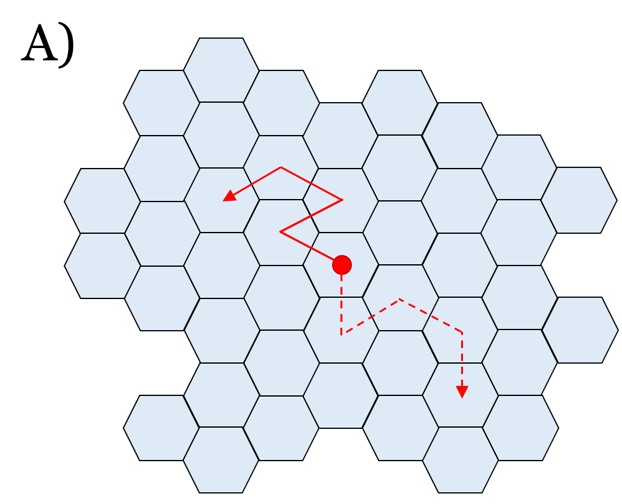
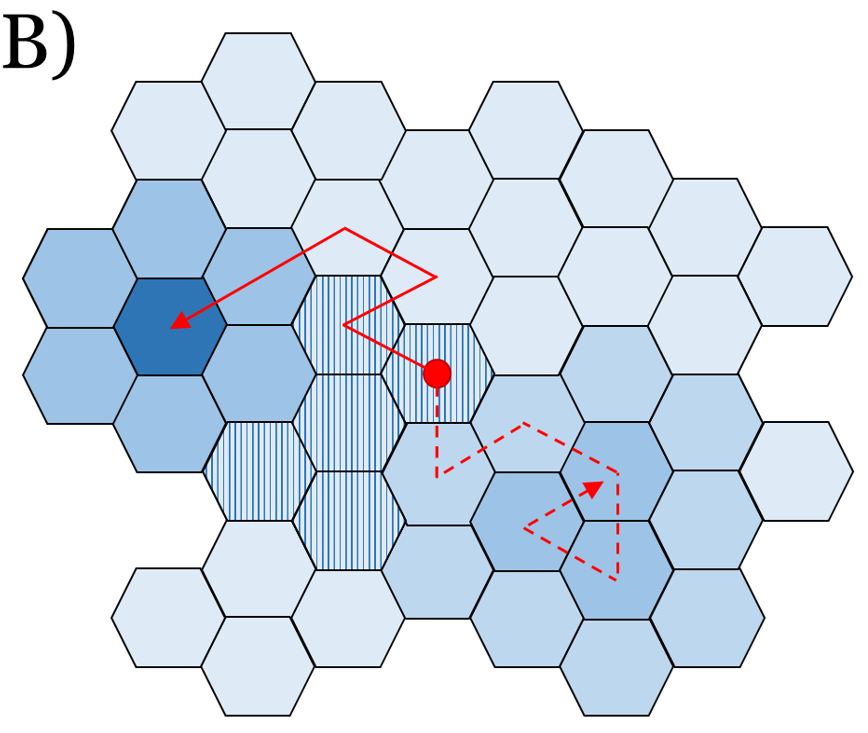
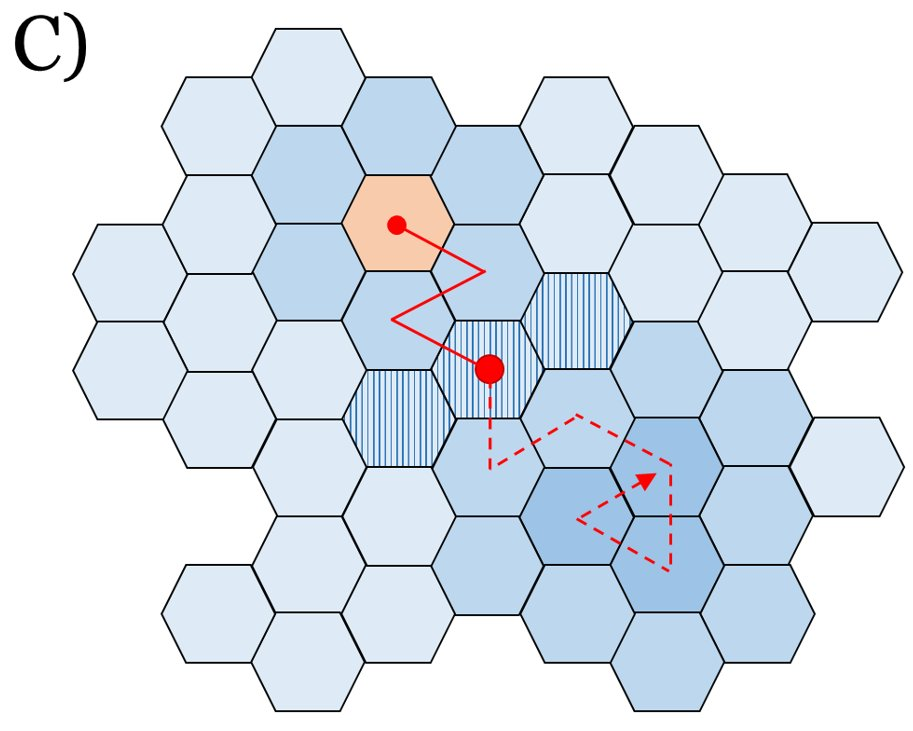
Secondly, we represent some basic ideas of decision making under uncertainty, via the concept of attractor landscapes. I now hope we would’ve talked about stability landscapes, but that ship already sailed. The idea can be understood like this: Say your society is the red ball, and each tile a state it’s in (e.g. “revolt”, “thriving”, “peace”, etc.) The society moves through a path of states.

These states are not equally probable; some are more “sticky” and harder to escape, like valleys in a landscape. These collections of states are called attractors. The area between two attractors is a tipping point (or here, kind of a “tipping ridge”).

I wholeheartedly encourage you to spend five minutes on Nicky Case’s interactive introduction to attractor landscapes here. It’s truly enlightening. The main thing to know about tipping points: as you cross them, nothing happens for a long time… Until everything happens at once.

The Dangers of Ruin Risks

All attractors are not made equal, though. For some, when you enter, you’ll never escape. These are called “ruin risks” (orange tile). If there is possibility of ruin in your landscape, probability dictates you will eventually reach it, obliterating all future aspirations.

As a basic principle, it does not make sense to see how close to the ledge you can walk and not fall. In personal life, you can take ruin risks to impress your friends or shoot for a Darwin Award. But keep your society away from the damned cliff.

As Nassim Nicholas Taleb teaches us: Risk is ok, ruin is not.

Navigating the Fog of War

In reality, not all states are visible from the start. Policymakers often face a “fog of war” (grey areas). Science can sometimes highlight where the major threats lie (“Here be Dragons”), but the future often remains opaque.

To make things worse for traditional planning, as you move a step from the starting position, the tiles may change. So you defined an ideal state, a Grand Vision (yellow) and set the milestones to reach it? If you remain steadfast, you could now be heading at a dead end or worse. Uh-oh.

(nb. due to space constraints, this image didn’t make it to the paper)

This situation, described in Dave Snowden’s Cynefin framework, is “complex.” Here, yesterday’s goals are today’s stray paths, so when complexity is high, you focus on the present – not some imaginary future. The strategy should be to take ONE step in a favourable direction, observe the now-unfolded landscape, and proceed accordingly.

The Cynefin Framework and Complex Systems

Sensemaking is a motivated, continuous effort to understand connections (which can be among people, places, and events) in order to anticipate their trajectories and act effectively.

Gary Klein

Sensemaking (or sense-making, as Dave Snowden defines it as a verb) refers to the attempt or capacity to make sense of an ambiguous situation in order to act in it. This is what we must do in complex situations, where excessive analysis can lead to paralysis instead of clarity.

Cynefin is a sense-making framework designed to enable conversations about such a situation, and offers heuristics to navigate the context. In the paper, we propose some tentative mappings of attractor landscape types to the Cynefin framework.

In general, our paper offers proposals for good governance, drawing from the science of sudden transitions in complex systems. Many examples pertain to pandemics, as they represent one of the most severe ruin risks we face (good contenders are of course wars and climate change).

By understanding the concepts illustrated here, policymakers could better navigate crises and build resilient societies capable of adapting to sudden changes.

If you want a deeper dive, please see the paper discussed in this post: At-tractor what-tractor? Tipping points in behaviour change science, with applications to risk management

NOTE: There’s another fresh paper out, this one in Translational Behavioural Medicine: How do behavioral public policy experts see the role of complex systems perspectives? An expert interview study. Could be of interest, too!

The Shape of Change to Come

Understanding and shaping complex social psychological systems: Lessons from an emerging paradigm to thrive in an uncertain world” is the working title of my recently submitted dissertation on human action and change therein, which I’ve been working on as a side project. This is an executive summary (or a teaser trailer if you like) for non-academic readers. A pre-print can be found here.

“the  totality is not,

as it were, a mere heap,

but the whole is something

besides the parts”

– Aristotle

In an ever-evolving world, the role of human behaviour in addressing pressing challenges cannot be overstated. Complex issues like climate change, pandemic response, and psychosocial well-being all hinge on human actions. Thus, understanding and steering positive behaviour change is of paramount importance. Traditionally, behaviour change research uses a decomposition-based approach, dissecting behaviours pertaining to societal problems into smaller parts and addressing each one separately. To get the picture, imagine a designer focused on building an engine part by part, fine-tuning each piece before fitting them together. This method works when we can clearly map out the pieces, their interactions are limited, and their effects are well understood. This is the domain of the decomposition-minded planning; the “ordered regime”, so to say.

However, human behaviour often does not always exist in such neatly compartmentalised contexts. Instead, it often operates within complex, dynamic systems where the individual pieces continually interact, mutually influencing each other in unpredictable ways. Consider a forest, for example. It’s not just about individual trees; the entire ecosystem, with its array of flora and fauna, weather patterns, and soil conditions, all contribute to the forest’s health. You can not simply study a single tree to understand the whole forest. This ecosystem view is the realm of the complexity-minded designer, who acknowledges that problems may not be easily separated but are woven into a larger, interconnected tapestry; the “complex regime”.

The current work suggests that an awareness of these so-called complex systems can enhance our approach to behaviour change. It argues that we are all active participants in our environments, capable of self-determination and self-organisation. Our behaviour is not just the result of isolated influences; instead, it often emerges from an ongoing web of interdependencies. A small action today can lead to major impacts tomorrow, and long periods of apparent stability can suddenly be disrupted by bursts of rapid change. This inherently unpredictable nature of complex regimes means that past data can not always guide us in the future. 

To navigate these complex systems, we need a new kind of designer: the evolutionary-minded designer. This designer harnesses the power of evolution, creating a wide range of possible solutions and allowing the system to select the most appropriate ones. The goal is to create flexible, adaptive systems that are resilient in the face of change and uncertainty – not just solutions, which rely on correct prediction of the specifics of the future. 

The work presented in this dissertation provides concepts and tools to initiate this approach. It includes a compendium of self-management techniques to empower individuals, and proposes a model of behaviour change as an interconnected network of processes, rather than a series of isolated, static entities. It also discusses how traditional linear models may fail in the face of complex systems and suggests ways of understanding and influencing behaviour change, which may help bridge the gap between social psychology and complex systems science.

In a world that’s increasingly complex and interconnected, our approach to behaviour change must adapt. By embracing complexity, we can better equip ourselves to face the challenges of the future. Rather than trying to oversimplify these complex problems, we should recognize and leverage the inherent richness and unpredictability of human behaviour – where it exists – aiming to develop responsive, adaptable strategies that foster positive change in this uncertain world.


Further reading

All of this will be explained in due time, but if you’re dying to hear more, have a look at this post or these readings (particularly the last one):

Heino, M. T. J., & Hankonen, N. (2022). Itsekontrolli on yhteisöponnistus: Systeemisiä näkökulmia käyttäytymisen muutokseen. In E. Mäkipää & M. Aalto-Kallio (Eds.), Muutosten tiet kietoutuvat yhteen (Vol. 2022, pp. 69–79). https://content-webapi.tuni.fi/proxy/public/2022-09/muutostentiet_heino-hankonen_v4.pdf

Heino, M. T. J., Knittle, K., Noone, C., Hasselman, F., & Hankonen, N. (2021). Studying Behaviour Change Mechanisms under Complexity. Behavioral Sciences, 11(5), Article 5. https://doi.org/10.3390/bs11050077

Heino, M. T. J., Proverbio, D., Marchand, G., Resnicow, K., & Hankonen, N. (2022). Attractor landscapes: A unifying conceptual model for understanding behaviour change across scales of observation. Health Psychology Review, 0(ja), 1–26. https://doi.org/10.1080/17437199.2022.2146598

Bar-Yam, Y. (2006). Engineering Complex Systems: Multiscale Analysis and Evolutionary Engineering. In D. Braha, A. A. Minai, & Y. Bar-Yam (Eds.), Complex Engineered Systems: Science Meets Technology (pp. 22–39). Springer. https://doi.org/10.1007/3-540-32834-3_2

Siegenfeld, A. F., & Bar-Yam, Y. (2020). An Introduction to Complex Systems Science and Its Applications. Complexity, 2020, 6105872. https://doi.org/10/ghthww

At-tractor what-tractor? Tipping points in behaviour change science, with applications to risk management

Back in 2020, our research group was delivering the last of five symposia included in a project called Behaviour Change Science and Policy (BeSP). I was particularly excited about this one because the topic was complexity, and the symposia series brought together researchers and policy makers interested in improving the society – without making things worse by assuming an overly narrow view of the world.

I had a particular interest in two speakers. Ken Resnicow had done inspiring conceptual work on the topic already back in 2006, and had been an influence on both me and my PhD supervisor (and BeSP project lead) Nelli Hankonen, in her early career. Sadly, the world hadn’t yet been ready for an extensive uptake of the ideas, and much of the methodological tools were inaccessible (or unsuitable) to social scientists. The other person of particular interest, Daniele Proverbio, on the other hand, was a doctoral researcher with training in physics and systems biology; I had met him by chance at the International Conference on Complex Systems, which I probably wouldn’t have attended, had it not been held online due to COVID. He was working on robust foundations and real-world applications of systems with so-called tipping points.

I started writing a paper with Ken, Daniele, Nelli and Gwen Marchand, who was also speaking at the symposium, as she had been working extensively on complexity in education. The paper started out as an introduction to complexity for behaviour change researchers, but as I took up a position in the newly founded behavioural science advisory group at the Finnish Prime Minister’s Office late 2020, the whole thing went to a back burner. It wasn’t just that, though. Being a scholar of motivation, I knew that being bored of your own words is a major warning sign, and things you prefer not to eat, you shouldn’t feed to others. So I didn’t touch the draft for over a year.

Meanwhile, I finished a manuscript which started out as a collection of notes from arguments about study design and analysis within our research group, when we were doing a workplace motivation self-management / self-organisation intervention. The manuscript demonstrated, how non-linearity, non-ergodicity and interdependence can be fatal for traditional methods of analysis. It was promptly rejected from Health Psychology Review, the flagship journal of the European Health Psychology Society – on the grounds that linear methods can solve all the issues, which was exactly the opposite of manuscript’s argument. That piece was later published in Behavioural Sciences, outlining the foundations of complex systems approaches in behaviour change science.

As the complexity fundamentals paper had now been written, I wasn’t too keen on continuing on our BeSP piece, before I was hit by a strange moment where everything I had dabbled with (and discussed with Daniele) for the previous year sort of came together. I re-wrote the entire paper in a very short time, partly around analysis I had started due to natural curiosity with no particular goal in mind.

This is non-linearity in action: instead of “productively” writing a little every day, you write nothing for a very long time, and then everything at once. And this is not a pathology – except in the minds of people who think everything in life should follow a pre-planned process of gradual fulfillment. I’ve spent decades trying to unlearn this, so I should know.

The paper turned out very non-boring to me, and I was particularly happy the aforementioned flagship journal (the one which rejected the earlier piece) accepted it with no requests for edits – despite being based on the same underlying ideas as the earlier one.

Graphical abstract of the attractor landscapes paper; courtesy of Daniele Proverbio. Describes two types of tipping points in systems with attractors.
Graphical abstract of the attractor landscapes paper; courtesy of Daniele Proverbio.

Implications to risk management

The theory underlying attractor landscapes and tipping points, points to two important issues in risk management. Firstly, large changes need not be the result of large events, but small pushes can suffice, when the system resides in a shallow attractor or on the top of a “hill” in the landscape. Secondly, the fact that earlier events have not caused large-scale behaviour change, does not imply that they continue not do so in the future. This is a mistake constantly made by Finnish doctors and epidemiologists throughout the pandemic, e.g. about people’s unwillingness to take up masks – we could stop COVID, for example, but don’t do so because people have been told this attractor is inescapable.

In a recent training for public servants, we experimented with conveying these ideas to non-scientists – lots of work to be done, but some did find it an enlightening escape from conventional linear thinking.

To sum up, some personal takeaways (your mileage may vary):

  1. The quality of motivation you experience when working on something boring is information: there might be a better idea, one actually worth your time, which gets trampled as you muddle through something less attractive. Same applies to health behaviours.
  2. Remain able to seize opportunities when they arise: steer clear of projects with deadlines, and milestones in particular. They coerce you to finish what you started, instead of dropping it for a time and starting anew much later.

The astute reader may have noticed, that I did not explain the damned attractors in this post at all. You’ll find all you need here:

What Does “Behaviour Change Science” Study?

This is an introductory post about this paper. The paper introduces to the object of study in “behaviour change science”, i.e. complex systems – which include most human systems from individuals to communities and nations.

In a health psychology conference many years ago (when we still travelled for that sort of thing), I wandered into the conference venue a bit late, and the sessions had already started. There was just one other person in the hallways, looking a bit lost. I was scared to death of another difficult-to-escape presentation cavalcade about how someone came up with p-values under 0.05, so I made some joke about our confusion and ended up preventing his attendance, too. Turned out he was a physicist recently hired in a behavioural medicine research group, sent to the conference to get his first bearings about the field. Understandably, he was confused with a hint of distraught: “I don’t understand a word about what these people talk about. And I’ve been to several sessions already without having seen a single equation!” (nb. if you don’t think this is funny, you’re probably not a social scientist.)

Given that back then I was finding my first bearings on network science, we had a lot to talk about during the rest of the conference. I don’t remember much about the conference, but I remember him making an excellent point about learning: The best way to learn anything is to talk to someone who’s just learned about the thing. While not yet mega-experts, they still have an idea of where you stand, and can hence make things much more understandable than those, who already swim in a sea of concepts unfamiliar to you.

In a recent paper about behaviour change as a topic of research, we tried to do exactly this. I know I’m crossing the chasm where I’m not yet the mega-expert, but am already losing the ability to see what people in my field find hard to grasp. I presented the paper in a research seminar and people found it quite challenging, but on the other hand, I’ve never seen such ultra-positivity from reviewers. So maybe it’s helpful to some.

This impeccably written manuscript provides a thorough, state-of-the-art review of complex adaptive systems, particularly in the context of behavior change, and it does an excellent job explaining difficult concepts.

– Reviewer 2

Here’s a quick test to see if it might be valuable to you. Have a look at this table, and if you think all is clear, you can skip the piece with good conscience:

I also made a video introduction to the topic. If you’re in a rush, you can just run through a pdf of the slides.

If you’re in an even bigger rush, the picture below gives a quick synopsis. To find out more, check out this post. You might also be interested in What Behaviour Change Science is Not.

Self-determined and self-organised: Fighting pandemics on the appropriate scales

The video is a Finnish talk I gave as part of a webinar series of the Institute for Health and Welfare (THL). I discuss the three scales of pandemic response: That of a) self-determined individuals, b) self-organised communities and c) governmental strategy choice in aiding these. Related, highly unpolished thoughts in English below. Slides here!

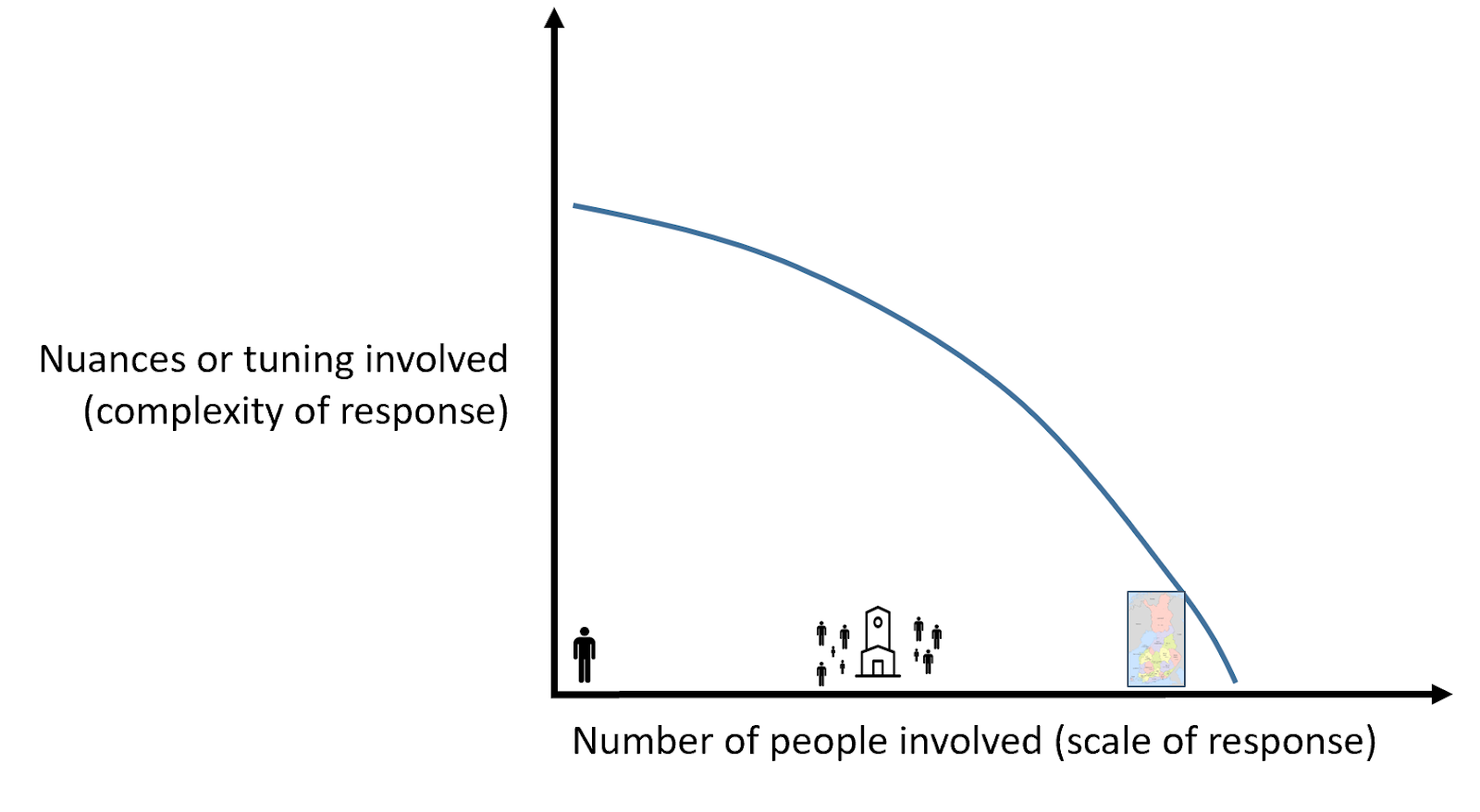
How should we think about changing people’s behaviour to mitigate pandemic threat? The starting point is to consider targets of interventions as complex systems. This means that biopsychosocial determinants such as capability, opportunity and motivation act together to create the current state of a system which is a person; aggregates of individuals define the state of a system which is a household, aggregates of which form a community, a society, and so forth. Each of these systems is of a different size, i.e. scale, and fulfills multiple roles in pandemic response – the redundancy brought about by overlap of functions performed by each element (say, individuals’ social distancing, and a community’s agreement to postpone cultural events to mitigate physical contact) is what largely ensures resilience of a system in crisis situations. In other words, information about intervention targets need to be framed as taking place within multi-level socio-ecological system, where tradeoffs between intervention nuance and scale exist. Figure below depicts this idea, and also underlines the mismatch when a large-scale unit, such as the government, attempts to dictate specifics of how e.g. schools or kindergartens should arrange their safety procedures, instead of acknowledging that “people are experts of their own environment”.

The above picture depicts a complexity profile, here a heuristic tool for considering intervention ownership. Any pandemic response must strike a balance between interventions that reach large audiences but (in spite of e.g. digital mass tailoring) are relatively homogenous, and interventions that reach small audiences but are highly tuned to their contexts. As long as the system performing the intervention remains the same, there is a fundamental tradeoff between complexity and scale, although changes in the system may allow increasing the area under the curve. Only individuals or small groups can perform ultra-local actions, and there are efforts where a larger governance structure is inevitable; those actions should be handled by agents at the appropriate scale. For example, a group of friends can come up with ideas to mingle safely, while e.g. city officials must make the decision to require quarantines and testing of incoming travellers. Horizontal axis depicts increasing audience size, from individuals to families, communities and countries. Blue line indicates the amount of nuance each entity can take into account, as depicted on the vertical axis.

Recently, we collected a sample of about 2000 people, who answered a survey on social psychological factors affecting personal protective behaviours such as mask use. As may be obvious, there are many open questions regarding implications of a cross-sectional analysis to the “real world”. Empirically evaluated social psychological phenomena are always embedded in time, making them to an extent idiographic and contextual, hence any generalisations to policy actions have to be considered in the light of nomothetic knowledge of complex systems. That is, the question of how we increase protective behaviours in the society is a multifaceted problem, requiring any actions to acknowledge the complexity of the system the behaviours take place in, and how they interact with other actions affecting community transmission. In my view, this is best done with the classical statement “First, do no harm” in mind.

A foremost condition for responsible application of science-based policy is a consideration of how the decision ought to be done, such that the costs of null effects are minimal. Finland has undertaken a suppression strategy common to European and Northern American countries, where increasingly stringent restrictions are gradually put in place while case numbers rise, and removed while cases decline. This sets different demands to individuals’ protective motivation and other personal resources (aka “pandemic fatigue”), compared to an elimination strategy, where relatively short but highly aggressive measures are taken to draw cases to zero. In the latter approach, most restrictions are lifted from case-free communities or countries, while applying border testing and quarantines to ensure the continued safety of the region’s inhabitants. In this latter case, provided that that future outbreaks are small and/or travel from regions with ongoing community transmission is low, local elimination ensues, and failures to increase protective behaviours imply – by necessity – a smaller impact than when attempted in a locale, safety of which depends mostly on personal protective behaviours.

Another consideration is that of systemic negative unintended side-effects of applying behavioural science recommendations to policy. Based on nomothetic knowledge of complex social systems and the results presented here, it is possible to give the following recommendations:

  1. Citizens’ sense of autonomy in choosing how to carry out the official pandemic mitigation recommendations should be fostered, without overlooking the necessity of feeling competence as well as camaraderie in the actions. This can be done with communication but perhaps more importantly, by facilitating people’s self-organisation tendencies and empowering them to design their own local responses, at the lowest scale (individual, family, neighbourhood, city/town, county, etc.) each of which is feasible to perform. This ensures local strengths get maximally applied, without severing functions, which are invisible to a governmental authority.
  2. Local norms (family, friends, other people in the indoor spaces one visits) ought to be stewarded to the direction which is necessary for pandemic control; this can again be done via communication, but based on literature on mitigating pandemics, it’s possible to hypothesise longer-lasting behavioural effects stemming from involving agentic individuals in the risk management of their surroundings.

Recommended reading:

  • Baker, M. G., Wilson, N., & Blakely, T. (2020). Elimination could be the optimal response strategy for covid-19 and other emerging pandemic diseases. BMJ, 371, m4907. https://doi.org/10/ghqk9h
  • Balsa-Barreiro, J., Vié, A., Morales, A. J., & Cebrián, M. (2020). Deglobalization in a hyper-connected world. Nature Palgrave Communications, 6(1), 1–4. https://doi.org/10/gjfxwz
  • Behaviour Change Science & Policy -projekti: http://linktr.ee/besp
  • Flyvbjerg, B. (2020). The law of regression to the tail: How to survive Covid-19, the climate crisis, and other disasters. Environmental Science & Policy, 114, 614–618. https://doi.org/10/gjkjwz
  • Hansson, S. O. (2004). Fallacies of risk. Journal of Risk Research, 7(3), 353–360. https://doi.org/10/c7567q
  • Horton, R. (2021). Offline: The case for No-COVID. Lancet, 397(10272), 359. https://doi.org/10.1016/S0140-6736(21)00186-0
  • Hyvönen, A.-E., Juntunen, T., Mikkola, H., Käpylä, J., Gustafsberg, H., Nyman, M., Rättilä, T., Virta, S., & Liljeroos, J. (2019). Kokonaisresilienssi ja turvallisuus: Tasot, prosessit ja arviointi [Raportti]. Valtioneuvoston kanslia. https://julkaisut.valtioneuvosto.fi/handle/10024/161358
  • Iwata, K., & Aoyagi, Y. (2021). Elimination of covid-19: A practical roadmap by segmentation. BMJ, n349. https://doi.org/10/gjqpxt
  • Käyttäytymistieteellisen neuvonantohankkeen työryhmä. (2021). Vaikuttavat valinnat päätöksenteon tukena: Käyttäytymistieteellinen neuvonanto -hankkeen loppuraportti [Sarjajulkaisu]. Valtioneuvoston kanslia. https://julkaisut.valtioneuvosto.fi/handle/10024/163138
  • Matti TJ Heino, Markus Kanerva, Maarit Lassander, & Ville Ojanen. (2021). Koronaväsymystä? Vai inhimillistä kyllästymistä, turhautumista, tottumista ja pyrkimystä normaaliin (Käyttäytymistieteellisen neuvonantoryhmän raportteja). https://vnk.fi/hanke?tunnus=VNK127:00/2020
  • Martela, F., Hankonen, N., Ryan, R. M., & Vansteenkiste, M. (2020). Motivating Voluntary Compliance to Behavioural Restrictions: Self-Determination Theory–Based Checklist of Principles for COVID-19 and Other Emergency Communications. European Review of Social Psychology. 10.1080/10463283.2020.1857082
  • Morales, A. J., Norman, J., & Bahrami, M. (Toim.). (2021). COVID-19: A Complex Systems Approach. STEM Academic Press. https://stemacademicpress.com/stem-volumes-covid-19
  • Priesemann, V., Balling, R., Brinkmann, M. M., Ciesek, S., Czypionka, T., Eckerle, I., Giordano, G., Hanson, C., Hel, Z., Hotulainen, P., Klimek, P., Nassehi, A., Peichl, A., Perc, M., Petelos, E., Prainsack, B., & Szczurek, E. (2021). An action plan for pan-European defence against new SARS-CoV-2 variants. The Lancet, S0140673621001501. https://doi.org/10/ghtzqn
  • Priesemann, V., Brinkmann, M. M., Ciesek, S., Cuschieri, S., Czypionka, T., Giordano, G., Gurdasani, D., Hanson, C., Hens, N., Iftekhar, E., Kelly-Irving, M., Klimek, P., Kretzschmar, M., Peichl, A., Perc, M., Sannino, F., Schernhammer, E., Schmidt, A., Staines, A., & Szczurek, E. (2021). Calling for pan-European commitment for rapid and sustained reduction in SARS-CoV-2 infections. The Lancet, 397(10269), 92–93. https://doi.org/10/ghp8kb
  • Rauch, E. M., & Bar-Yam, Y. (2006). Long-range interactions and evolutionary stability in a predator-prey system. Physical Review E, 73(2), 020903. https://doi.org/10/d9zbc4
  • Siegenfeld, A. F., & Bar-Yam, Y. (2020). The impact of travel and timing in eliminating COVID-19. Communications Physics, 3(1), 1–8. https://doi.org/10/ghh8hg
  • World Health Organization Regional Office for Europe. (2020). Pandemic fatigue: Reinvigorating the public to prevent COVID-19: policy considerations for Member States in the WHO European Region (WHO/EURO:2020-1160-40906-55390). Article WHO/EURO:2020-1160-40906-55390. https://apps.who.int/iris/handle/10665/335820

Pathways and complexity in behaviour change research

These are slides of a talk given at the Aalto University Complex Systems seminar. Contrasts two views to changing behaviour; the pathway view and the complexity view, the latter being at its infancy. Presents some Secret Analysis Arts of Recurrence, which Fred Hasselman doesn’t want you to know about. Includes links to resources. If someone perchance saw my mini-moocs (1, 2) and happened to find them useful, drop me a line and I’ll make one of this.

Lifestyle factors are hugely relevant in preventing disease in modern societies; unfortunately people often fail in their attempts to change health behaviour – both their own, as well as that of others’. In recent years, behaviour change design has been conceived as a process where one identifies deficiencies in factors influencing the behaviours (commonly called “determinants”). Complexity thinking suggests putting emphasis on de-stabilisation instead.

The perspective taken here is mostly at the idographic level. At the time of writing, we have behaviour change methods to affect e.g. skills, perceived social norms, attitudes and so forth – but very little on general de-stabilisation of the motivational system as an important predictor of change.

Perspectives are welcome!

ps. Those of you to worry about brainwashing and freedom of thought: Chill. Stuff that powerful doesn’t really exist, and if it did, marketers would know about it and probably rule the world. [No, they don’t rule the world, I’ve been there]

pps. Forgot to put it in the slides, but this guy Merlijn Olthof will perhaps one day tweet about his work about destabilisation in psychotherapy contexts. Meanwhile, you can e.g. be his 10th Twitter follower, or keep checking his Google Scholar profile, as there’s a new piece coming out soon!

Randomised experiments (mis?)informing social policy in complex systems

In this post, I vent about anti-interdisciplinarity, introduce some basic perspectives of complexity science, and wonder whether decisions on experimental design actually lead us to end up in a worse place than where we were, before we decided to use experimental evidence to inform social policy.

People in our research group recently organised a symposium, Interdisciplinary perspectives on evaluating societal interventions to change behaviour (talks watchable here), as part of a series called Behaviour Change Science & Policy (BeSP). The idea is to bring together people from various fields from philosophy to behavioural sciences, medicine and beyond, in order to better tackle problems such as climate change and lifestyle diseases.

One presentation touched upon Finland’s randomised controlled trial to test the effects of basic income on employment (see also report on first year results). In crude summary, they did not detect effects of free money on finding employment. (Disclaimer: They had aimed for 80% statistical power, meaning that if all your assumptions regarding the size of the effect are correct, in the long term, 20% of the time you’d get no statistically significant effect in spite of there being a real effect.)

During post-symposium drinks, I spoke with an economist about the trial. I was wondering, how come they used individual instead of cluster randomisation – randomising neighbourhoods, for example. The answer was resource constraints; much larger sample sizes are needed for the statistics to work. To me it seemed clear, that it’s a very different situation if one person in a network of friends got free money, as compared to if everyone did. The economist wondered: “How come there could be second-order effects when there were no first-order effects?” The conversation took a weird turn. Paraphrasing:

Me: Blahblah compelling evidence from engineering and social sciences to math and physics that “more is different”, i.e. phenomena play out differently depending on the scale at consideration… blahblah micro-level interactions create emergent macro-level patterns blahblah.

Economist: Yeah, we’re not having that conversation in our field.

Me: Oh, what do you mean?

Economist: Well, those are not things discussed in our top journals, or considered interesting subjects to research.

Me: I think they have huge consequences, and specifically in economics, this guy in Oxford just gave a presentation on what he called “Complexity economics“. He had been doing it for some decades already, I think he originally had a physics background…

Economist: No thanks, no physicists in my economics.

Me: Huh?

Economist: [exits the conversation]

Now, wasn’t that fun for a symposium on interdisciplinary perspectives.

I have a lot of respect for the mathematical prowess of economists and econometricians, don’t get me wrong. One of my favourites is Scott E. Page, though I only know him due to an excellent course on complexity (also available as an audio book). I do probably like him, because he breaks out of the monodisciplinary insulationist mindset economists are often accused of. Page’s view of complexity actually relates to our conversation. Let’s see how.

First off, he describes complexity (and most social phenomena of interest) as arising from four factors, which can be thought as tuning knobs or dials. Complexity arises, when each dial is not tuned into either of the extremes, which is where equilibria arise, but somewhere in the middle. And complex systems tend to reside far from equilibrium, permanently.

To dig more deeply into how the attributes of interdependence,
connectedness, diversity, and adaptation and learning generate
complexity, we can imagine that each of these attributes is a dial that
can be turned from 0 (lowest) to 10 (highest).

Scott E. Page

  • Interdependence means the extent of how much one person’s actions affect those of another’s. This dial ranges from complete independence, where one person’s actions do not affect others’ at all, to complete dependence, where everyone observes and tries to perfectly match all others’ actions. In real life, we see both unexpected cascades (such as the US decision makers’ ethanol regulations, leading to the Arab Spring), as well as some, but never complete, independence – that is, manifestations that do not fit into either extreme of the dial, but lie somewhere in between.
  • Connectedness refers to how many other people a person is connected to. The extremes range from people living in a cabin in the woods all alone, to hypersocial youth living in Instagram trying to keep tabs on everyone and everything. The vast majority of people lie somewhere in between.
  • Diversity is the presence of qualitatively different types of actors: If every person is a software engineer, mankind is obviously doomed… But the same happens if there’s only one engineer, one farmer etc. Different samples of real-world social systems (e.g. counties) consist of intermediate amounts of diversity, lying somewhere in between.
  • Adaptation and learning refer to the extent of the actors’ smartness. This ranges from following simple, unchanging rules, to being perfectly rational and informed, as assumed in classical economics. In actual decision making, we see “bounded rationality”, reliance on rules of thumb and tradition, as well as both optimising and satisficing behaviours – the “somewhere in between”.

The complexity of complex systems arises, when diverse, connected people interact on the micro-level, and by doing so produce “emergent” macro-level states of the world, to which they adapt, creating new unexpected states of the world.

You might want to read that one again.

Back to basic income: When we pick 2000 random individuals around the country and give them free money, we’re implicitly assuming they are not connected to any other people, and/or that they are completely independent the actions of others’. We’re also assuming that they are either the same, or that it’s not interesting that they are of different types. And so forth. If we later compare their employment data to that of those who were not given basic income, the result we get is an estimate of the causal effect in the population, if all assumptions would hold.

But consider how these assumptions may fail. If the free money was perceived as a permanent thing, and given to people’s whole network of unemployed buddies, it seems quite plausible that they would adapt their behaviour as a response of the dynamics of their social network changing. This might even be different in cliques of certain people, who might use the safety net of basic income to collectively found companies and take risks, and cliques of other people, who might alter their daily drinking behaviour to match the costs with the predictable income – for better or worse. But when you randomise individually and ignore how people cluster in networks, you’re studying a different thing. Whether it’s an interesting thing or a silly thing, is another issue.

Now, it’s easy to come up with these kinds of assumption-destroying scenarios, but a whole different ordeal to study them empirically. We need to simplify reality in order to deal with it. The question is this: How much of an abstraction can a map (i.e. a model in a research study, making those simplified assumptions) be, in order to still represent reality adequately? This is also an ontological question, because if you take the complexity perspective seriously, you say bye-bye to the kind of thinking that allows you to dream up predictable effects a button-press (such as a policy change) has over the state of a system. People who act in—or try steering—complex systems, control almost nothing but influence almost everything.

An actor in a complex system controls almost nothing but influences almost everything.

Scott E. Page

Is some information, some model, still better than none? Maybe. Maybe not. In Helsinki, you’re better off without a map, than with a map of Stockholm – the so-called “Best map fallacy” (explained here in detail). Rare, highly influential events drive the behaviour of complex systems: the Finnish economy was not electrified by average companies starting to sell more, but by Nokia hitting the jackpot. And these events are very hard, if not impossible, to predict✱.

Ok, back to basic income again. I must say that the people who devised the experiment were not idiots, and included e.g. interviews of people to get some idea about unexpected effects. I think that this type of an approach is definitely necessary when dealing with complexity, and all social interventions should include qualitative data in their evaluation. But, again, unless the unemployed don’t interact, with randomisation done individually you’re studying a different thing than when it’s done in clusters. I do wonder if it would have been possible to include some matched clusters, to see if any qualitatively different dynamics take place, when you give basic income to a whole area instead of randomly picked individuals within it.

Complex systems organizational map.jpg
The society is a complex system, and must be studied as such. Figure: Hiroki Sayama (click to enlarge)

But, to wrap up this flow of thought, I’m curious if you think it is possible to randomise a social intervention individually AND always keep in mind that the conclusions are only valid if there are no interactions between people’s behaviour and that of their neighbours. Or is it inevitable that that the human mind smoothes out the details?

Importantly: Is our map better now, than it was before? Will this particular experiment go in history as—like the economist stated in “there were no first-order effects”—basic income not having any effect on job seeking? (remember, aim was only 80% statistical power). Lastly, I want to say I consider it unforgiveable to only work within one discipline and disregard the larger world you’re operating in: When we bring science to policy making, we must be doubly cautious of the assumptions our conclusions stand on. Luckily, transparent scientific methodology allows us to be explicit about them.

Let me hear your thoughts, and especially objections, on Twitter, or by email!

✱ One solution is to harness convexity, which can be oversimplified like this:

  1. Unpredictable things will happen, and they will make you either better or worse off.
  2. Magnitude of an event is different from it’s effect on you, i.e. there are huge events that don’t impact you at all, and small events that are highly meaningful to you. Often that impact depends on the interdependence and connectedness dials.
  3. To an extent, you can control the impact an event has on you.
  4. You want to control exposure in such a way, that surprise losses are bounded, while surprise gains are as limitless as possible.

Idiography illustrated: Things you miss when averaging people

This post contains slides I made to illustrate some points about phenomena, which will remain forever out of reach, if we continue the common practice of always averaging individual data. For another post on perils of averaging, check this out, and for an overview of idiographic research with resources, see here.  

(Almost the same presentation with some narration is included in this thread, in case you want more explanation.)

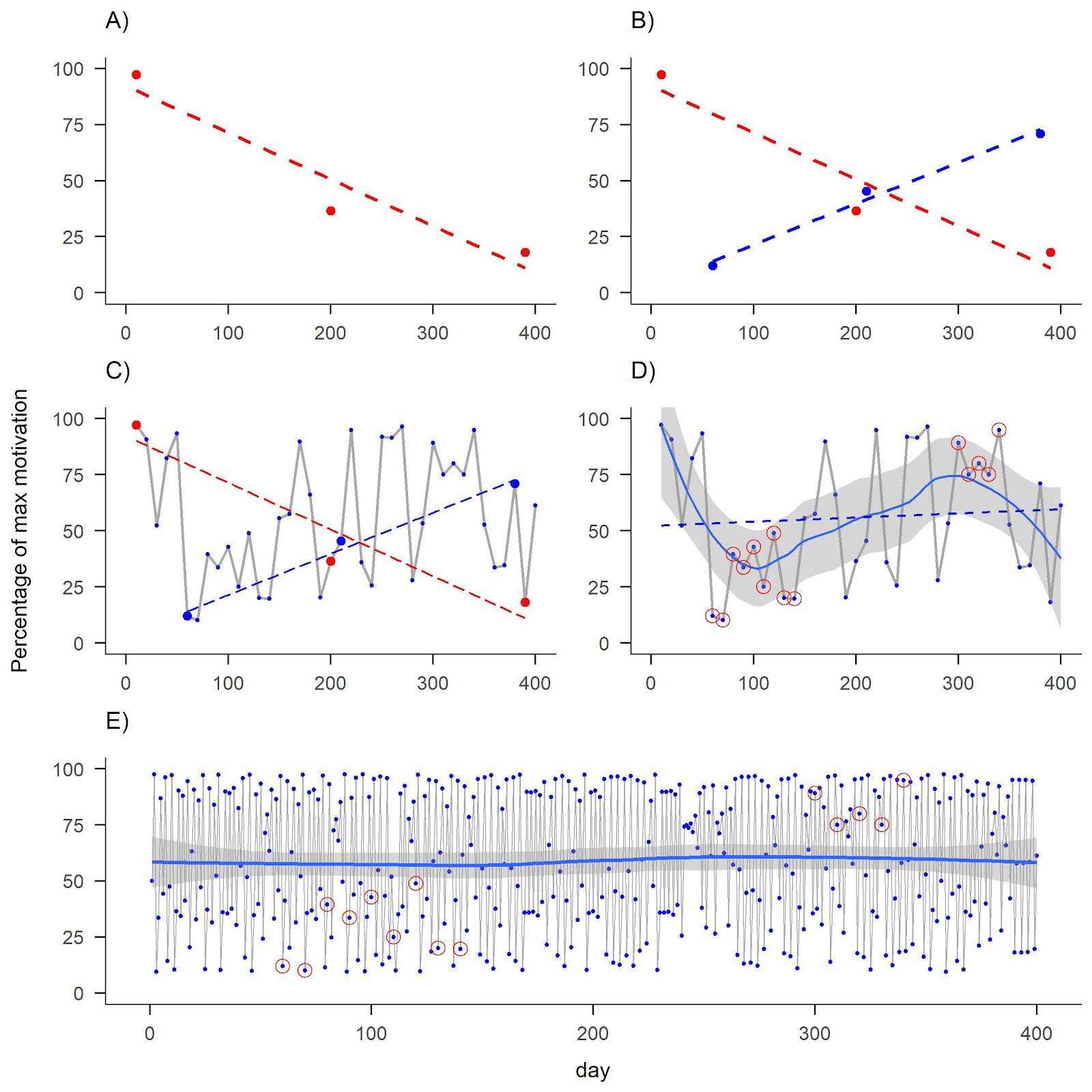
Here’s one more illustration of why you need the right sampling frequency for whatever it is you study – and the less you know, the denser sampling you need initially. From a paper I’m drafting:

chaosplot

The figure illustrates a hypothetical percentage of a person’s maximum motivation (y-axis) measured on different days (x-axis). Panels: 

  • A) measurement on three time points—representing conventional evaluation of baseline, post-intervention and a longer-term follow-up—shows a decreasing trend.
  • B) Measurement on slightly different days shows an opposite trend. 
  • C) Measuring 40 time points instead of three would have accommodated both phenomena.
  • D) New linear regression line (dashed) as well as the LOESS regression line (solid), with potentially important processes taking place during the circled data points.
  • E) Having measured 400 time points instead, would have revealed a process of “deterministic chaos” instead. Not knowing the equation and the starting points, it would be impossible to predict accurately, but this doesn’t mean regression is helpful.

During the presentation, a question came up: How much do we need to know? Do we really care about the “real” dynamics? Personally, I mostly just want information to be useful, so I’d be happy just tinkering with trial and error. Thing is, tinkering may benefit from knowing what has already failed, and where fruitful avenues may lie. My curiosity ends, when we can help people change their behaviour in ways that fulfill the spirit of R.A. Fisher’s criterion for an empirically demonstrable phenomenon:

In relation to the test of significance, we may say that a phenomenon is experimentally demonstrable when we know how to conduct an experiment which will rarely fail to give us a statistically significant result. (Fisher 1935b/1947, p. 14; see Mayo 2018)

So, if I was a physiology researcher studying the effects of exercise, I would have changed fields (to e.g. PA promotion) when the negative effects of low activity became evident, whereas other people want to learn the exact metabolic pathways by which the thing happens. And I will quit intervention research when we figure out how to create interventions that fail to work <5% of the time.

Some people say we’re dealing with human phenomena that are so unpredictable and turbulent, that we cannot expect to do much better than we currently do. I disagree with this view, as all the methods I’ve seen used in our field so far are designed for ergodic, stable, linear systems. But there are other kinds of methods, which physicists started using when they left behind the ones that stuck with us, around maybe the 19th century. I’m very excited about learning more at the Complexity Methods for Behavioural Science summer school (here are some slides on what I presume will be among the topics).


Additional resources:

I don’t have examples on e.g. physical activity, because nobody’s done that yet, and lack of good longitudinal within-individual data is a severe historical hindrance. But some research groups are gathering longitudinal continuous data, and one that I know of, has very long time series of machine vision data on school yard physical activity (those are systems, too, just like individuals). Plenty has already been done in the public health sphere.

Hell do I know, this might turn out to be a dead-end, like most new developments tend to be.

But I’d be happy to be convinced that it is an inferior path to our current one 😉

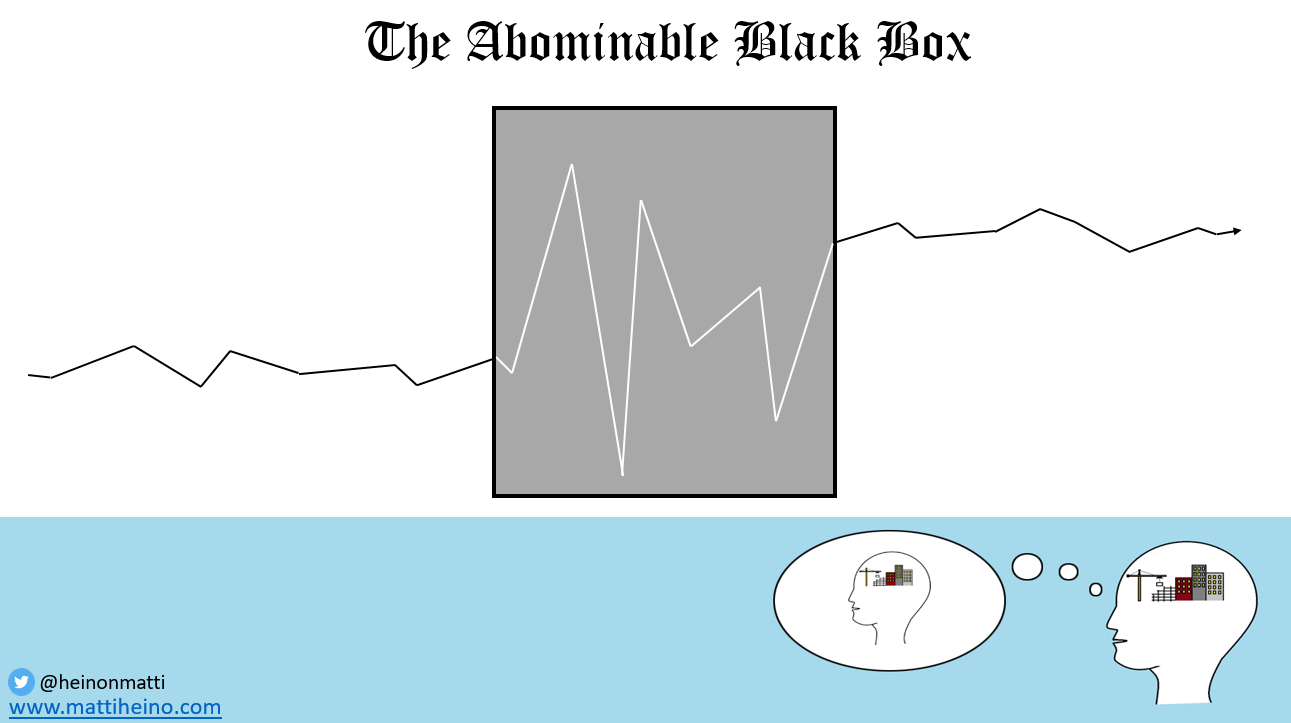
blackbox