From Droplets to Fine Particles: How the pandemic changed our understanding of infection spread

This is an English translation of a Finnish post outlining some learnings from our government funded consortium of 5 universities, studying what we can learn from the COVID-19 pandemic response. The interdisciplinary collaboration has significantly influenced how I think of pathogen spread, and I found the post quite enlightening. I hence wanted to share this with a larger audience, because auto-translate tools still don’t work well for Finnish. Original authors are Lotta-Maria Oksanen, Tuomas Aivelo, Viktor Zöldi, and Tarja Sironen. I am grateful to the first author for providing feedback on the translation, but all mistakes in the final text are mine – please report if you see any.


Throughout time, people have pondered how infections spread and how they should be combated. The pandemic changed how we think pathogens in the respiratory tract spread.

Exposure occurring through the air is no longer seen as rare or exceptional. It is now viewed as a daily transmission route for respiratory infections in normal social interaction.

Research on the topic is being conducted in the Government-funded Lessons from the Pandemic Crisis (PAKO) project, which investigates COVID-era actions across different sectors to prepare for future crises. The University of Helsinki [medical faculty]’s sub-study forms a comprehensive picture of the understanding that prevailed in Finland. The study focuses on the view about transmission routes and the changes it faced, and the protection guidelines introduced. It also produces an analysis of the variants observed in Finland during the pandemic, their characteristics, and their speed of arrival.

The Historical View: Droplets at the Center of Infection

Before the pandemic, it was thought that respiratory infections spread via large droplets generated when a symptomatic person coughs or sneezes. These droplets cause infection when hitting the recipient’s mucous membranes, i.e., the eyes, nose, or mouth.

Over a hundred years ago, medicine was living through a time of change. It began to be understood that diseases are caused by pathogens. There was a desire to get rid of old beliefs, such as miasma – polluted air that originated from rotting sources and was believed to cause diseases. Dried saliva mixed with dust was also believed at that time to have great significance in the spread of diseases. Indeed, public spaces read: “Do not spit on the floor.” Studies were conducted in which test subjects, for example, swirled a solution containing bacteria in their mouths and read aloud. Dishes were placed on the floor in front of them, revealing how far the bacteria spread. Bacteria grew especially on the dishes that were close by. In the studies, the significance of fresh secretions was understood, and attention focused on large droplets.

The role of air as a carrier of infections lost apparent credibility even further, when a leading public health scientist Charles Chapin (1856-1941) criticised airborne transmission in his key textbook. He proposed that contact infection is the most central and obvious transmission route. The idea of contact and droplets as dominant modes of transmission lived strong for decades, and thus hand washing and droplets became familiar to everyone in pandemic guidelines as well.

The New View: Respiratory Infections Spread Via the Air

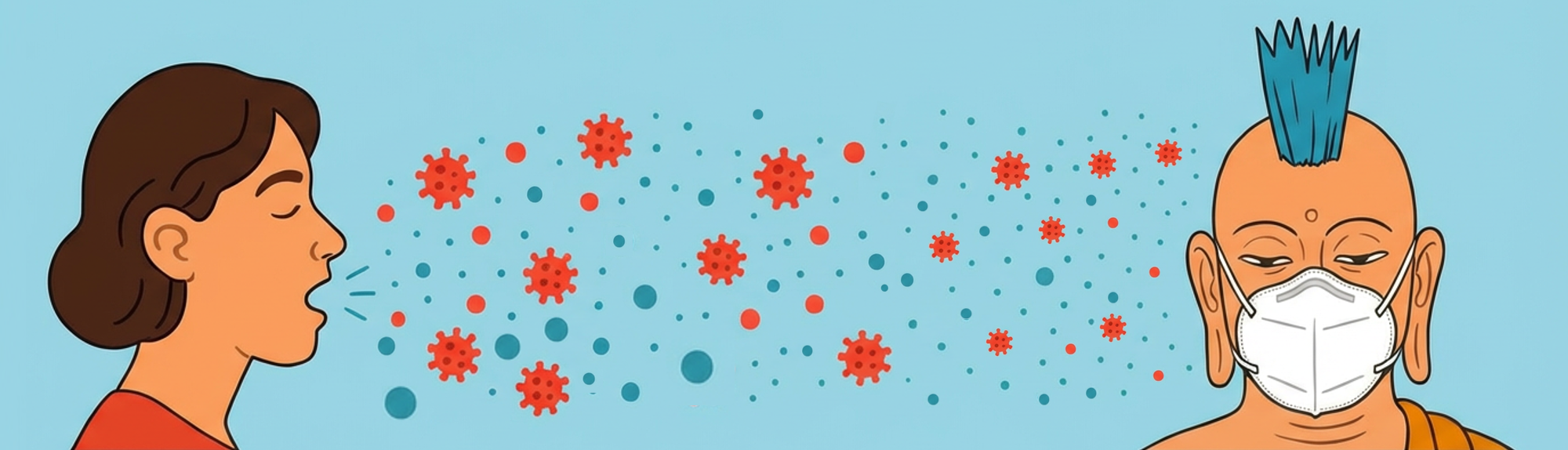
The problem with droplet thinking was that smaller particles remain in the air and do not settle on the dish. The old technology simply was not sufficient to observe these. Especially regarding viruses, technical challenges exist even today. Airborne transmission has, however, proven to be central in many transmission events. Advanced measurement methods have shown that nearly all particles we produce are very small and that we produce infectious particles also when breathing. In animal experiments, other transmission routes have been ruled out, demonstrating that infection must have occurred via the air – for example, a seminal research setup that demonstrated the airborne nature of tuberculosis has been replicated also with SARS-CoV-2

Human experiments have also yielded interesting results. In a study examining Rhinovirus, laboratory-infected “donors” and susceptible volunteers sat playing cards for 12 hours, sitting at a distance of 1.5-2m from each other. Some of the participants had their hands tied so that it was impossible for them to touch their faces, making infection possible only through the air. Infections were equally common among hands-tied and untied groups. In a separate branch of the experiment, where the cards were thoroughly soiled with the infectors’ nasal secretions, but the infectors did not participate in the game, no infections occurred at all.

Correspondingly, many pandemic-era super-spreader events – such as various concert and choir events, many of which observed safety distances – a significant portion of participants still fell ill. Such transmission events are only possible through airborne transmission. While it was previously thought that close proximity was proof of contact infection, it is now understood that exposure to small particles is also highest at close range.

Infection Through the Air: Threat or Opportunity?

Traditionally, air has been considered difficult to control. Modern technologies, such as ventilation, air purification, and respirator-grade masks, however, make it possible to target actions precisely at smaller particles and thus reduce infection risk. The UN held its first Conference on Healthy Indoor Air on 23 September 2025, and safe indoor air was defined as a key objective. Indeed, new international ventilation standards that take infection risks into account, have been proposed for new construction and renovation projects.

Taking airborne infection into account also opens an excellent opportunity to improve patient and occupational safety in social and health care. With awareness, this infection risk can be monitored and combated. Until now, protective guidelines have mainly concerned droplets, leaving a central part of the exposure unnoticed. Noting the airborne nature enables use of personal protective equipment that protects against it. An example would be recognising that the effect of screens or curtains is minimal on respiratory infection in a shared room without other additional measures – such as air purifiers – especially during prolonged exposure.

The Role of Information and the Challenge of Distortion

The pandemic has also made visible another phenomenon: the distortion of information. In the era of social media and rapid communication, research information and carefully collected evidence compete for attention with false information, partisan interpretation, and outright disinformation.

The phenomenon is global, but it escalated, for example, in the United States. Sharp dividing lines regarding e.g. the use of masks and vaccines emerged both spontaneously, and were created purposefully, during the pandemic. Information became a tool for political and ideological maneuvering – instead of a shared foundation for decision making.

Information alone is not enough. Structures and processes are also needed that enable the flow of information and support trust in experts, authorities, and research, as well as dialogue between these actors. Without this trust, even the best possible research information does not translate into action.

The pandemic showed how one can change course in the middle of a crisis if basic trust exists: Finns, for example, quickly adopted masking or kept their distance when the authorities recommended it. Conversely, new ideas do not end up in practice if the opportunity to bring new information to the decision-making table is lacking. Discussion must continue and trust must be built between crises; then the structures will be ready.

Looking Forward

From the history of medicine, we know that it takes a long time before new information changes practices. The necessity of hand washing between handling the deceased and treating living surgeries or deliveries was once difficult to accept. Nowadays, medical breakthroughs are considerably faster, but questioning old ways still often leads to negative reactions first. Over time, through education and dialogue, new information begins to gain a foothold.

Change is an opportunity. With advanced knowledge, we can bring different fields to the same table to solve the problem. For example, we can enhance measures that reduce infection risk in indoor air already in building design, and simultaneously reduce other exposure to particles. In this change, digitalisation and sensor technology offer new possibilities. Smart buildings can adjust ventilation energy-efficiently using real-time data. Collected data, in turn, helps visualise risky spaces and target corrective measures exactly where they are needed most – making healthy indoor air the new norm.

This means that in future epidemics, we will have more means at our disposal than just prohibitions and restrictions. What if in the next pandemic we didn’t have to greet the elderly from behind a window, but could hug them while wearing a respirator-grade mask? Often, it is precisely large structural hygiene changes, such as the cold chain or water purification, that bring significant public health benefits in the long run – is clean indoor air the next great change that also increases everyday health security? 

It is time to ask: are we ready to invest in behaviours, technology, and structures that make our workplaces, hospitals, schools, and homes healthier?


Original authors:

Lotta-Maria Oksanen, Postdoctoral Researcher, University of Helsinki

Tuomas Aivelo, Assistant Professor, Leiden University, Academy Research Fellow, University of Helsinki

Viktor Zöldi, Postdoctoral Researcher, University of Helsinki

Tarja Sironen, Professor, University of Helsinki
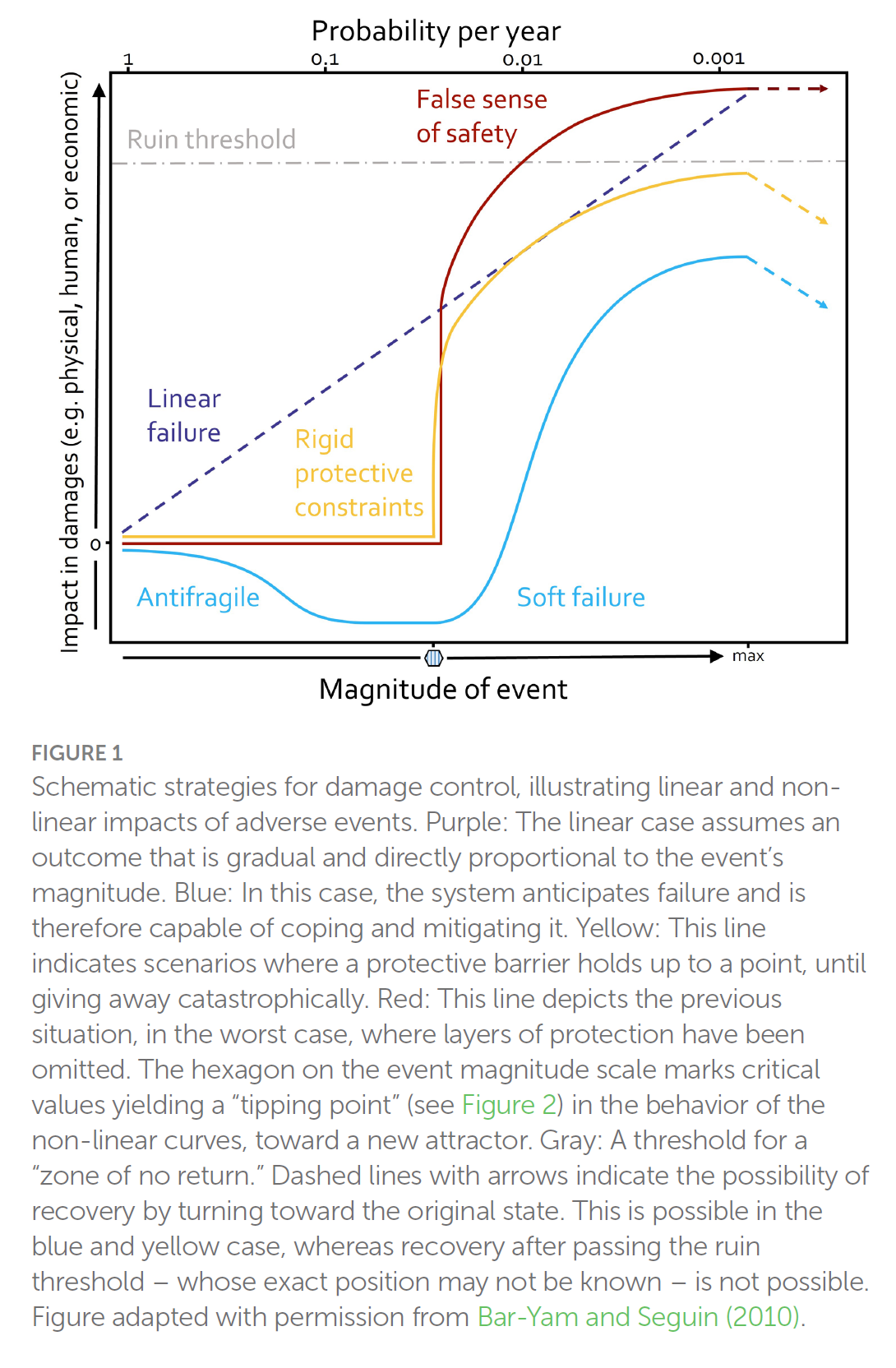
New paper: From a False Sense of Safety to Resilience Under Uncertainty

Understanding how people act in crises and how to manage risk is crucial for decision-makers in health, social, and security policy. In a new paper published in the journal Frontiers in Psychology, we outline ways to navigate uncertainty and prepare for effective crisis responses.

The paper is part of a special issue called From Safety to Sense of Safety. The title is a play on this topic, which superficially interpreted can lead to a dangerous false impression: that we ought to intervene on people’s feelings instead of the substrate from which they emerge.

Nota bene: In June 2024, this topic is part of an online course for the New England Complex Systems Institute, and have some discount codes for friends of this blog. Do reach out!

The Pitfall of a False Sense of Safety

In the paper we first of all argue that we should understand so-called disaster myths, a prominent one being the myth of mass panic. This refers to the idea that people tend to lose control and go crazy during crises when they worry or fear too much, which implies we need to intervene on risk perceptions. But in fact, no matter what disaster movies or news reports show you, actual panic situations are rare. During crises, people tend to act prosocially. Hence, decision-makers should shift their focus from mitigating fear and worry – potentially leading to a false sense of safety – towards empowering communities to autonomously launch effective responses. This approach fosters resilience rather than complacency.

Decision Making Under Uncertainty: Attractor Landscapes

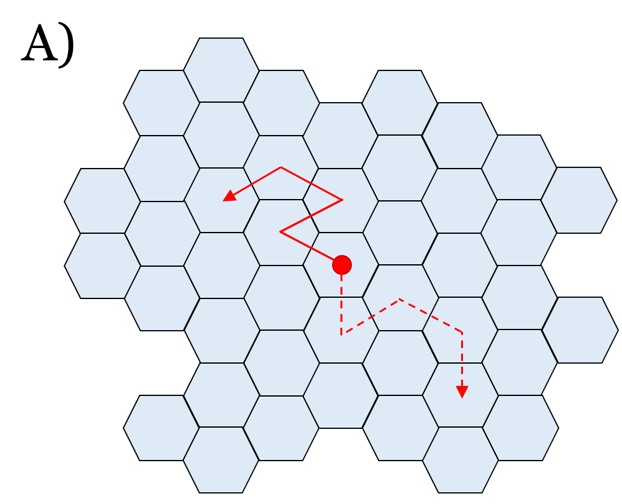
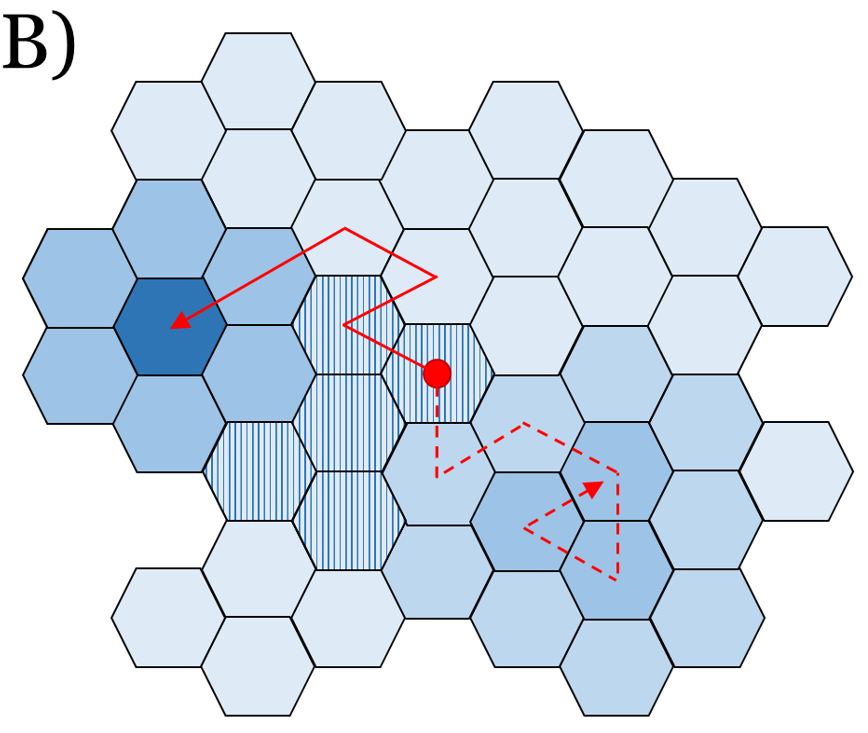
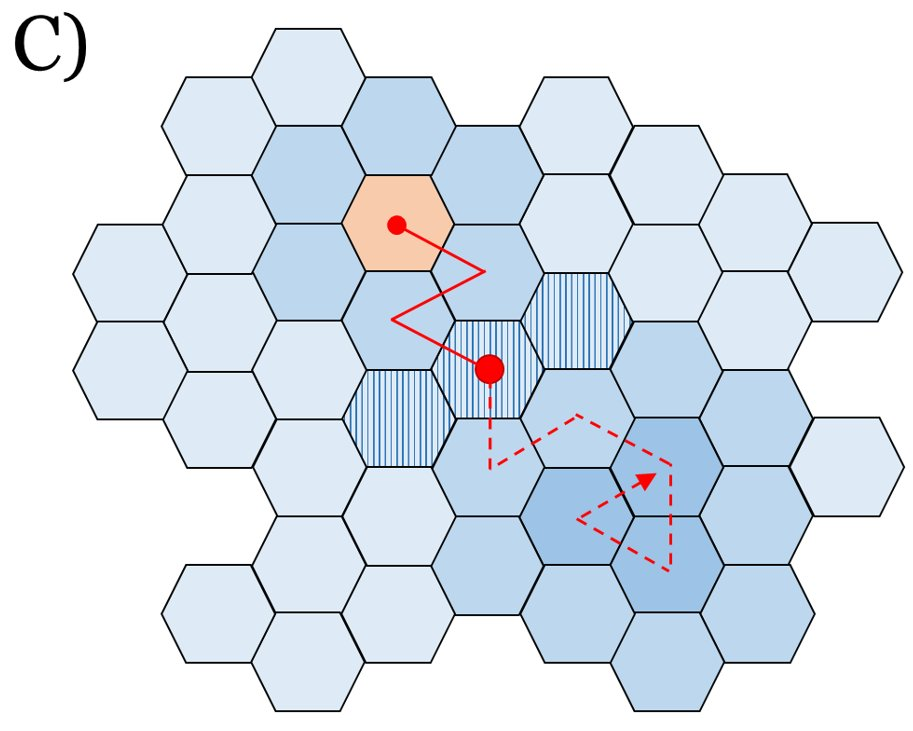
Secondly, we represent some basic ideas of decision making under uncertainty, via the concept of attractor landscapes. I now hope we would’ve talked about stability landscapes, but that ship already sailed. The idea can be understood like this: Say your society is the red ball, and each tile a state it’s in (e.g. “revolt”, “thriving”, “peace”, etc.) The society moves through a path of states.

These states are not equally probable; some are more “sticky” and harder to escape, like valleys in a landscape. These collections of states are called attractors. The area between two attractors is a tipping point (or here, kind of a “tipping ridge”).

I wholeheartedly encourage you to spend five minutes on Nicky Case’s interactive introduction to attractor landscapes here. It’s truly enlightening. The main thing to know about tipping points: as you cross them, nothing happens for a long time… Until everything happens at once.

The Dangers of Ruin Risks

All attractors are not made equal, though. For some, when you enter, you’ll never escape. These are called “ruin risks” (orange tile). If there is possibility of ruin in your landscape, probability dictates you will eventually reach it, obliterating all future aspirations.

As a basic principle, it does not make sense to see how close to the ledge you can walk and not fall. In personal life, you can take ruin risks to impress your friends or shoot for a Darwin Award. But keep your society away from the damned cliff.

As Nassim Nicholas Taleb teaches us: Risk is ok, ruin is not.

Navigating the Fog of War

In reality, not all states are visible from the start. Policymakers often face a “fog of war” (grey areas). Science can sometimes highlight where the major threats lie (“Here be Dragons”), but the future often remains opaque.

To make things worse for traditional planning, as you move a step from the starting position, the tiles may change. So you defined an ideal state, a Grand Vision (yellow) and set the milestones to reach it? If you remain steadfast, you could now be heading at a dead end or worse. Uh-oh.

(nb. due to space constraints, this image didn’t make it to the paper)

This situation, described in Dave Snowden’s Cynefin framework, is “complex.” Here, yesterday’s goals are today’s stray paths, so when complexity is high, you focus on the present – not some imaginary future. The strategy should be to take ONE step in a favourable direction, observe the now-unfolded landscape, and proceed accordingly.

The Cynefin Framework and Complex Systems

Sensemaking is a motivated, continuous effort to understand connections (which can be among people, places, and events) in order to anticipate their trajectories and act effectively.

Gary Klein

Sensemaking (or sense-making, as Dave Snowden defines it as a verb) refers to the attempt or capacity to make sense of an ambiguous situation in order to act in it. This is what we must do in complex situations, where excessive analysis can lead to paralysis instead of clarity.

Cynefin is a sense-making framework designed to enable conversations about such a situation, and offers heuristics to navigate the context. In the paper, we propose some tentative mappings of attractor landscape types to the Cynefin framework.

In general, our paper offers proposals for good governance, drawing from the science of sudden transitions in complex systems. Many examples pertain to pandemics, as they represent one of the most severe ruin risks we face (good contenders are of course wars and climate change).

By understanding the concepts illustrated here, policymakers could better navigate crises and build resilient societies capable of adapting to sudden changes.

If you want a deeper dive, please see the paper discussed in this post: At-tractor what-tractor? Tipping points in behaviour change science, with applications to risk management

NOTE: There’s another fresh paper out, this one in Translational Behavioural Medicine: How do behavioral public policy experts see the role of complex systems perspectives? An expert interview study. Could be of interest, too!

Tartuntojen torjunta ja unohtunut ennakointi

English summary: This post outlines two key points missing from Finnish public discussion in 2023. It was originally published on January 16, and has been audited for its continuing relevance on August 31. The main scientific points are made here (non-pharmaceutical interventions like masks work, particularly when they’re combined with other measures; see text for explanation of non-linear compounding), here (mass testing can end the pandemic), here (international consensus we should not let the pandemic run amok), here (long covid is a biological disease) and here (novel pathogens call for a swift and prudent elimination approach).

Suomessa vallitsee neljäntenä pandemiavuonna tilanne, jota on hankala kuvata muulla termillä kuin aika jännä. Korona on esitetty suomalaisille lähinnä hengitystieinfektiona, ei monielinsairautena, joka se kuitenkin on. Kansalaisille ei myöskään ole kunnolla viestitty, että sairastettu korona voi immuunijärjestelmän vahvistamisen sijaan heikentää sitä kokonaisvaltaisesti – eikä tämä koske vain riskiryhmiä, vaan myös nuoria ja perusterveitä. Tämän hetken käsityksen mukaan lapset sairastavat koronan yleensä lievin oirein. Millainen vaikutus vasta kehittyvään elimistöön on kokonaisimmuniteettia mahdollisesti vahingoittavalla monielinsairaudella, sitä emme vielä tarkalleen tiedä, vaikka tiedämmekin pandemioiden jättävän vuosikymmenten mittaisia jälkiä sairastuneisiin. Ylikuolleisuutta on juuri nyt enemmän kuin koskaan sotien jälkeen, eikä sitä ole enää mahdollista kieltää, mutta johtavat terveysviranomaiset tuntuvat olevan kiinnostuneempia “pelon” hillinnästä; kuin mitään ei olisi tehtävissä. Jännää on myös se, että kuolemista ääneen puhumiseen suhtaudutaan aggressiivisesti vähätellen, ja esim. Väestöliiton peräänkuuluttama itsenäinen selvitys aiheesta herättää vastustusta.

Käsittelen kuitenkin seuraavassa kahta tärkeintä asiaa, joiden viestinnässä on ajettu päin puuta: tartuntojen torjunnan kannattavuus, ja sen mahdollisuus.

1. Tartuntoja kannattaa torjua

Kuva 1: Kansainvälisen 386 asiantuntijaa sisältäneen paneelin tärkeimmät ennaltaehkäisyä koskevat pandemiasuositukset. Klikkaa suuremmaksi. Lähde

Vuonna 2021 Suomessa siirryttiin torjumaan tartuntojen sijaan vakavaa sairastumista ja kuolemia. Tammikuussa 2023 taas WHO edelleen suosittaa mm. “Wear a mask when you’re around other people”, ja kehottaa 10 päivän eristykseen oireellisen koronan tapauksessa. Heinä-elokuussa WHO painottaa koronaviruksen olevan edelleen iso ongelma, mutta seurantajärjestelmien lakkauttamisen johdosta se ei näy enää virallisissa luvuissa. Syksyn aallon edessä hallitusten ei pitäisi laiminlyödä velvollisuuksiaan. Lancet-tiedelehdessä kannustetaan koherenttiin eliminaatiostrategiaan uusien taudinaiheuttajien torjunnassa. Tartuntojen torjunnan tärkeyttä painotti myös kansainvälisten asiantuntijoiden konsensustutkimus, joka julkaistiin v. 2022 lopulla arvostetussa Nature-tiedelehdessä. Se on tällä hetkellä yksi tieteellisen julkaisemisen tunnetun historian eniten huomiota saaneista tutkimuksista, mutta Suomessa siitä ei ole tietääkseni edes uutisoitu (sidonnaisuusilmoitus: olin itse mukana kirjoittajana). 

Miksi tartuntoja kannattaa torjua? Koska yhden tartunnan torjumalla torjuu samalla koko ketjun tartuntojen seurauksia. Tätä sanotaan kansanterveystieteessä preventioksi; myös muita tauteja, kuten tyypin 2 diabetesta on huomattavasti halvempaa hoitaa ennaltaehkäisevästi, kuin kalliita hoitoja ja sairaspaikkoja lisäämällä. Päätöspuudiagrammi alla tiivistää, miten paljon jossittelua voi vähentää välttämällä tartunnan.

Kuva 2: Yksinkertaistettu heuristinen päätöspuu riskinhallinnan suunnitteluun. Sakset sisältävät jäljempänä kohdassa 2. esitellyt suojatoimet, jotka poistavat yhtälöstä kaikki katkoviivan alla olevat polut. Kuva keskittyy yksilöön ja siitä puuttuu esim. tartunnan levittämisen seuraukset läheisiin, sekä sairaspoissaolojen vaikutukset kansantaloudelle.
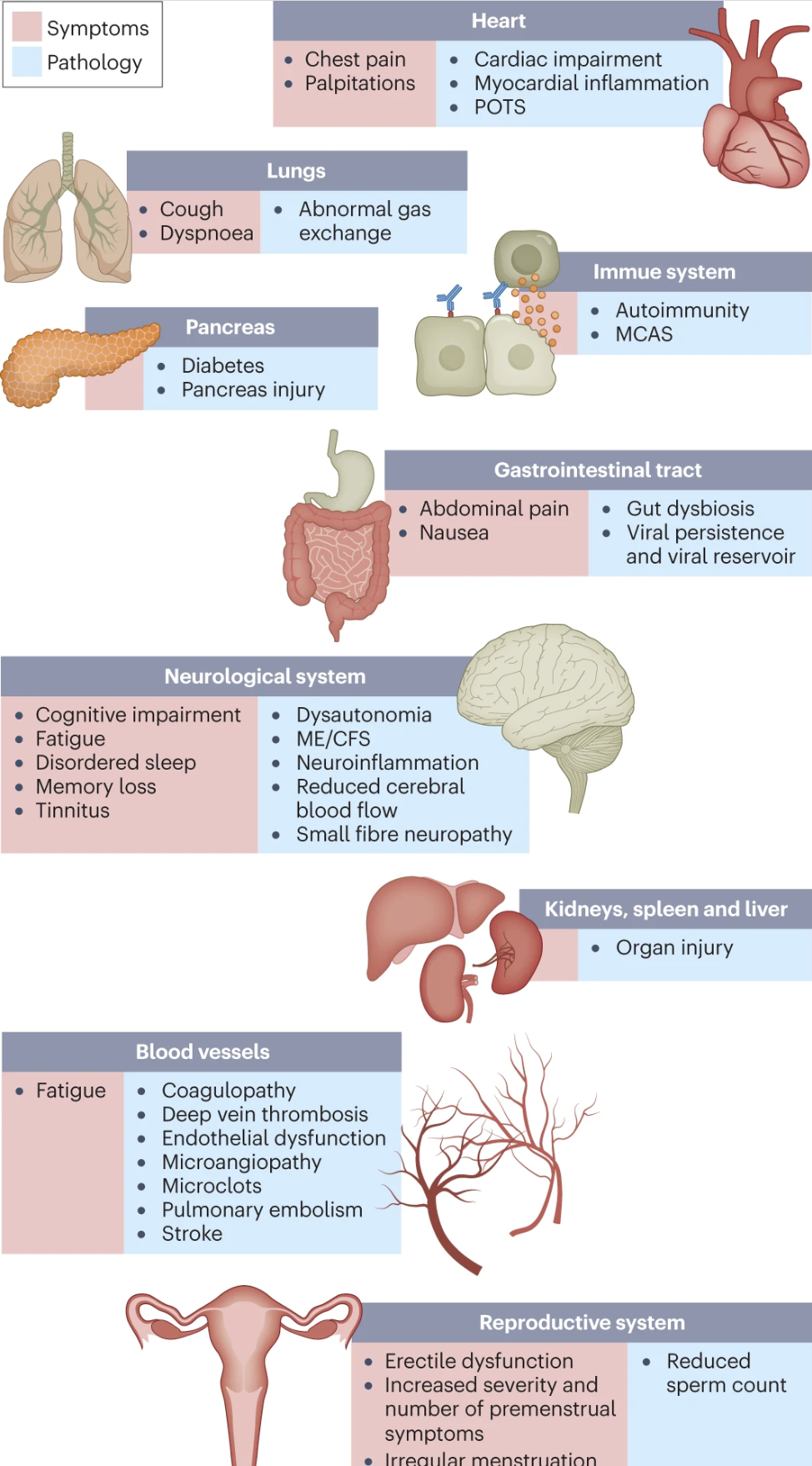
Kuva 3: Mille kaikelle koronatartunta altistaa? Klikkaa suuremmaksi. Lähde

Päätöspuusta huomannet pitkän koronan riskin, joka ilmenee tartunnan saaneilla – ja vain tartunnan saaneilla. Pitkän koronan kustannukset Suomessakin lasketaan jo miljardeissa, ja tilanne on pidempään suojaustoimia vailla olleissa maissa vielä heikompi. Sairauteen liittyvistä biologisista mekanismeista tuli vastikään Nature-tiedelehdessä kokoava artikkeli, jossa peräänkuulutettiin tiedotuskampanjaa, joka toisi pitkään koronaan liittyvät riskit kansalaisten tietoisuuteen. Kiinnostuksella odotan, koska sellainen nähdään Suomessa.

2. Tartuntoja voidaan torjua

Vaikka mediassa on viimeisen kolmen vuoden aikana näkynyt paljon näyttöön pohjaamattomia lausuntoja siitä, ettei tartuntoja voisi torjua, käyttäytymistieteiden pohjalta tämä on ollut aina mahdollista – ja on sitä edelleen. On siis selvää, että tartuntoja voidaan torjua. Käyttäytymisiin perustuvia suojatoimia on viittä tyyppiä: 

  • Hengityssuojainten käyttö
  • Ilmahygieniatoimet (tuuletus ja ilmanpuhdistinten hankinta, mahdollisesti jossain vaiheessa myös UV-valo)
  • Kontaktien välttäminen
  • Testaus & eristys
  • Rokotusten ottaminen 

Näitä voidaan toteuttaa eri tasoilla; esim. kontaktien välttelyn alin taso työpaikoilla on turvavälien pitäminen ja työvuorojen porrastus, ylin taas 100% etätyö. Halutessaan pitää tartunnat poissa yhdellä tempulla ja jättäessään muut toimet pääosin tekemättä, Kiina joutui vetämään testauksen ja eristyksen lockdown-asentoon asti. Torjuntatyö on kuitenkin huomattavasti helpompaa, kun ei luota suojakeinoista vain yhteen. Esimerkiksi Lancet Regional Health – Europe:ssa julkaistut viimeisimmät laskelmat osoittavat mahdolliseksi sen, että jos kahdesti viikossa tehtävän sylkitestin lisäksi otetaan ainakin väliaikaisesti käyttöön mm. FFP-tasoiset hengityssuojaimet, epidemia voidaan päättää – inhimillisesti ja taloudellisesti halvemmalla, kuin mitä sen kanssa kärvistely tällä hetkellä maksaa. Tämä johtuu suojatoimien ns. epälineaarisesta kertautumisesta:

Ajatellaan, että Jesse käyttää FFP2-suojainta tiivistämättä sitä kunnolla kasvoilleen, ja sitä käyttämällä laskee tartunnan saamisen todennäköisyyttään ¼:aan alkuperäisestä. Hän tapaa muita ihmisiä huoneessa, jossa on toteutettu ilmahygieniatoimia, jotka vähentävät maskittomien tartunnan saamisen todennäköisyyttä ¼:aan alkuperäisestä. Mikä on Jessen suojakerroin? Se ei ole ⅛ lähtötilanteesta, vaan tartunnan todennäköisyys on 1/16 lähtötilanteeseen verrattuna. Jos tilassa olleet ihmiset ovat tehneet koronatestit, jotka maskien ja ilmahygienian tavoin pudottaisivat tartuntatodennäköisyyttä ¼:aan lähtötilanteesta (koska positiivisen tuloksen saaneet jäivät kotiin, mutta testit olivat epätarkkoja), Jessen todennäköisyys saada tartunta olisi 1/(4³) = 1/64 suojattomaan lähtötilanteeseen verrattuna.

[Huom. luvut on valikoitu selkeyden vuoksi; niiden ei ole tarkoitus kuvastaa kunkin toimenpiteen todellista vaikuttavuutta, joka voi tilanteesta riippuen olla suurempi tai pienempi.]

Edellä mainituissa Lancet-laskelmissa näkyy strategian erinomainen vakaus; se toimii, vaikka monet jättäisivät noudattamatta sitä, ja vaikka virus muuntuisi entistä tartuttavammaksi. Torjunta kannattaa, vaikka ei ole saavutettaisikaan koronaviruksen pysyvää paikallista eliminaatiota, jonka jatkuvuuteen tarvittaisiin kansainvälistä koordinaatiota. Tikkari- tai sylkitesti – vaikka hampaidenpesun yhteydessä – pari kertaa viikossa olisi pieni hinta eduista, joita saavutetaan alhaisemmilla tartuntaluvuilla niin taloudelle kuin terveydelle. Kaiken lisäksi vastaavan strategian logistiikkaa on jo pilotoitu Saksassa yli 3 kertaa Suomen kokoisella alueella. Jos testiin yhdistettäisiin influenssa ja RSV, olisimme jo aivan uudella tasolla tartuntatautien torjunnassa. 

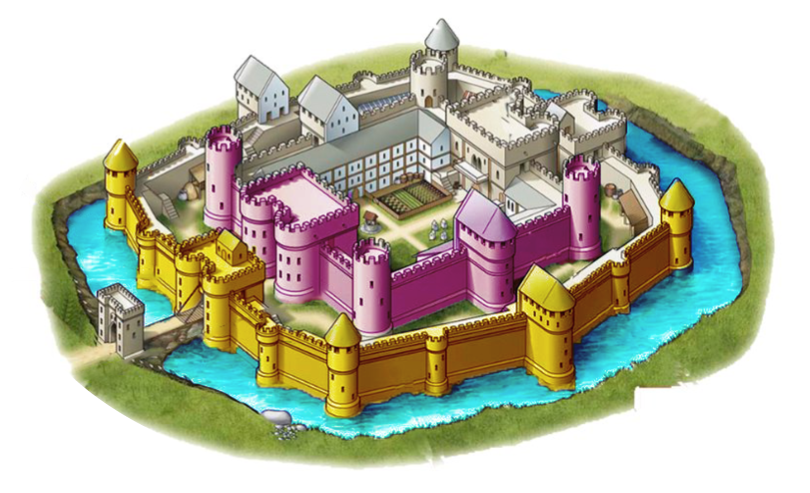
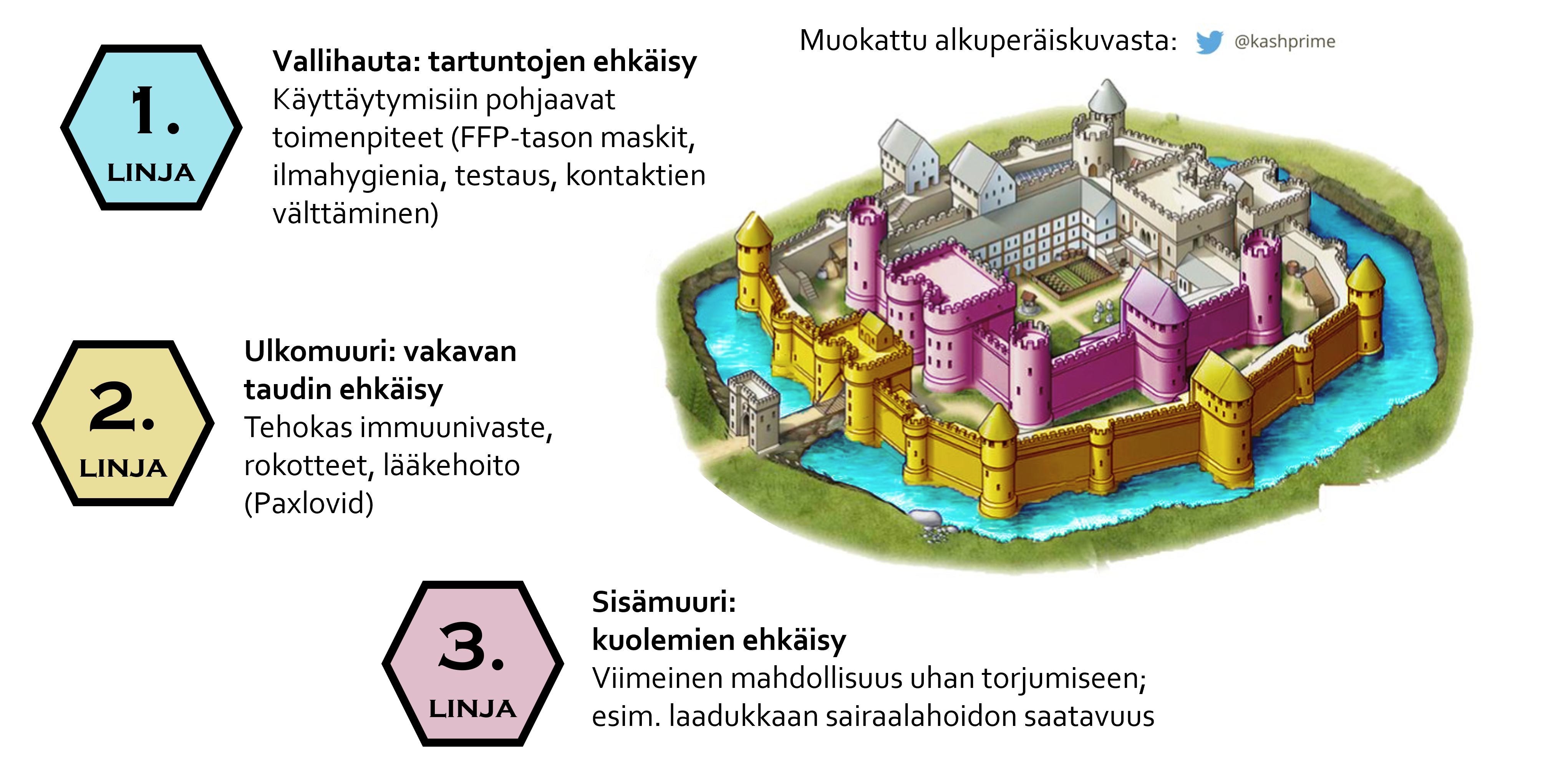
Kuva alla näyttää vielä kertaalleen, mistä tartuntojen torjunnassa on kyse. Julkisessa keskustelussa peräänkuulutettu sairaalapaikkojen ja krematorioiden lisääminen on varmasti tärkeää, vertautuen linnan sisimpiin suojarakenteisiin. Meidän pitäisi kuitenkin työskennellä sen eteen, että niitä tarvittaisiin entistä vähemmän. 

Kuva 4: Suojatoimet käsitteellistettyinä linnan osiksi. Kirjoitushetkellä (syksy 2023) Suomessa laskusilta on vielä ala-asennossa. Muokattu Kashif Pirzadan alkuperäisversiosta.

Kaikkiin variantteihin purevia pan-koronarokotteita on jo olemassa ja nyt selvitetään, jos joku kustantaisi kalliit kokeet turvallisuuden varmistamiseksi. Niitäkin odotellessa – kun kerran vaihtoehtojakin on – olisi viisasta olla tekemättä peruuttamatonta tuhoa terveydelle ja taloudelle. Myös siinä tapauksessa, että pääkärsijät olisivatkin niitä bussin alle heitettyjä “riskiryhmäläisiä”.

“Hallituksen moraalinen testi on siinä, kuinka se kohtelee elämänsä alkutaipaleella olevia; lapsia. Niitä jotka ovat taipaleensa lopussa; vanhuksia. Niitä jotka ovat elämän varjoissa; sairaita, puutteenalaisia ja vammaisia”

– Hubert H. Humphrey, 1977

Lisälukemistoa:

Pandemian päättäminen testaamisen voimin: Philippe, et al. (2023). Mass testing to end the COVID-19 public health threat. The Lancet Regional Health – Europe. https://doi.org/10.1016/j.lanepe.2022.100574

Kansainvälinen asiantuntijakonsensus: Lazarus, et al. (2022). A multinational Delphi consensus to end the COVID-19 public health threat. Nature. https://doi.org/10.1038/s41586-022-05398-2

Yleistajuinen koonti tärkeimmistä koronan vaikutuksista: https://thetyee.ca/Analysis/2022/09/23/Top-Immunologist-Dropping-COVID-Hubris/

Yleistajuinen minivideosarja pitkästä koronasta vaikutuksineen: https://www.youtube.com/watch?v=M4tGFiLXsIk&list=PLzyLGd4jQxQ-zNjmOUR43ha53AjXHU3HH

Aiempaa tieteellistä kirjallisuutta tartuntoja minimoivista strategioista:

At-tractor what-tractor? Tipping points in behaviour change science, with applications to risk management

Back in 2020, our research group was delivering the last of five symposia included in a project called Behaviour Change Science and Policy (BeSP). I was particularly excited about this one because the topic was complexity, and the symposia series brought together researchers and policy makers interested in improving the society – without making things worse by assuming an overly narrow view of the world.

I had a particular interest in two speakers. Ken Resnicow had done inspiring conceptual work on the topic already back in 2006, and had been an influence on both me and my PhD supervisor (and BeSP project lead) Nelli Hankonen, in her early career. Sadly, the world hadn’t yet been ready for an extensive uptake of the ideas, and much of the methodological tools were inaccessible (or unsuitable) to social scientists. The other person of particular interest, Daniele Proverbio, on the other hand, was a doctoral researcher with training in physics and systems biology; I had met him by chance at the International Conference on Complex Systems, which I probably wouldn’t have attended, had it not been held online due to COVID. He was working on robust foundations and real-world applications of systems with so-called tipping points.

I started writing a paper with Ken, Daniele, Nelli and Gwen Marchand, who was also speaking at the symposium, as she had been working extensively on complexity in education. The paper started out as an introduction to complexity for behaviour change researchers, but as I took up a position in the newly founded behavioural science advisory group at the Finnish Prime Minister’s Office late 2020, the whole thing went to a back burner. It wasn’t just that, though. Being a scholar of motivation, I knew that being bored of your own words is a major warning sign, and things you prefer not to eat, you shouldn’t feed to others. So I didn’t touch the draft for over a year.

Meanwhile, I finished a manuscript which started out as a collection of notes from arguments about study design and analysis within our research group, when we were doing a workplace motivation self-management / self-organisation intervention. The manuscript demonstrated, how non-linearity, non-ergodicity and interdependence can be fatal for traditional methods of analysis. It was promptly rejected from Health Psychology Review, the flagship journal of the European Health Psychology Society – on the grounds that linear methods can solve all the issues, which was exactly the opposite of manuscript’s argument. That piece was later published in Behavioural Sciences, outlining the foundations of complex systems approaches in behaviour change science.

As the complexity fundamentals paper had now been written, I wasn’t too keen on continuing on our BeSP piece, before I was hit by a strange moment where everything I had dabbled with (and discussed with Daniele) for the previous year sort of came together. I re-wrote the entire paper in a very short time, partly around analysis I had started due to natural curiosity with no particular goal in mind.

This is non-linearity in action: instead of “productively” writing a little every day, you write nothing for a very long time, and then everything at once. And this is not a pathology – except in the minds of people who think everything in life should follow a pre-planned process of gradual fulfillment. I’ve spent decades trying to unlearn this, so I should know.

The paper turned out very non-boring to me, and I was particularly happy the aforementioned flagship journal (the one which rejected the earlier piece) accepted it with no requests for edits – despite being based on the same underlying ideas as the earlier one.

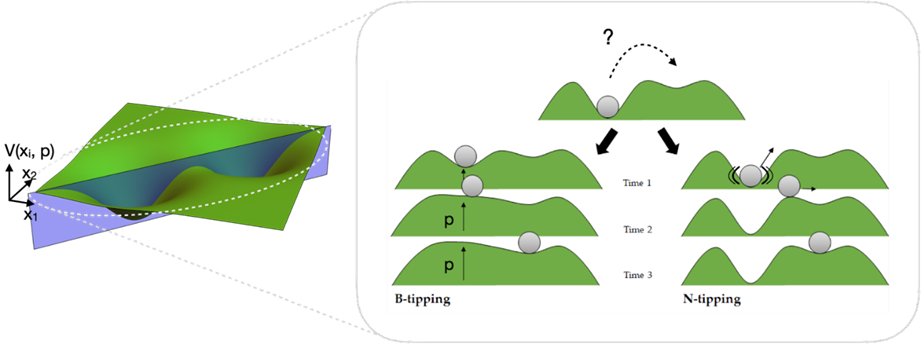
Graphical abstract of the attractor landscapes paper; courtesy of Daniele Proverbio. Describes two types of tipping points in systems with attractors.
Graphical abstract of the attractor landscapes paper; courtesy of Daniele Proverbio.

Implications to risk management

The theory underlying attractor landscapes and tipping points, points to two important issues in risk management. Firstly, large changes need not be the result of large events, but small pushes can suffice, when the system resides in a shallow attractor or on the top of a “hill” in the landscape. Secondly, the fact that earlier events have not caused large-scale behaviour change, does not imply that they continue not do so in the future. This is a mistake constantly made by Finnish doctors and epidemiologists throughout the pandemic, e.g. about people’s unwillingness to take up masks – we could stop COVID, for example, but don’t do so because people have been told this attractor is inescapable.

In a recent training for public servants, we experimented with conveying these ideas to non-scientists – lots of work to be done, but some did find it an enlightening escape from conventional linear thinking.

To sum up, some personal takeaways (your mileage may vary):

  1. The quality of motivation you experience when working on something boring is information: there might be a better idea, one actually worth your time, which gets trampled as you muddle through something less attractive. Same applies to health behaviours.
  2. Remain able to seize opportunities when they arise: steer clear of projects with deadlines, and milestones in particular. They coerce you to finish what you started, instead of dropping it for a time and starting anew much later.

The astute reader may have noticed, that I did not explain the damned attractors in this post at all. You’ll find all you need here:

When Finland Decided to Open Up: A Behavioural Scientist’s Perspective

I’ve been writing this post between 4.-21. February 2022, when questionable information is rampant in Finnish public discussions: Omicron is thought to be comparable to the flu, a trend of ever-milder variants is considered an inevitable biological law, the pandemic is (again) claimed to be over, and the sentiment is that there’s nothing much we can or need do about it anyway. This post is a historical reference so we don’t forget what happened to a relatively successful Finnish pandemic management scheme between June 2021 and February 2022. I also present two future scenarios to consider, when the hopium in current media discourse turns out to be hot air again. My hope is, that individuals and communities will shift their perspective and start buffering the nation against bad outcomes, not the best-case scenarios – which do not require preparation anyway. The post does not reflect views of the behavioural science advisory group (KETTU) operating in the Finnish Prime Minister’s Office, nor those of the Citizen Shield pandemic prevention project.

[UPDATE 2023-30-10: Post reviewed at this date, and judged to have continued relevance. Added some references to the end, and updated the speculation of pan-variant vaccine refusers from 5% to 5-50%.]

Hi. We’re Finland. You may remember us from hit songs such as Don’t Stand So Close to Me, Unless We’re in the Sauna and Nokia’s Gonna Last Forever. In more recent times, we’ve been cited as one of the best countries in pandemic management: in fact, by fall 2021 had only had approximately one thousand recorded COVID-deaths. Reasons for the relative success include remote geographical location, low population density, and cultural features, including the general avoidance of close physical proximity between individuals – and perhaps less so public health prowess (in fact, we only narrowly avoided going Full Tegnell on the pandemic). Let me just quickly recount what happened to the success story in the latter half of 2021, because it’s kinda funny.

It’s June 2021, right before government officials start their holidays. I’m telling people we should make preparations for the Delta variant. The suggestion is shrugged off with humour, and in all fairness, it did look like we were going to near-zero cases again for the summer… Before a bunch of football fans returning from Russia kicked off the Delta wave. After the usual debate on whether new variants will find Finns attractive, cases started going up, and we were soon in the slow initial growth of the exponential curve. So, there I was in August 2021 when the holidays ended: anxiously awaiting for someone to state, that in order for us to keep the freedoms we had during the summer, we’re going to need to smash the curve (something akin to what various countries from Portugal to Japan later did). Instead, in early September, the government announced everyone has a great need to go back go normal, and that now is the time to do it: “It’s Time to Live!”

Our health officials agreed, because after all, Denmark had already decided, that September 2021 was the time to end precautions*. To quote our director of health security: “We are on the home stretch of the pandemic […] and due to the vaccination rate, don’t need to worry about the pandemic in Finland any more [although minor setbacks may occur]” (September 2021). Also in September, in a particularly funny episode, an epidemiologist from the Finnish equivalent of CDC, called a multidisciplinary group of local precaution-advocating scientists “a crackpots’ day care club”.

*footnote: some may forget, that this did not turn out very well for them or any other of the “we’re going to live with the virus now” countries – Denmark’s end of the pandemic was cancelled, until announced again in early 2022.

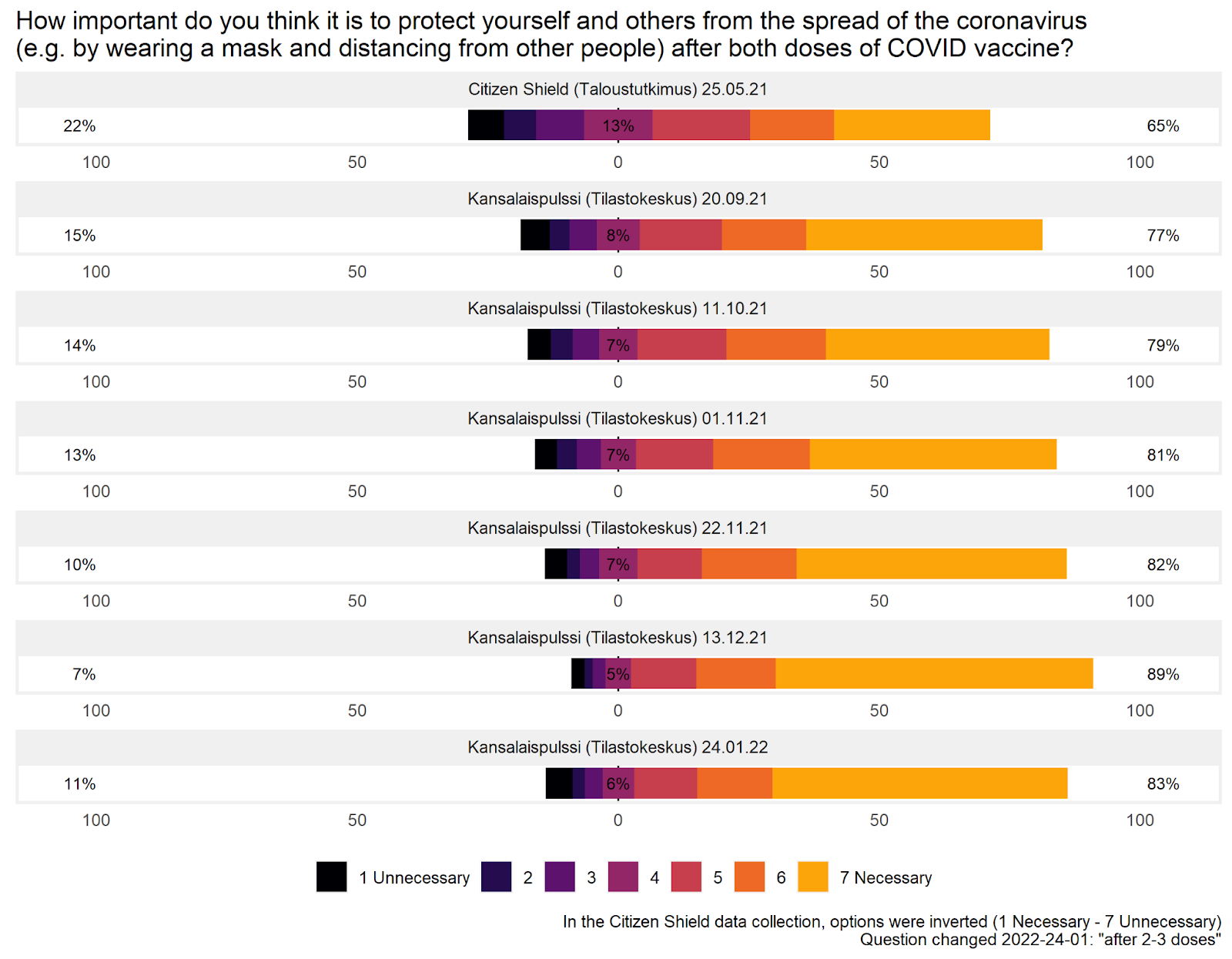
Here’s some survey data to describe the Finnish situation from a perspective of personal protective behaviours:

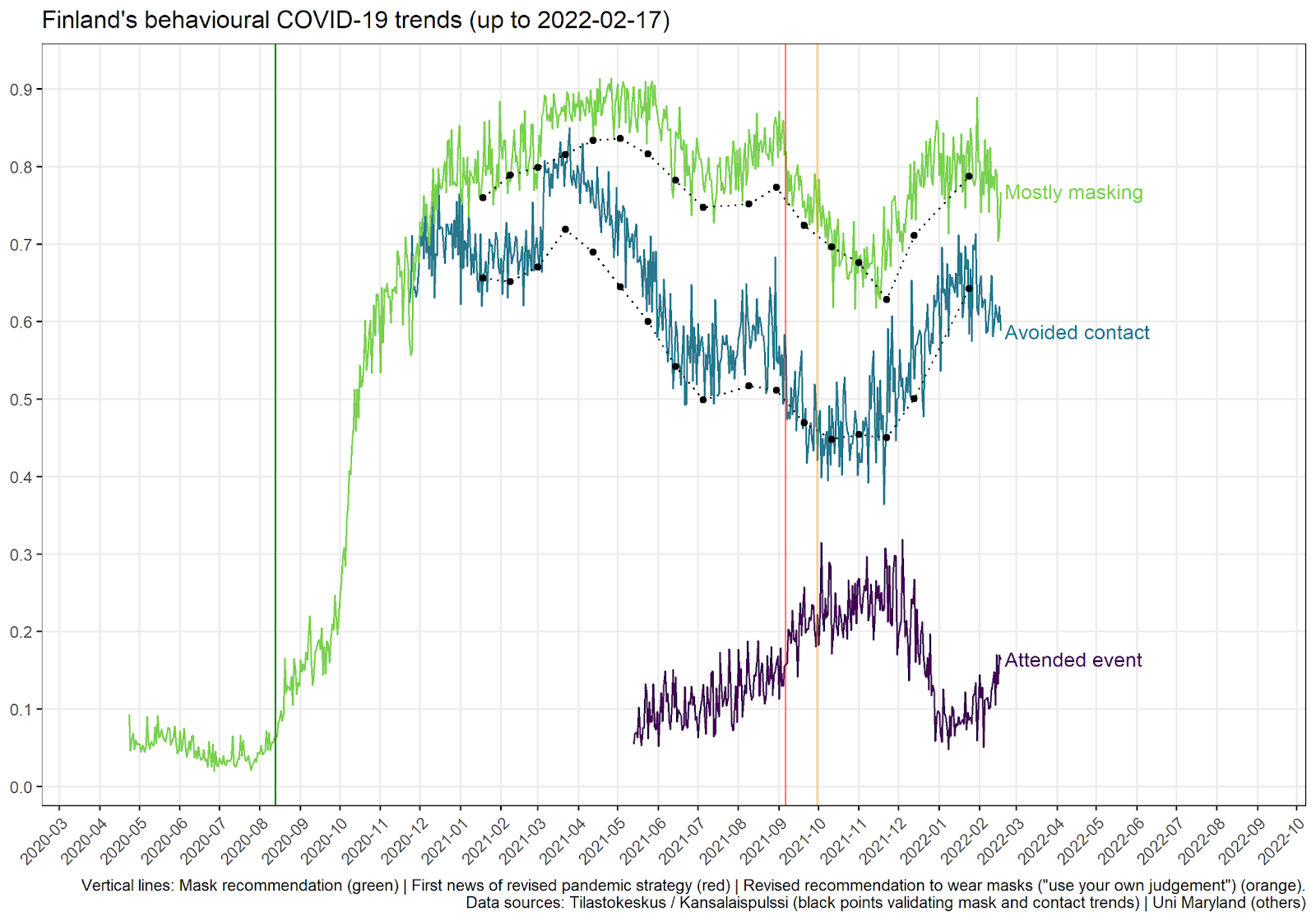
Figure 1: Despite the late adoption of masks, Finns rapidly increased their uptake in Fall 2020. Precautions decline during Fall 2021, under heavy mainstream media pressure to return to normal, and go up again as the situation worsens rapidly.

Major news media seemed convinced not only that the pandemic was over (again), but that they needed to perform psychological interventions to reduce the public’s risk perception – despite rising case numbers. Reporters were calling me on the phone: “You’re a social psychologist; how can we make people go back to normal?”. Chief editors of the largest newspapers made flashy statements such as “COVID is over when everyone stops being afraid”, and “[despite scientists who called for unnecessary suppression] Finland is nearing herd immunity, while Australia and New Zealand are in trouble” (aside: they weren’t, but we were).

The need to go back to normal was couched in statements about the people being tired of protective actions. This was curious, because all the while surveys indicated that people actually thought it was pretty important to continue exercising precaution, even after vaccinations:

Figure 2. Rising trend in stated need to continue precautions from mid-2021 to early 2022 – meanwhile, officials repeat the statement that people are very tired. Note: the behavioural science advisory group combined survey and interview data, concluding in a report in December, that people (mostly younger age groups) are mostly annoyed of restricting close contacts, while e.g. masks in public spaces remained highly acceptable.

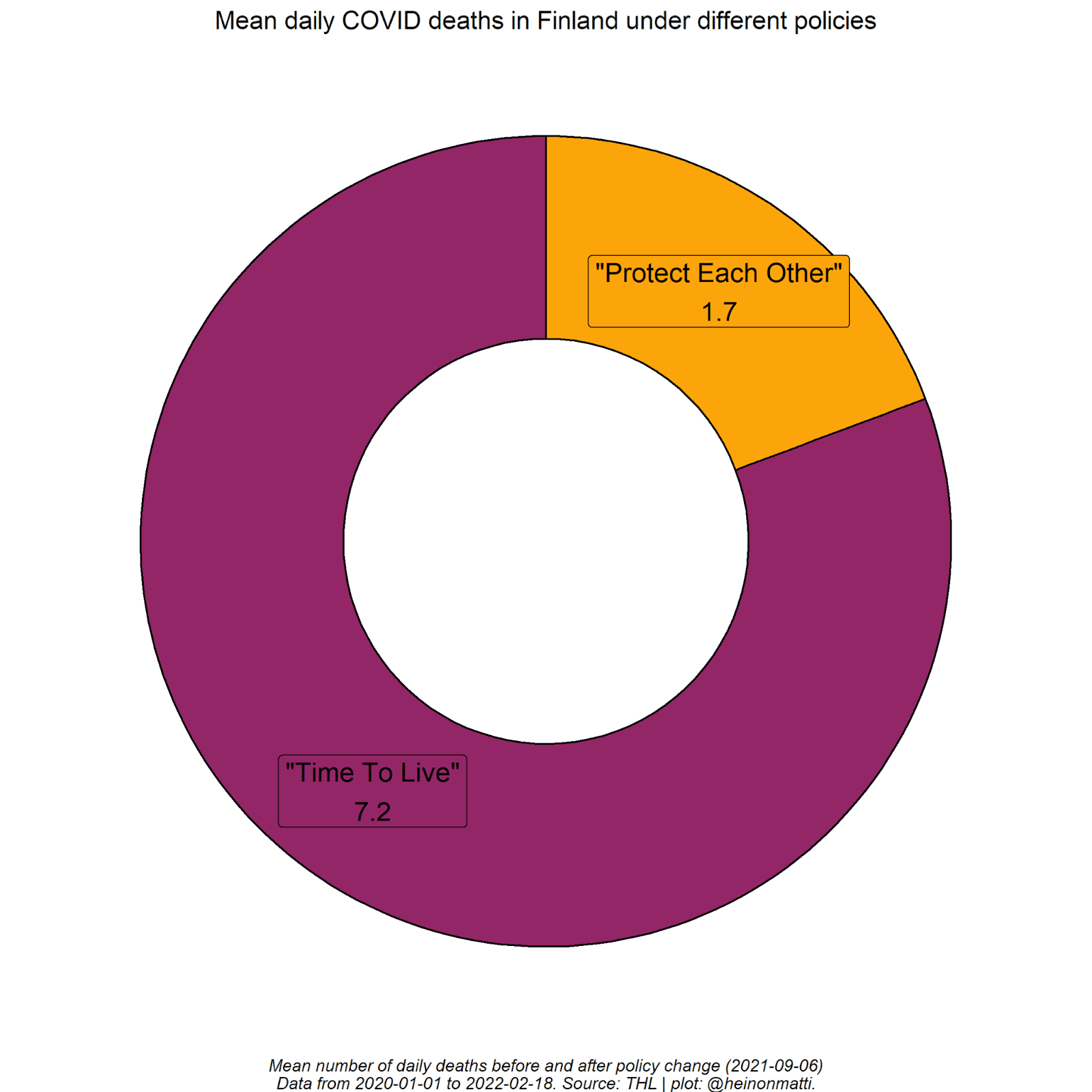
In the end of November 2021, Omicron caught us in the midst of an exponentially worsening delta epidemic, and by the time of writing (February 2022), we are waiting for BA2 close to the worst situation of the pandemic’s history. Here’s a summary of what happened when the pandemic management strategy was changed in September 2021, to cater the people’s supposed need to go back to 2019 ASAP:

Figure 3. After Finland switched its pandemic management approach (less testing, never mind total case numbers, aim to go back to normal), things went somewhat awry. [UPDATE 10/23: by this date, the numbers have not got better; on the contrary]

What are we doing currently, to remedy the situation? Surely not repeating any past mistakes? Memorable bits of recent news: Our aim should be to open up quickly, COVID will be just like the flu by summer 2022Vaccinations and a weakening virus are making the epidemic lose its edge. Central assumptions – I repeat, assumptions – include that everyone will get sick, the population becomes stronger with better immunity, and after some time (One year? Ten years? Hundreds / thousands of years?), we don’t need to mind the virus any longer. Seeing our new director of the Ministry of Social Affairs and Health cite the inevitability of getting ill, it just makes me wonder: What none of this is true, who has a Plan B? To a non-doctor, long term neurological and cardiovascular damage does not look like something to aim for, in order to gain short-lived immunity. Also, many public officials in Southern Finland have ignored the law which says you should not let dangerous infectious diseases run amok – does this mean they now have a mental investment in the nothing-could-nor-can-be-done narrative?

If you’re Finnish, you may be suprised that many countries around the world are way better vaccinated than us, and are doing quite a good job in pushing down Omicron with vaccines and protective public health measures. The situation reflects the WHO Director General’s statement calling for a “vaccines-plus” -strategy:

I need to be very clear: vaccines alone will not get any country out of this crisis. Countries can and must prevent the spread of Omicron with measures that work today. It’s not vaccines instead of masks, it’s not vaccines instead of distancing, it’s not vaccines instead of ventilation or hand hygiene. Do it all. Do it consistently. Do it well.

– Director General of the WHO, Tedros Adhanom Ghebreyesus, as quoted in Covid-19: An urgent call for global “vaccines-plus” action 

I end with two long-term scenarios, just to record what I considered the most important at the time of writing:

An optimistic scenario. There’s some critical threshold of disability caused by the pandemic, as well as global supply chain malfunctions from the ever-increasing pace of immunity evading variants. Upon crossing this threshold, health officials, the business sector and/or government representatives understand, that the only way out is to go for the exit – i.e. an elimination strategy, or other such coherent response. It can be done, but not if you insist traditional epidemiological models are the reality, instead of just ways to simplify some part of it. Note that it is clearly disinformation to state, that talking about elimination means advocating for an eternal lockdown; see e.g. how it can be achieved with mass testing. Depending on your belief structure, the elimination strategy may seem far-fetched right now, but nonlinear impacts of not doing it can accumulate fast, if and when the pandemic continues its course instead of going away. [See here for a Finnish post on driving down infections.]

A pessimistic scenario. Finnish Health officials await for a scientific consensus, which keeps proceeding at the pace of Planck’s principle (i.e. every step forward requires the funeral of an influential person keen on retaining the status quo). People “Swedify” and grow complacent, quick to normalise every new turn to the worse. We go back to accepting mortality rates of the pre-antibiotic era, until a new type of vaccine is created, which handles all potential variants. The vaccine is refused by some 5-50% of the population, from which forms the basis of a polarised societal system. In this system, some official services which refuse the unvaccinated, are replaced by underground / black market equivalents catering to their needs. The default option for countering the next pandemic becomes wait for the vaccine because we learned that anything else is ridiculous and a conspiracy theory. Then, while twiddling our thumbs, the next pandemic kills a billion people, which due to global interconnectedness, permanently changes the lives of several generations.

Tell me I’m wrong.

[with thanks to Kaisa Saurio for helpful comments]

Koronataistelu muuttuu sissisodaksi

Most people in Finland want to protect others from COVID, wheras decision makers and the media are planning celebrations of the end of the pandemic. Meanwhile, the healthcare system is getting overwhelmed fast. The only solution may be self-organisation.

Maaliskuun lopulla ennustin, että tulemme avaamaan yhteiskunnan liian aikaisin. Ennen kesälomia yritin varoitella toistamasta deltamuunnoksen kohdalla samaa virhettä, joka edellisten varianttien tapauksessa oltiin tehty. Kesällä kausivaihtelutoiveet saivat kyytiä, ja delta murtautui Salpalinjan läpi – yhteisen kamppailun sijaan kuitenkin päätettiin, että kansalaisille (lue: aikuisille) rokoteaseistusta tarjoamalla vihollisen metkuista ei tarvitsisi välittää.

En ole ennen kokenut samanlaista ristiriitaa kansainvälisiin kokemuksiin perustuvien suositusten ja suomalaisen median välillä. Olin ällistynyt:

“Me haluamme avata yhteiskunnan, me tulemme sen tekemään […] Me luovumme näistä kaikista rajoituksista, mitä meillä on. Se on hallituksen tahto.” (linkki)

“Korona loppuu siinä vaiheessa, kun kukin meistä itse päättää lakata pelkäämästä” (linkki)

Alla olevasta kuvasta näkyy, että yli 75% kansalaisista pitää suojautumistoimia edelleen tarpeellisena:

Olen yrittänyt kertoa ihmisten jatkuvaa suojautumista ihmetteleville toimittajille, etteivät ihmiset ole suosituksia sokeasti noudattavia robotteja, vaan sopeuttavat toimintaansa tilannekohtaisesti ja ajan myötä muuttuvaan riskiarvioon pohjaten. Tämä on ollut monille vaikea ymmärtää, ja koko pandemian ajan hallitukset ja “asiantuntijat” ovat pelänneet laajamittaista paniikkia, jos ihmisille annetaan liian huolestuttavaa informaatiota. Aiheesta on olemassa erinomainen blogipostaus ja olen itsekin kirjoittanut itseohjautuvuuden tärkeydestä, joten sanottakoon vain, että tämä on tieteellisen kirjallisuuden näkökulmasta päätöntä. Keinotekoisen turvallisuudentunteen pakkosyöttäminen kansalaisille johtaa ongelmiin.

Tähän väliin on hyvä muistuttaa mieliin, että taistelu virusta vastaan on taistelua esim. monielinvaurioita, aivovammoja ja pitkäaikaisia työ-/koulupoissaoloja vastaan, kuolemista puhumattakaan. Viruksen kanssa eläminen tarkoittaa näiden lisääntymisen kanssa elämistä.

Takaisin sodankäyntiin. Perinteisessä sodankäynnissä voidaan karkeasti erotella kaksi keinovalikoimaa:

a) Ne joilla saadaan aikaan nopeasti laaja-alainen vaikutus (panssarivaunupataljoonat aavikolla, mattopommitukset kaupungissa, laivasto avomerellä). Nämä keinot mahdollistaa korkean tason koordinaatio, ja koronatilanteessa niitä voi verrata massarokotuksiin, liikkumisrajoituksiin, rajojen terveysturvallisuuden varmistamiseen karanteenein, sekä testaa-jäljitä-eristä -infrastruktuuriin. Vuonna 2020 Suomessa näitä ajettiin puolivillaisesti, yllättyen yhä uudelleen asioista, jotka eivät vaikuttaneet kovin yllättäviltä.

b) Toinen kategoria sisältää keinoja, joilla saavutetaan pieniä paikallisia voittoja, mahdollisesti vuosien tai vuosikymmenten kuluessa kerääntyen (autonomisesti toimivat sissiryhmät tai muut paikallisväestöön integroituneet erikoisjoukot). Näissä keinoissa “johtoportaalla”, mikäli sellaista on, ei edes välttämättä ole ajantasaista tietoa siitä, mitä joukot tekevät ja missä. Koronatilanteessa niitä voi verrata omatoimiseen pikatestaukseen ennen tapaamisia, ilmanpuhdistinten hankkimiseen työpaikoille ja kouluihin, (FFP2-)maskien käyttöön tilannekohtaisesti, ja kuplautumiseen, ts. vain tietyn porukan kanssa tapaamiseen sekä flunssaoireista tälle porukalle tiedottamiseen. Vuoden 2021 syksyyn asti tämä kategoria pääosin puuttui Suomen koronavasteesta.

Mutta emmekö voisi vain suojella riskiryhmiä? Toki, mutta vaikkei tämä tarkoittaisikaan miljoonan ihmisen eristämistä, on mahdotonta tietää, tuleeko tapaamasi henkilö tapaamaan jonkun, joka ei ole voinut ottaa rokotetta – tai on ottanut 1-2 annosta, mutta teho on ehtinyt hiipua. Onneksi tämä toimii myös toisin päin: suojautumalla voi suojata paljon suurempaa porukkaa, kuin tulee ajatelleeksi. Kysymykseksi muodostuukin: “Ketään ei jätetä” vai “ketäs jätettäisiin jotta ei tarvitsisi tehdä vaivalloisia asioita?”

Kysymykseksi muodostuukin: “Ketään ei jätetä” vai “ketäs jätettäisiin jotta ei tarvitsisi tehdä vaivalloisia asioita”?

Suomessa on pitkälti tukahdutettu keskustelu eliminaatiostrategiasta, vaikka se onkin ainoa tunnettu pitkän tähtäimen ratkaisu pandemioihin, jotka aiheuttavat yleisvaarallista tartuntatautia. Poliitikkojen ja virkamiesten on kuitenkin vaikea sitoutua mihinkään, mikä saattaisi nostaa heidät tikunnokkaan. Viranhaltijalle on turvallista tehdä niin, kuin kaikki muutkin tekevät; parasta politiikkaa on vastuuttaa kansalaisia sen sijaan, että virkakoneisto lähtisi suorittamaan jotain vaivalloista, mikä voi epäonnistua. Nyt, kun tälle linjalle on lähdetty uuden maskisuosituksen myötä, realisti valmistautuu pitkään sissisotaan, jossa yllämainitun a-osaston keinoihin ei voi luottaa – vaikka toivo toki elää.

Ehkä hallitus voisikin antaa maskisuosituksen tapaisen, virallisen “oman harkinnan mukaan” toteutettavan ilmahygieniasuosituksen, pikatestaussuosituksen ja kuplautumissuosituksen. Virkamiesten haasteet toteuttaa tehtäviään tuovat suomalaisille erinomaisen tilaisuuden oppia paikallisesti itseorganisoituvaa turvallisuustoimintaa. Mutta kokonaisstrategian epäonnistumista ei voi vierittää rokottamattomille, niin kätevää kuin se olisikin kaiken epidemian vähättelyn jälkeen.

Toimimalla nyt omatoimisesti ennakoiden – pikatestit, FFP2-maskit (myös uudelleenkäytettynä), tuuletus, ilmanpuhdistus, kontaktien rajoittaminen – voimme vielä estää mustan joulun.

Pandemia, irtikytkeytymiskyvykkyys ja mitä sitten?

This post lays out, in a nutshell, why I care about pandemics and how I think we should reasonably treat them.

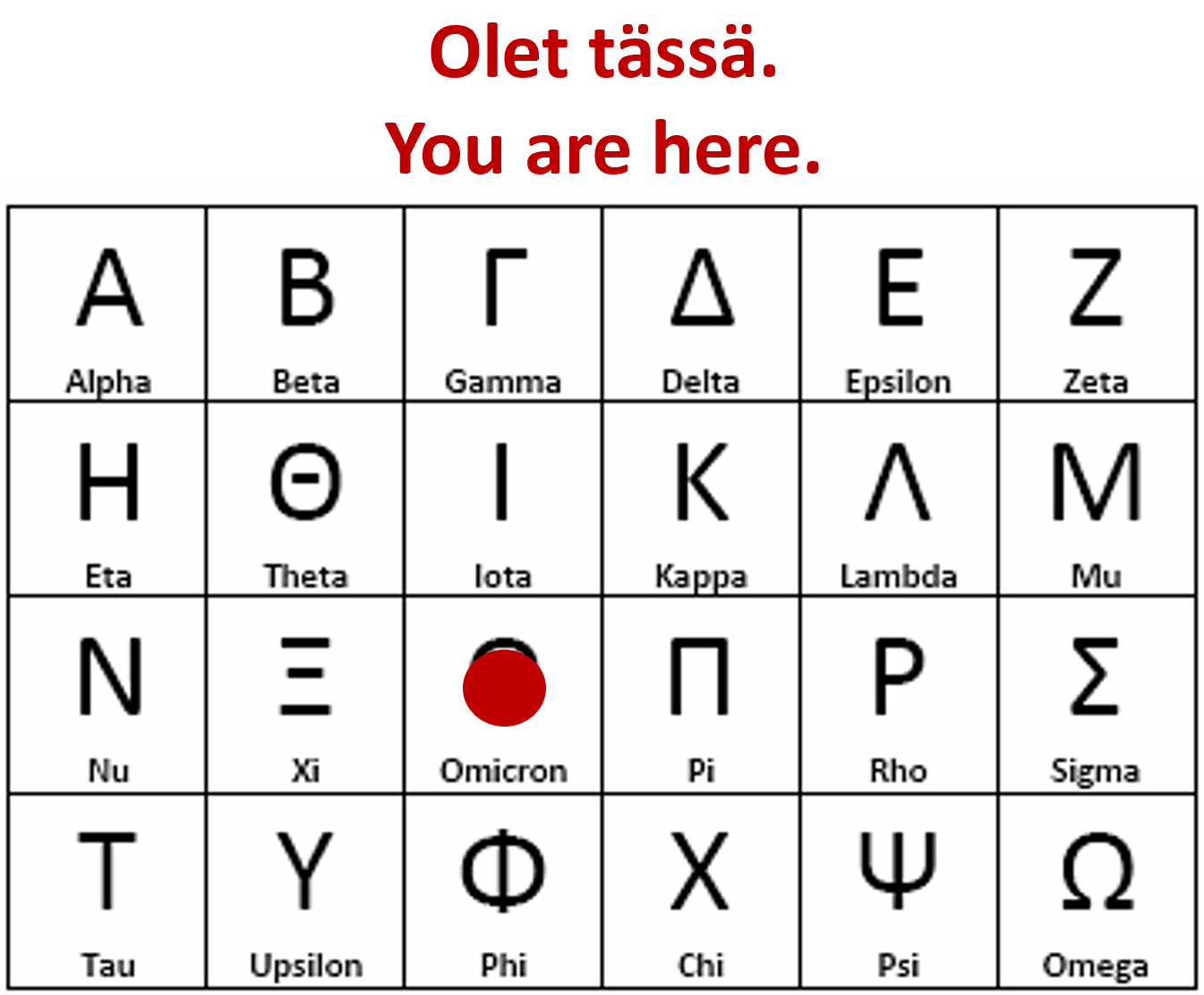
Päivitys 23.12.2021: Alkuperäinen kirjoitus oli kesäkuussa 2021. Kirjoitus tarkastettu tällä päivämäärällä, ja todettu entistäkin ajankohtaisemmaksi (päivitetty ainoastaan Olet tässä -kuva).

Kysymys: Miksi pandemioista pitäisi välittää?

Vastaus: Tiedämme, että historiallisesti pandemioiden kuolonuhrit noudattavat äärimmäisen paksuhäntäistä todennäköisyysjakaumaa (esim. GPD-jakaumasta* todennäköisyys yli miljardin kuolonuhrin pandemialle ~1%).

(*parametrit: xi = 1.62, mu = 0, beta = 1.1747 * 10^6; ks. tämä)

Tiedämme myös, että riskiarvio on alakanttiin, koska globaali verkostoituneisuus on viimeisen 100 vuoden aikana lisääntynyt räjähdysmäisesti. Tämä lisää erilaisten dominoefektien todennäköisyyttä, jolloin seuraukset voivat olla tuhoisat (ks. esim. tämä tai tämä). Koronapandemia oli tätä taustaa vasten erinomainen valmiusharjoitus, sillä se ei pyyhkinyt suurta osaa ihmiskuntaa planeetalta – mikä on pitkällä tähtäimellä paitsi mahdollista, myös todennäköistä, mikäli kaikkialta pääsee kaikkialle kaiken aikaa (ks. tämä).

Kysymys: Mitä tarkoitat, kun sanot “vanha normaali”?

Vastaus: Tarkoitan 1900-luvun loppupuolella kehittynyttä mielialaa, jossa ajateltiin, että 1) pandemioista ei tarvitse välittää ja 2) naiivi skientismi on (epävarmuustekijöiden myöntämisen ja kontrolloinnin sijaan) ratkaisu käytännössä kaikkiin ihmiskuntaa kohtaaviin ongelmiin.

Kysymys: Mitä tarkoitat, kun sanot “uusi normaali”?

Vastaus: Tarkoitan tilannetta, jossa yhteiskunnan jatkuvuus varmistetaan, jotta voidaan nauttia saavutetuista eduista kuten vapaudesta, terveydestä ja hyvästä elämästä.

Kysymys: Miltä tämä sitten näyttäisi?

Vastaus: Jokapäiväinen elämä näyttäisi samalta kuin vuonna 2019, lukuunottamatta sitä, että aggressiivisten tartuntatautien esiintymisalueille matkustavien tulisi palatessaan käydä luotettavassa testissä tai viettää aikaa esim. karanteenihotellissa. Meillä olisi lisäksi arsenaalissamme irtikytkeytymiskyvykkyyttä: uusien, vakavien patogeenien ilmaantuessa jossain päin maailmaa, voisimme pystyttää palomuureja globaalin virusverkoston oville. Tämä pitäisi voida tehdä mahdollisimman vähän ihmisten elämää ja yhteiskunnan toimintoja häiriten – tavoitteena olisi, ettei se näkyisi millään tapaa jokapäiväisessä elämässä (rajojen yli säännöllisesti esim. työnsä vuoksi liikkuvat voisivat jatkaa liikkumista haettuaan siihen luvan).

Irtikytkeytyminen olisi aina väliaikaista ja sitä lyhyempää, mitä nopeammin uhkaavan patogeenin riskiarviointi saataisiin tehtyä. Sen hyväksyttävyyttä tulisi arvioida kuuntelemalla kaikkia kansan sosioekonomisia luokkia: ei ole lainkaan itsestäänselvää, että varakkaiden tulisi voida matkustaa (aina, kaikkialle, ja kaiken aikaa), mikäli se tarkoittaa haavoittuvampien ryhmien elämän merkittävää häiriintymistä (esim. kirjastojen ja muiden julkisten palveluiden sulku, tulonmenetykset ja vaikeasti toteutettavat etätyövaatimukset, jne.)

Käytännössä tämä tarkoittaisi hälytysjärjestelmää, jonka lauetessa testausta ja karanteeneja otettaisiin käyttöön mieluummin liian nopeasti kuin liian hitaasti, sillä mikäli järjestelmä pettää ja uusi patogeeni pääseekin maahan, kansalaisten elämä häiriintyy mahdollisesti hyvinkin merkittävästi (ks. vuoden 2020 keväällä alkanut sulkujojoilu läntisellä pallonpuoliskolla). Toisin sanoin: liikkumis- ja muut rajoitukset maan sisällä ovat seurausta rajatoimien epäonnistumisesta.

Liikkumis- ja muut rajoitukset maan sisällä ovat seurausta rajatoimien epäonnistumisesta.

Atlantinpuolisessa Kanadassa, Australiassa ja Uudessa-Seelannissa on viimeisen reilun vuoden aikana kehitetty toimintamalleja tämän toteuttamiseksi, ja aiheesta opitaan koko ajan lisää. Suomesta koronavirus on käytännössä eliminoitu useita kertoja – muualla maassa tosin HUS:ia tehokkaammin – joten tähän on meillä moniin maihin nähden hyvät edellytykset. Rajoituksia täälläkin on kuitenkin jouduttu jatkamaan, koska niiden aiheuttama vaivannäkö on ehkä arvioitu pienemmäksi, kuin rajojen terveysturvallisuuden turvaamisen aiheuttama vaivannäkö.

Kysymys: Kuulostaa kamalan hankalalta ja meillähän on jo rokote?

Vastaus: Olen huolissani neljästä asiasta, mikäli eliminaatio-/segmentaatiostrategiaa ei oteta käyttöön, tai irtikytkeytymiskyvykkyyttä aleta pikimmiten rakentamaan:

  1. Uudet variantit. Kuinka kauan haluamme tanssia uusien boosteri- ja kausirokotusten kanssa toivoen, että sellainen voittaa kilpajuoksun uutta virusvarianttia vastaan?
  2. Pitkä COVID. Mitä riskeeraamme altistamalla rokottamattomat ihmisryhmät taudille?
  3. Kansalaisvaltioiden lisääntynyt riippuvuus lääkeyhtiöjättiläisistä. Onko se toivottavaa?
  4. Seuraava pandemia. Jos emme muuta mitään, kuinka paljon haluamme lyödä vetoa sen puolesta, että saamme ensi kerralla rokotteen ennen kuin korjaamaton vahinko on tapahtunut?

Kuten THL:n seminaarissa esitin, meidän tulisi tehdä kansana päätöksiä siitä, millaisia arvoja haluamme toteuttaa pandemiauhkien kanssa toimiessa. Kun tämä on yhdessä sovittu, pienemmille yksiköille (AVIt, maakunnat, kaupungit, kylät, naapurustot, perheet, yksilöt) täytyy antaa autonomiaa toteuttaa koonsa puolesta omaan vaikutuspiirinsä kuuluvia käytännön torjuntatoimien toteutuksia, omia vahvuuksiaan hyödyntäen. Mutta parasta olisi, jos proaktiivinen ja tehokas viranomaisvaste pääosiltaan poistaisi kansalaisten tarpeen käyttää omia resurssejaan tartuntataudin selättämiseksi.

Haluan korostaa, että tämä ei ole mikään “Rajatkii!”-sotahuuto. Esimerkiksi verkostotieteen pohjalta voidaan kylmän viileästi tehdä johtopäätös, että resilienttien järjestelmien osat eivät ole kaikki yhteydessä toisiinsa kaiken aikaa (ks. esim. tämä). Mika Salmisen sanoin: Eihän korona itsestään mistään ilmesty, vaan rajojen yli se tulee.

Kiinnostuneille tutkimusviitteitä alla.

Tässä vielä 3,5 minuuttia pähkinänkuorta siitä, mitä “laipiointi” eliminaatio- / segmentaatiostrategiassa tarkoittaa. Video on pätkä Arjen Resilienssi -webinaarista; sanon siinä tartuntojen olevan menossa kohti nollaa, koska tapahtuma oli ennen kesäkuun lopun deltaorgioita.

Lukemistoa:

  • Baker, M. G., Wilson, N., & Blakely, T. (2020). Elimination could be the optimal response strategy for covid-19 and other emerging pandemic diseases. BMJ, 371, m4907. https://doi.org/10/ghqk9h
  • Balsa-Barreiro, J., Vié, A., Morales, A. J., & Cebrián, M. (2020). Deglobalization in a hyper-connected world. Nature Palgrave Communications, 6(1), 1–4. https://doi.org/10/gjfxwz
  • Flyvbjerg, B. (2020). The law of regression to the tail: How to survive Covid-19, the climate crisis, and other disasters. Environmental Science & Policy, 114, 614–618. https://doi.org/10/gjkjwz
  • Hansson, S. O. (2004). Fallacies of risk. Journal of Risk Research, 7(3), 353–360. https://doi.org/10/c7567q
  • Horton, R. (2021). Offline: The case for No-COVID. Lancet397(10272), 359. https://doi.org/10.1016/S0140-6736(21)00186-0
  • Hyvönen, A.-E., Juntunen, T., Mikkola, H., Käpylä, J., Gustafsberg, H., Nyman, M., Rättilä, T., Virta, S., & Liljeroos, J. (2019). Kokonaisresilienssi ja turvallisuus: Tasot, prosessit ja arviointi [Raportti]. Valtioneuvoston kanslia. https://julkaisut.valtioneuvosto.fi/handle/10024/161358
  • Iwata, K., & Aoyagi, Y. (2021). Elimination of covid-19: A practical roadmap by segmentation. BMJ, n349. https://doi.org/10/gjqpxt
  • Käyttäytymistieteellisen neuvonantohankkeen työryhmä. (2021). Vaikuttavat valinnat päätöksenteon tukena: Käyttäytymistieteellinen neuvonanto -hankkeen loppuraportti [Sarjajulkaisu]. Valtioneuvoston kanslia. https://julkaisut.valtioneuvosto.fi/handle/10024/163138
  • Matti TJ Heino, Markus Kanerva, Maarit Lassander, & Ville Ojanen. (2021). Koronaväsymystä? Vai inhimillistä kyllästymistä, turhautumista, tottumista ja pyrkimystä normaaliin (Käyttäytymistieteellisen neuvonantoryhmän raportteja). https://vnk.fi/hanke?tunnus=VNK127:00/2020
  • Martela, F., Hankonen, N., Ryan, R. M., & Vansteenkiste, M. (2020). Motivating Voluntary Compliance to Behavioural Restrictions: Self-Determination Theory–Based Checklist of Principles for COVID-19 and Other Emergency Communications. European Review of Social Psychology. 10.1080/10463283.2020.1857082
  • Morales, A. J., Norman, J., & Bahrami, M. (Toim.). (2021). COVID-19: A Complex Systems Approach. STEM Academic Press. https://stemacademicpress.com/stem-volumes-covid-19
  • Priesemann, V., Balling, R., Brinkmann, M. M., Ciesek, S., Czypionka, T., Eckerle, I., Giordano, G., Hanson, C., Hel, Z., Hotulainen, P., Klimek, P., Nassehi, A., Peichl, A., Perc, M., Petelos, E., Prainsack, B., & Szczurek, E. (2021). An action plan for pan-European defence against new SARS-CoV-2 variants. The Lancet, S0140673621001501. https://doi.org/10/ghtzqn
  • Priesemann, V., Brinkmann, M. M., Ciesek, S., Cuschieri, S., Czypionka, T., Giordano, G., Gurdasani, D., Hanson, C., Hens, N., Iftekhar, E., Kelly-Irving, M., Klimek, P., Kretzschmar, M., Peichl, A., Perc, M., Sannino, F., Schernhammer, E., Schmidt, A., Staines, A., & Szczurek, E. (2021). Calling for pan-European commitment for rapid and sustained reduction in SARS-CoV-2 infections. The Lancet, 397(10269), 92–93. https://doi.org/10/ghp8kb
  • Rauch, E. M., & Bar-Yam, Y. (2006). Long-range interactions and evolutionary stability in a predator-prey system. Physical Review E73(2), 020903. https://doi.org/10/d9zbc4
  • Siegenfeld, A. F., & Bar-Yam, Y. (2020). The impact of travel and timing in eliminating COVID-19. Nature Communications Physics, 3(1), 1–8. https://doi.org/10/ghh8hg
  • World Health Organization Regional Office for Europe. (2020). Pandemic fatigue: Reinvigorating the public to prevent COVID-19: policy considerations for Member States in the WHO European Region (WHO/EURO:2020-1160-40906-55390). Article WHO/EURO:2020-1160-40906-55390. https://apps.who.int/iris/handle/10665/335820

Self-determined and self-organised: Fighting pandemics on the appropriate scales

The video is a Finnish talk I gave as part of a webinar series of the Institute for Health and Welfare (THL). I discuss the three scales of pandemic response: That of a) self-determined individuals, b) self-organised communities and c) governmental strategy choice in aiding these. Related, highly unpolished thoughts in English below. Slides here!

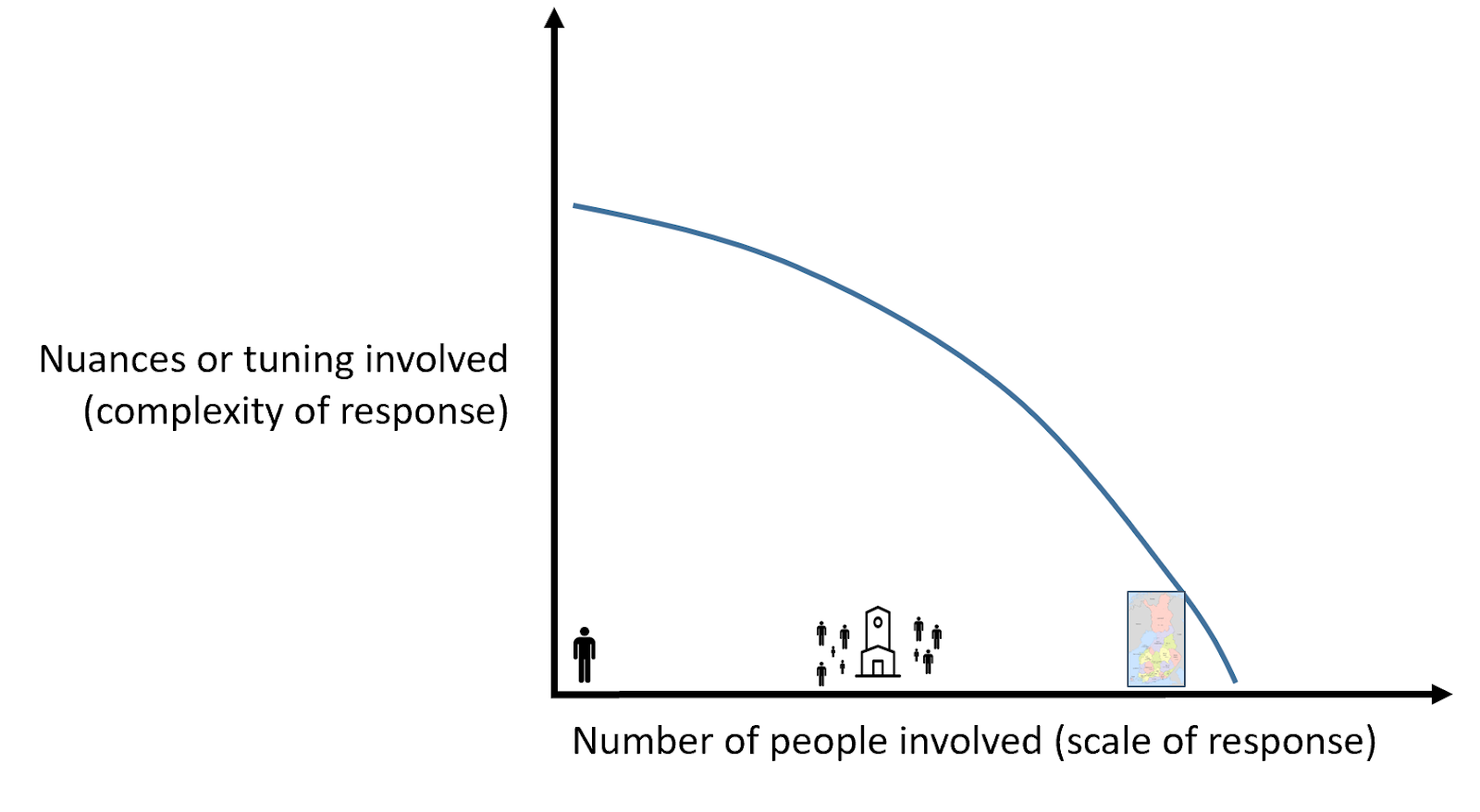
How should we think about changing people’s behaviour to mitigate pandemic threat? The starting point is to consider targets of interventions as complex systems. This means that biopsychosocial determinants such as capability, opportunity and motivation act together to create the current state of a system which is a person; aggregates of individuals define the state of a system which is a household, aggregates of which form a community, a society, and so forth. Each of these systems is of a different size, i.e. scale, and fulfills multiple roles in pandemic response – the redundancy brought about by overlap of functions performed by each element (say, individuals’ social distancing, and a community’s agreement to postpone cultural events to mitigate physical contact) is what largely ensures resilience of a system in crisis situations. In other words, information about intervention targets need to be framed as taking place within multi-level socio-ecological system, where tradeoffs between intervention nuance and scale exist. Figure below depicts this idea, and also underlines the mismatch when a large-scale unit, such as the government, attempts to dictate specifics of how e.g. schools or kindergartens should arrange their safety procedures, instead of acknowledging that “people are experts of their own environment”.

The above picture depicts a complexity profile, here a heuristic tool for considering intervention ownership. Any pandemic response must strike a balance between interventions that reach large audiences but (in spite of e.g. digital mass tailoring) are relatively homogenous, and interventions that reach small audiences but are highly tuned to their contexts. As long as the system performing the intervention remains the same, there is a fundamental tradeoff between complexity and scale, although changes in the system may allow increasing the area under the curve. Only individuals or small groups can perform ultra-local actions, and there are efforts where a larger governance structure is inevitable; those actions should be handled by agents at the appropriate scale. For example, a group of friends can come up with ideas to mingle safely, while e.g. city officials must make the decision to require quarantines and testing of incoming travellers. Horizontal axis depicts increasing audience size, from individuals to families, communities and countries. Blue line indicates the amount of nuance each entity can take into account, as depicted on the vertical axis.

Recently, we collected a sample of about 2000 people, who answered a survey on social psychological factors affecting personal protective behaviours such as mask use. As may be obvious, there are many open questions regarding implications of a cross-sectional analysis to the “real world”. Empirically evaluated social psychological phenomena are always embedded in time, making them to an extent idiographic and contextual, hence any generalisations to policy actions have to be considered in the light of nomothetic knowledge of complex systems. That is, the question of how we increase protective behaviours in the society is a multifaceted problem, requiring any actions to acknowledge the complexity of the system the behaviours take place in, and how they interact with other actions affecting community transmission. In my view, this is best done with the classical statement “First, do no harm” in mind.

A foremost condition for responsible application of science-based policy is a consideration of how the decision ought to be done, such that the costs of null effects are minimal. Finland has undertaken a suppression strategy common to European and Northern American countries, where increasingly stringent restrictions are gradually put in place while case numbers rise, and removed while cases decline. This sets different demands to individuals’ protective motivation and other personal resources (aka “pandemic fatigue”), compared to an elimination strategy, where relatively short but highly aggressive measures are taken to draw cases to zero. In the latter approach, most restrictions are lifted from case-free communities or countries, while applying border testing and quarantines to ensure the continued safety of the region’s inhabitants. In this latter case, provided that that future outbreaks are small and/or travel from regions with ongoing community transmission is low, local elimination ensues, and failures to increase protective behaviours imply – by necessity – a smaller impact than when attempted in a locale, safety of which depends mostly on personal protective behaviours.

Another consideration is that of systemic negative unintended side-effects of applying behavioural science recommendations to policy. Based on nomothetic knowledge of complex social systems and the results presented here, it is possible to give the following recommendations:

  1. Citizens’ sense of autonomy in choosing how to carry out the official pandemic mitigation recommendations should be fostered, without overlooking the necessity of feeling competence as well as camaraderie in the actions. This can be done with communication but perhaps more importantly, by facilitating people’s self-organisation tendencies and empowering them to design their own local responses, at the lowest scale (individual, family, neighbourhood, city/town, county, etc.) each of which is feasible to perform. This ensures local strengths get maximally applied, without severing functions, which are invisible to a governmental authority.
  2. Local norms (family, friends, other people in the indoor spaces one visits) ought to be stewarded to the direction which is necessary for pandemic control; this can again be done via communication, but based on literature on mitigating pandemics, it’s possible to hypothesise longer-lasting behavioural effects stemming from involving agentic individuals in the risk management of their surroundings.

Recommended reading:

  • Baker, M. G., Wilson, N., & Blakely, T. (2020). Elimination could be the optimal response strategy for covid-19 and other emerging pandemic diseases. BMJ, 371, m4907. https://doi.org/10/ghqk9h
  • Balsa-Barreiro, J., Vié, A., Morales, A. J., & Cebrián, M. (2020). Deglobalization in a hyper-connected world. Nature Palgrave Communications, 6(1), 1–4. https://doi.org/10/gjfxwz
  • Behaviour Change Science & Policy -projekti: http://linktr.ee/besp
  • Flyvbjerg, B. (2020). The law of regression to the tail: How to survive Covid-19, the climate crisis, and other disasters. Environmental Science & Policy, 114, 614–618. https://doi.org/10/gjkjwz
  • Hansson, S. O. (2004). Fallacies of risk. Journal of Risk Research, 7(3), 353–360. https://doi.org/10/c7567q
  • Horton, R. (2021). Offline: The case for No-COVID. Lancet, 397(10272), 359. https://doi.org/10.1016/S0140-6736(21)00186-0
  • Hyvönen, A.-E., Juntunen, T., Mikkola, H., Käpylä, J., Gustafsberg, H., Nyman, M., Rättilä, T., Virta, S., & Liljeroos, J. (2019). Kokonaisresilienssi ja turvallisuus: Tasot, prosessit ja arviointi [Raportti]. Valtioneuvoston kanslia. https://julkaisut.valtioneuvosto.fi/handle/10024/161358
  • Iwata, K., & Aoyagi, Y. (2021). Elimination of covid-19: A practical roadmap by segmentation. BMJ, n349. https://doi.org/10/gjqpxt
  • Käyttäytymistieteellisen neuvonantohankkeen työryhmä. (2021). Vaikuttavat valinnat päätöksenteon tukena: Käyttäytymistieteellinen neuvonanto -hankkeen loppuraportti [Sarjajulkaisu]. Valtioneuvoston kanslia. https://julkaisut.valtioneuvosto.fi/handle/10024/163138
  • Matti TJ Heino, Markus Kanerva, Maarit Lassander, & Ville Ojanen. (2021). Koronaväsymystä? Vai inhimillistä kyllästymistä, turhautumista, tottumista ja pyrkimystä normaaliin (Käyttäytymistieteellisen neuvonantoryhmän raportteja). https://vnk.fi/hanke?tunnus=VNK127:00/2020
  • Martela, F., Hankonen, N., Ryan, R. M., & Vansteenkiste, M. (2020). Motivating Voluntary Compliance to Behavioural Restrictions: Self-Determination Theory–Based Checklist of Principles for COVID-19 and Other Emergency Communications. European Review of Social Psychology. 10.1080/10463283.2020.1857082
  • Morales, A. J., Norman, J., & Bahrami, M. (Toim.). (2021). COVID-19: A Complex Systems Approach. STEM Academic Press. https://stemacademicpress.com/stem-volumes-covid-19
  • Priesemann, V., Balling, R., Brinkmann, M. M., Ciesek, S., Czypionka, T., Eckerle, I., Giordano, G., Hanson, C., Hel, Z., Hotulainen, P., Klimek, P., Nassehi, A., Peichl, A., Perc, M., Petelos, E., Prainsack, B., & Szczurek, E. (2021). An action plan for pan-European defence against new SARS-CoV-2 variants. The Lancet, S0140673621001501. https://doi.org/10/ghtzqn
  • Priesemann, V., Brinkmann, M. M., Ciesek, S., Cuschieri, S., Czypionka, T., Giordano, G., Gurdasani, D., Hanson, C., Hens, N., Iftekhar, E., Kelly-Irving, M., Klimek, P., Kretzschmar, M., Peichl, A., Perc, M., Sannino, F., Schernhammer, E., Schmidt, A., Staines, A., & Szczurek, E. (2021). Calling for pan-European commitment for rapid and sustained reduction in SARS-CoV-2 infections. The Lancet, 397(10269), 92–93. https://doi.org/10/ghp8kb
  • Rauch, E. M., & Bar-Yam, Y. (2006). Long-range interactions and evolutionary stability in a predator-prey system. Physical Review E, 73(2), 020903. https://doi.org/10/d9zbc4
  • Siegenfeld, A. F., & Bar-Yam, Y. (2020). The impact of travel and timing in eliminating COVID-19. Communications Physics, 3(1), 1–8. https://doi.org/10/ghh8hg
  • World Health Organization Regional Office for Europe. (2020). Pandemic fatigue: Reinvigorating the public to prevent COVID-19: policy considerations for Member States in the WHO European Region (WHO/EURO:2020-1160-40906-55390). Article WHO/EURO:2020-1160-40906-55390. https://apps.who.int/iris/handle/10665/335820

Pandemia haastaa ajattelumme: Neljä kompastuskiveä torjuntapolulla

This is a series of five videos (in Finnish), outlining what I currently consider the most important facets of Finnish pandemic preparedness. Also published at motivationselfmanagement.com

PÄIVITYS 27.03.2021: Ennustan, että tulemme poistamaan rajoitukset liian aikaisin, mikä johtaa alla esitetyn mukaisesti uusiin ongelmiin, yllätyksiin ja viivästyksiin epidemian poistamisessa Suomesta. Mikäli tälle ennustukselle haluaa laittaa kapuloita rattaisiin, voi käydä allekirjoittamassa uuden kansalaisaloitteen (en ole itse ollut mukana sen laatimisessa).


Videoissa alla selitän asiat, jotka näen tärkeimpinä ja tieteellistä tarkastelua parhaiten kestävinä näkökulmina suomalaiseen pandemiavasteeseen. Näkemykset eivät ole Behaviour Change & Well-being -tutkimusryhmän, Valtioneuvoston kanslian käyttäytymistieteellisen neuvonantoryhmän, tai Citizen Shield -pandemiavalmiushankkeen virallisia kantoja.

Osa 0: Johdatus käyttäytymiseen, järjestelmiin ja keskinäisriippuvaisuuteen.

Osa 1: Leveysrajoitteisista hännistä.

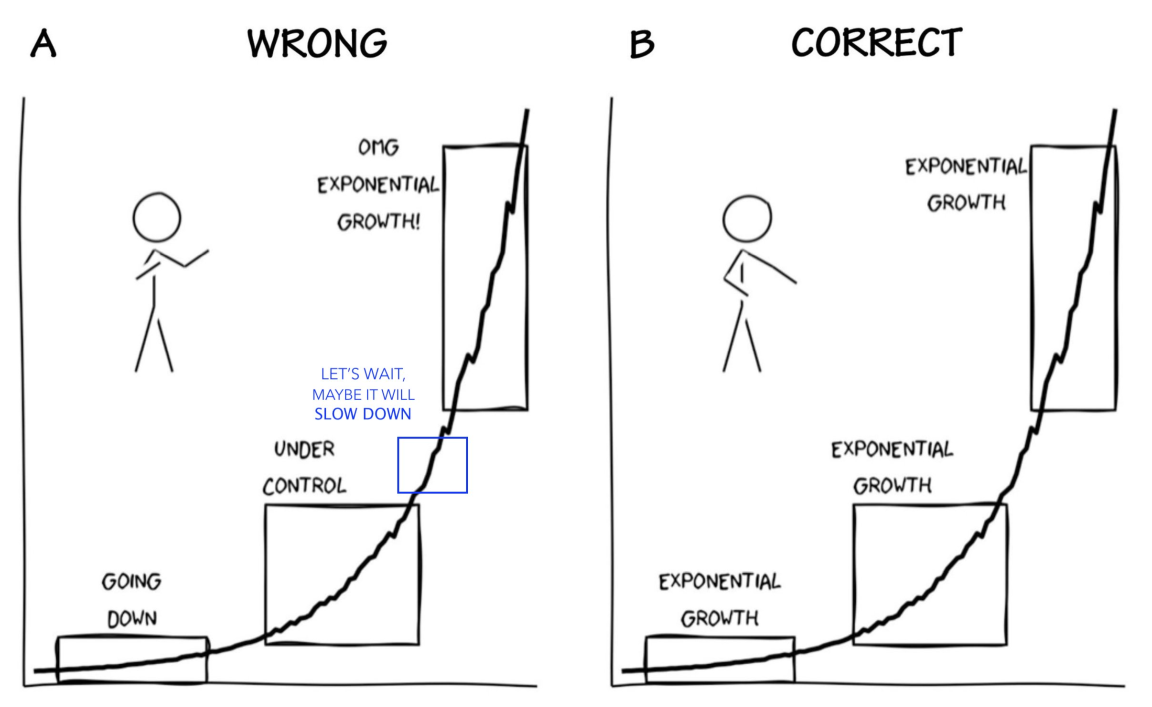
Osa 2: Noususta, tuhosta ja oikea-aikaisuudesta. [Erratum: Eksponentiaalisen kasvun/laskun selityksessä pitäisi tarkalleen ottaen olla ison R:n sijaan pieni r – kyseessä siis eksponentiaalisen yhtälön r-kasvuparametri, ei tartuttavuusluku R0]

Tässä vielä yksi pointti siitä, miten kasvu hahmotetaan (lähde):

Osa 3: Ikävien yllätysten minimoinnista.

Osa 4: Resilienssistä ja yhteenveto.

Videoissa mainittu tilannekuvaa ylläpitävä verkkosivu:

epidemia.fi

Relevantteja blogipostauksia:

Kanadan tilanteesta:

https://www.canada.ca/en/public-health/services/diseases/2019-novel-coronavirus-infection/latest-travel-health-advice.html

https://travel.gc.ca/travel-covid

Mainittuja/relevantteja julkaisuja:

0. Cirillo, P. & Taleb, N. N. Tail risk of contagious diseases. Nature Physics 16, 606–613 (2020).

1.Rauch, E. M. & Bar-Yam, Y. Long-range interactions and evolutionary stability in a predator-prey system. Phys. Rev. E 73, 020903 (2006).

2.Kollepara, P. K., Siegenfeld, A. F., Taleb, N. N. & Bar-Yam, Y. Unmasking the mask studies: why the effectiveness of surgical masks in preventing respiratory infections has been underestimated. arXiv:2102.04882 [q-bio] (2021).

3.Siegenfeld, A. F. & Bar-Yam, Y. The impact of travel and timing in eliminating COVID-19. Communications Physics 3, 1–8 (2020).

4.Taleb, N. N., Bar-Yam, Y. & Cirillo, P. On single point forecasts for fat-tailed variables. International Journal of Forecasting (2020) doi:10/ghgvdx.

5.Siegenfeld, A. F., Taleb, N. N. & Bar-Yam, Y. Opinion: What models can and cannot tell us about COVID-19. PNAS (2020) doi:10.1073/pnas.2011542117.

6.Wong, V., Cooney, D. & Bar-Yam, Y. Beyond Contact Tracing: Community-Based Early Detection for Ebola Response. PLoS Currents (2016) doi:10.1371/currents.outbreaks.322427f4c3cc2b9c1a5b3395e7d20894.

7.Shen, C., Taleb, N. N. & Bar-Yam, Y. Review of Ferguson et al ‘Impact of non-pharmaceutical interventions…’ (2020).

Kirjallisuutta eliminaatio-/segmentaatiostrategiasta:

1.Geoghegan, J. L., Moreland, N. J., Le Gros, G. & Ussher, J. E. New Zealand’s science-led response to the SARS-CoV-2 pandemic. Nat Immunol 22, 262–263 (2021).

2.The Lancet Infectious Diseases. The COVID-19 exit strategy—why we need to aim low. The Lancet Infectious Diseases S1473309921000803 (2021) doi:10/gh4kvk.

3.Morell, M., Estrada, K., Dominguez, E., Perez, A. & Montesino, D. The Efficacy of Long-Term Elimination Efforts: A Case Study on New Zealand’s SARS. 20.

4.Baker, M. G., Kvalsvig, A. & Verrall, A. J. New Zealand’s COVID‐19 elimination strategy. Medical Journal of Australia 213, 198 (2020).

5.Summers, D. J. et al. Potential lessons from the Taiwan and New Zealand health responses to the COVID-19 pandemic. The Lancet Regional Health – Western Pacific 4, 100044 (2020).

6.Heywood, A. E. & Macintyre, C. R. Elimination of COVID-19: what would it look like and is it possible? The Lancet Infectious Diseases 20, 1005–1007 (2020).

7.Wilson, N., Boyd, M., Kvalsvig, A., Chambers, T. & Baker, M. Public Health Aspects of the Covid-19 Response and Opportunities for the Post-Pandemic Era. pq 16, (2020).

8.Elimination of covid-19. A practical roadmap by segmentation. m4907 (2021).

9.Priesemann, V. et al. An action plan for pan-European defence against new SARS-CoV-2 variants. The Lancet S0140673621001501 (2021) doi:10/ghtzqn.

10.Sachs, J. D. et al. Lancet COVID-19 Commission Statement on the occasion of the 75th session of the UN General Assembly. The Lancet 396, 1102–1124 (2020).

11.Lee, A., Thornley, S., Morris, A. J. & Sundborn, G. Should countries aim for elimination in the covid-19 pandemic? BMJ 370, m3410 (2020).

12.Blakely, T. et al. The probability of the 6‐week lockdown in Victoria (commencing 9 July 2020) achieving elimination of community transmission of SARS‐CoV‐2. Medical Journal of Australia 213, 349 (2020).

13.Priesemann, V. et al. Calling for pan-European commitment for rapid and sustained reduction in SARS-CoV-2 infections. The Lancet 397, 92–93 (2021).

14.Baker, M. G., Wilson, N. & Blakely, T. Elimination could be the optimal response strategy for covid-19 and other emerging pandemic diseases. BMJ 371, m4907 (2020).

15.Blakely, T., Thompson, J., Bablani, L., Andersen, P., Ouakrim, D. A., Carvalho, N., Abraham, P., Boujaoude, M.-A., Katar, A., Akpan, E., Wilson, N., & Stevenson, M. (2021). Determining the optimal COVID-19 policy response using agent-based modelling linked to health and cost modelling: Case study for Victoria, Australia. MedRxiv, 2021.01.11.21249630. https://doi.org/10/gjh8x5

Suomen tie ulos kriisistä

Yaneer Bar-Yam is a complexity scientist, who has worked with and warned about pandemics for 15 years. His interview with Esa-Pekka Pälvimäki and Thomas Brand (in English) regarding the COVID-19 situation in Finland can be found here; these are some of my notes and video extracts.

Nämä ovat muistiinpanoni Esa-Pekka Pälvimäen ja Thomas Brandin toimittamasta kompleksisuustieteilijä ja pandemiatutkija Yaneer Bar-Yamin haastattelusta, jossa tämä kommentoi Suomen Koronavirustilannetta. Bar-Yam on yksi kompleksisuustieteiden isistä, ja äärimmäisen kunnioitettu tutkija. Ks. myös Suomenkielisiä työkaluja COVID-19 taisteluun.

Ensisijainen asia: On ymmärrettävä, että voimme päästä taudista eroon. Voimme lopettaa tämän taudin siinä, missä olemme lopettaneet muitakin tauteja: SARS, MERS ja Ebola eivät ole globaaleja riesoja. Tästä lisää myöhemmin.

“On maita, jotka ovat toimineet viisaasti ja päässeet taudista eroon; ne ovat [historian silmissä] voittajia. Suomi ei ole vielä siellä… jos Suomi haluaa päästä johtajien joukkoon, sen tulee toimia nopeasti ja voimakkaasti taudin hävittämiseksi.”

Kaksi tietä ulos kriisistä:

  1. Kahden viikon sulku johtaa siihen, että uudet tautitapaukset loppuvat lähes kokonaan. Niillä alueilla, joilla edelleen on tapauksia, sulkua tulee jatkaa. Hallituksen tulisi tukea kaupunkien ja muiden yhteisöjen päätösvaltaa siinä, että nämä voivat säädellä itse omia rajoituksiaan.
  2. Viiden viikon kansallinen sulku: On paljon maita, jotka ovat menestyneet COVID-taistossa kansallisen sulun avulla (esim. Etelä-Korea, Kreikka, Islanti, Luxemburg, Kroatia; ks. kuva). Tähän joukkoon kuuluvat maat voivat avata matkustusrajoituksia toistensa välillä. Toim. huom. yksikään maa ei ole peitonnut virusta ilman päättäväisiä vastatoimia.

Mikä on yhteisöjen rooli epidemian torjunnassa? Mikäli lainvoimainen ulkonaliikkumiskielto tai muut liikkumisrajoitteet ovat mahdottomia, pandemiavaste voidaan tehdä yhteisöissä; viestinä on, että olemme samassa veneessä ja kaikki haluavat päästä takaisin normaaliin – palataan siis normaaliin mahdollisimman nopeasti! Kaikki eivät suosituksia tietenkään tule noudattamaan, mutta jos suurin osa niin tekee, se riittää. Yleinen ja hyväksi havaittu tekniikka epidemian hallintaan on ovelta ovelle kulkeminen ja yhteisön jäsenten voinnin tiedusteleminen; ovatko he terveitä, sairaita, tarvitsevatko he jotakin? Tätä voi pari viikkoa tehdä yhteisön jäsen, Suomessa kenties taloyhtiön suojelu/turvallisuusvastaava?

Yhteisöissä, joissa tauti leviää poikkeuksellisen vahvasti, tulee puhua johtajille ja kertoa, että taudista ja sen tuottamasta kärsimyksestä voidaan päästä eroon. Ei ole mitään tärkeämpää kuin se, että yhteisöt saadaan ottamaan omistajuus ja vastuu omista jäsenistään. Heitä, heidän huoliaan ja ongelmiaan tulee kuunnella ja kysyä, kuinka heitä voitaisiin parhaalla tavalla auttaa.


Käynnistyykö leviäminen väistämättä uudestaan, jos tautia kantava henkilö pääsee tartunnoista vapaalle alueelle? Uudet tartunta-aallot eivät ole tarpeellisia. Tartuntatauteja on hävitetty ennenkin, ja samoin voidaan Koronaviruskin hävittää: paikallisesti ja globaalisti. Kyse on valinnasta. Esim. 1-3 tapausta voidaan aina pysäyttää kontaktijäljityksen ja altistuneiden eristämisen avulla; voimme myös toimillamme vaikuttaa siihen, että tapausten ilmaantuminen on hyvin epätodennäköistä. Mutta jos tapauksia on esim. kymmenen, tarvitaan järeämpiä toimia.

Palaako tauti aina ja ikuisesti ulkomailta, kunnes rokotus on saatavilla; eihän minkään maan talous kestä niin pitkiä rajoituksia? Ei, taudin hävittäminen saadaan tehtyä viikoissa. Suomessa se saataisiin poistettua monista paikoista kahdessa viikossa, toisissa kolmessa tai useammassa. Viidessä-kuudessa viikossa se katoaisi kaikkialta. Tähän liittyy kiinnostava harha: taudin alkuvaiheessa ajateltiin taudittoman maailman kestävän ikuisesti, ja nyt ajatellaan taudin kestävän ikuisesti. Ei – normaalitila ei kestä ikuisesti, eikä poikkeustila kestä ikuisesti. SARS ja MERS eivät päätyneet nekään kiertämään maailmaa ikuisesti.


Entä laumaimmuniteetti? Laumaimmuniteetin hankinnan kustannus on valtava, eikä ole selvää, että se toimisi. Jos emme tee suurempia toimia, yritämme pitää tautitapaukset alhaalla ja odotamme rokotetta sekä laumaimmuniteettia, siinä voi mennä vuosia, ja se voi maksaa 250 000 henkeä.

Keskustelussa sivuttiin seitsemää ensimmäistä kohtaa 9-kohtaisesta toimintaohjelmasta (ks. COVID-19: How to Win, sekä suomennetut ohjeet: COVID-19 -taistelusuositukset poliittisille päätöksentekijöille | Miksi viiden viikon lockdown voi pysäyttää COVID19-epidemian? | Milloin voimme jälleen avata yhteiskunnan?)

  1. Kaikkien – yritysten, yhteisöjen ja hallituksen – saaminen mukaan ponnistukseen.
  2. Sulku (lockdown): Fyysisen etäisyyden (6–9 metriä; 2m ei riitä) pitäminen, tartuntojen rajoittaminen perheryhmissä (positiiviseksi testatut henkilöt lähetetään karanteeniin esim. hotelliin oman asunnon sijaan).
  3. Tapausten tunnistaminen ja eristäminen (miellyttäviin paikkoihin, esim. hotelleihin) ajoissa.
  4. Kasvosuojainten käyttäminen, erityisesti välttämättömissä palveluissa.
  5. Edes jonkinasteiset matkustusrajoitukset. Liikkumisen rajoittaminen tarpeellisiksi nähtyihin palveluihin on parempi kuin se, että kaikki liikkuvat mielin määrin, mikä tuo tartuntatapaukset paikkoihin joissa niitä ei välttämättä muuten olisi.
  6. Välttämättömien palveluiden käytön saaminen turvalliseksi. Turvalliset työtilat, etätyömahdollisuudet, ruokakauppojen kotiin-/kadullekuljetukset, jne.
  7. Laajamittainen testaus, jotta tiedetään missä tarvitaan lisärajoituksia ja missä rajoituksia voidaan höllentää. Tietokonetomografiaa voidaan käyttää testaamisen nostamiseen uudelle tasolle; se tuottaa hyvin vähän vääriä negatiivisia havaintoja.


“Kuka tahansa, joka nykyään sanoo, ettei ole olemassa informaatiota, jonka perusteella kasvosuojainten voi sanoa olevan hyödyllisiä taudin leviämisen kannalta, on sokea. He pitävät maskia suun ja nenän sijaan silmillään. Näyttö on olemassa, tieteellinen ymmärrys on olemassa; tämän viestin pitää olla selkeä.”

– Yaneer Bar-Yam (39:34)

Valtava virhe vastatoimissa on, että ajattelemme ja toimimme kuin tämä olisi influenssa. Mutta siitä ei ole kyse; voimme oppia enemmän vakavista tartuntatautitapauksista selvinneiltä mailta, kuin voimme menneestä toiminnastamme vanhojen perus-influenssojen parissa. Esimerkiksi Ebola on tullut paikallisen häviämisen jälkeen takaisin vain siksi, että se on palannut eläinten kautta ihmisiin.


Vaihtoehtoinen strategia ei ole Flatten the Curve, ts. “Pidä tapausmäärät alhaalla ja odottele”.


Tässä vielä video kokonaisuudessaan:


https://www.youtube.com/watch?v=LRSQdm3HboY