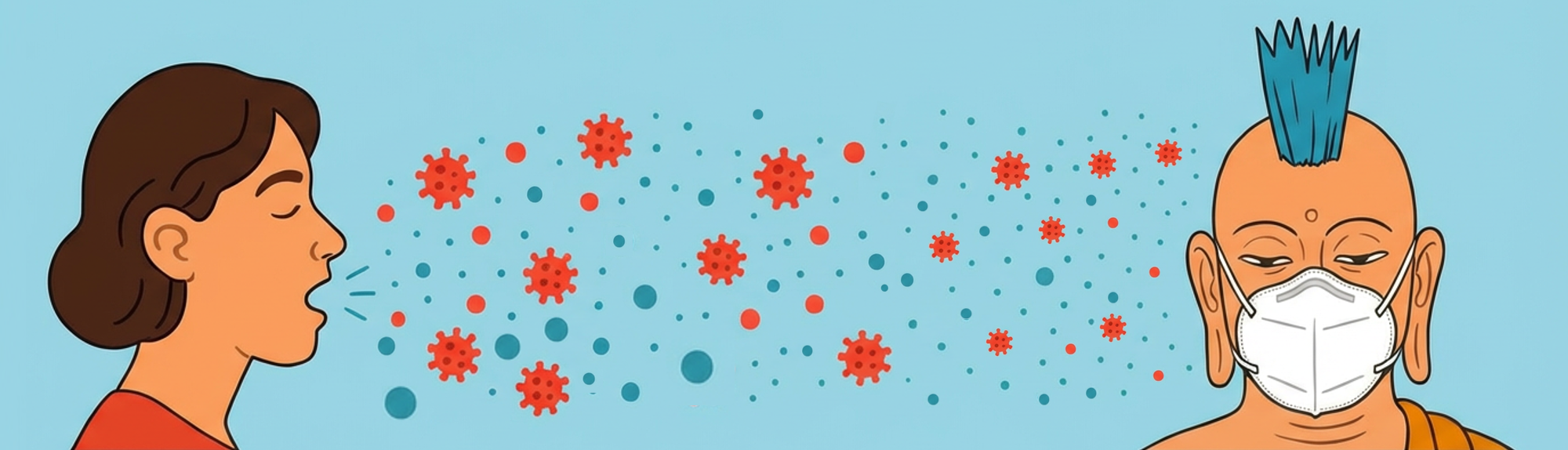
From Droplets to Fine Particles: How the pandemic changed our understanding of infection spread

This is an English translation of a Finnish post outlining some learnings from our government funded consortium of 5 universities, studying what we can learn from the COVID-19 pandemic response. The interdisciplinary collaboration has significantly influenced how I think of pathogen spread, and I found the post quite enlightening. I hence wanted to share this with a larger audience, because auto-translate tools still don’t work well for Finnish. Original authors are Lotta-Maria Oksanen, Tuomas Aivelo, Viktor Zöldi, and Tarja Sironen. I am grateful to the first author for providing feedback on the translation, but all mistakes in the final text are mine – please report if you see any.


Throughout time, people have pondered how infections spread and how they should be combated. The pandemic changed how we think pathogens in the respiratory tract spread.

Exposure occurring through the air is no longer seen as rare or exceptional. It is now viewed as a daily transmission route for respiratory infections in normal social interaction.

Research on the topic is being conducted in the Government-funded Lessons from the Pandemic Crisis (PAKO) project, which investigates COVID-era actions across different sectors to prepare for future crises. The University of Helsinki [medical faculty]’s sub-study forms a comprehensive picture of the understanding that prevailed in Finland. The study focuses on the view about transmission routes and the changes it faced, and the protection guidelines introduced. It also produces an analysis of the variants observed in Finland during the pandemic, their characteristics, and their speed of arrival.

The Historical View: Droplets at the Center of Infection

Before the pandemic, it was thought that respiratory infections spread via large droplets generated when a symptomatic person coughs or sneezes. These droplets cause infection when hitting the recipient’s mucous membranes, i.e., the eyes, nose, or mouth.

Over a hundred years ago, medicine was living through a time of change. It began to be understood that diseases are caused by pathogens. There was a desire to get rid of old beliefs, such as miasma – polluted air that originated from rotting sources and was believed to cause diseases. Dried saliva mixed with dust was also believed at that time to have great significance in the spread of diseases. Indeed, public spaces read: “Do not spit on the floor.” Studies were conducted in which test subjects, for example, swirled a solution containing bacteria in their mouths and read aloud. Dishes were placed on the floor in front of them, revealing how far the bacteria spread. Bacteria grew especially on the dishes that were close by. In the studies, the significance of fresh secretions was understood, and attention focused on large droplets.

The role of air as a carrier of infections lost apparent credibility even further, when a leading public health scientist Charles Chapin (1856-1941) criticised airborne transmission in his key textbook. He proposed that contact infection is the most central and obvious transmission route. The idea of contact and droplets as dominant modes of transmission lived strong for decades, and thus hand washing and droplets became familiar to everyone in pandemic guidelines as well.

The New View: Respiratory Infections Spread Via the Air

The problem with droplet thinking was that smaller particles remain in the air and do not settle on the dish. The old technology simply was not sufficient to observe these. Especially regarding viruses, technical challenges exist even today. Airborne transmission has, however, proven to be central in many transmission events. Advanced measurement methods have shown that nearly all particles we produce are very small and that we produce infectious particles also when breathing. In animal experiments, other transmission routes have been ruled out, demonstrating that infection must have occurred via the air – for example, a seminal research setup that demonstrated the airborne nature of tuberculosis has been replicated also with SARS-CoV-2

Human experiments have also yielded interesting results. In a study examining Rhinovirus, laboratory-infected “donors” and susceptible volunteers sat playing cards for 12 hours, sitting at a distance of 1.5-2m from each other. Some of the participants had their hands tied so that it was impossible for them to touch their faces, making infection possible only through the air. Infections were equally common among hands-tied and untied groups. In a separate branch of the experiment, where the cards were thoroughly soiled with the infectors’ nasal secretions, but the infectors did not participate in the game, no infections occurred at all.

Correspondingly, many pandemic-era super-spreader events – such as various concert and choir events, many of which observed safety distances – a significant portion of participants still fell ill. Such transmission events are only possible through airborne transmission. While it was previously thought that close proximity was proof of contact infection, it is now understood that exposure to small particles is also highest at close range.

Infection Through the Air: Threat or Opportunity?

Traditionally, air has been considered difficult to control. Modern technologies, such as ventilation, air purification, and respirator-grade masks, however, make it possible to target actions precisely at smaller particles and thus reduce infection risk. The UN held its first Conference on Healthy Indoor Air on 23 September 2025, and safe indoor air was defined as a key objective. Indeed, new international ventilation standards that take infection risks into account, have been proposed for new construction and renovation projects.

Taking airborne infection into account also opens an excellent opportunity to improve patient and occupational safety in social and health care. With awareness, this infection risk can be monitored and combated. Until now, protective guidelines have mainly concerned droplets, leaving a central part of the exposure unnoticed. Noting the airborne nature enables use of personal protective equipment that protects against it. An example would be recognising that the effect of screens or curtains is minimal on respiratory infection in a shared room without other additional measures – such as air purifiers – especially during prolonged exposure.

The Role of Information and the Challenge of Distortion

The pandemic has also made visible another phenomenon: the distortion of information. In the era of social media and rapid communication, research information and carefully collected evidence compete for attention with false information, partisan interpretation, and outright disinformation.

The phenomenon is global, but it escalated, for example, in the United States. Sharp dividing lines regarding e.g. the use of masks and vaccines emerged both spontaneously, and were created purposefully, during the pandemic. Information became a tool for political and ideological maneuvering – instead of a shared foundation for decision making.

Information alone is not enough. Structures and processes are also needed that enable the flow of information and support trust in experts, authorities, and research, as well as dialogue between these actors. Without this trust, even the best possible research information does not translate into action.

The pandemic showed how one can change course in the middle of a crisis if basic trust exists: Finns, for example, quickly adopted masking or kept their distance when the authorities recommended it. Conversely, new ideas do not end up in practice if the opportunity to bring new information to the decision-making table is lacking. Discussion must continue and trust must be built between crises; then the structures will be ready.

Looking Forward

From the history of medicine, we know that it takes a long time before new information changes practices. The necessity of hand washing between handling the deceased and treating living surgeries or deliveries was once difficult to accept. Nowadays, medical breakthroughs are considerably faster, but questioning old ways still often leads to negative reactions first. Over time, through education and dialogue, new information begins to gain a foothold.

Change is an opportunity. With advanced knowledge, we can bring different fields to the same table to solve the problem. For example, we can enhance measures that reduce infection risk in indoor air already in building design, and simultaneously reduce other exposure to particles. In this change, digitalisation and sensor technology offer new possibilities. Smart buildings can adjust ventilation energy-efficiently using real-time data. Collected data, in turn, helps visualise risky spaces and target corrective measures exactly where they are needed most – making healthy indoor air the new norm.

This means that in future epidemics, we will have more means at our disposal than just prohibitions and restrictions. What if in the next pandemic we didn’t have to greet the elderly from behind a window, but could hug them while wearing a respirator-grade mask? Often, it is precisely large structural hygiene changes, such as the cold chain or water purification, that bring significant public health benefits in the long run – is clean indoor air the next great change that also increases everyday health security? 

It is time to ask: are we ready to invest in behaviours, technology, and structures that make our workplaces, hospitals, schools, and homes healthier?


Original authors:

Lotta-Maria Oksanen, Postdoctoral Researcher, University of Helsinki

Tuomas Aivelo, Assistant Professor, Leiden University, Academy Research Fellow, University of Helsinki

Viktor Zöldi, Postdoctoral Researcher, University of Helsinki

Tarja Sironen, Professor, University of Helsinki

Evidence is in the Past, Risk is in the Future: On Tail Events and Foresight

Context: This post outlines a manuscript in preparation and exhibits some of its visualisations, partly also presented at the European Public Health Conference (November 2025). If a blog format isn’t your poison, you can also see this video or this one-pager (conference poster).


It’s April 2025. Red Eléctrica, the electricity grid provider for the Iberian Peninsula, declares: “There exists no risk of a blackout. Red Eléctrica guarantees supply.”

Twenty days later, a massive blackout hits Portugal, Spain, and parts of France.

What the hell happened?

To understand this, we need to talk about ladders.

The Ladder Thought Experiment

Let’s take an example outlined in the wonderful article An Introduction to Complex Systems Science and Its Applications: Imagine 100 ladders leaning against a wall. Say each has a 1/10 probability of falling. If these ladders are independent, the probability that two fall together is 1/100. Three falling together: 1/1000. The probability of all 100 falling simultaneously becomes astronomically small – negligible, essentially zero.

Now tie all the ladders together with rope. You’ve made any individual ladder safer (less likely to fall on its own), but you’ve created a non-negligible chance that all might fall together.

This is cascade risk in interconnected systems.

Two Types of Risk

From a society’s perspective, we can understand risks as falling into one of two categories:

Modular risks (thin-tailed) don’t endanger whole societies or trigger cascades. A traffic accident in Helsinki won’t affect Madrid or even Stockholm. These risks have many typical precedents, slowly changing trends, and are relatively easy to imagine. We can use evidence-based risk management because we have large samples of past events to learn from.

If something is present daily but hasn’t produced an extreme for 50 years, it probably never will.

Cascade risks (fat-tailed) pose existential threats through domino effects. Pandemics, wars, and climate change fall here. They’re abstract due to rarity, with few typical precedents – events tend to be either small or catastrophic, with little in between.

If something hasn’t happened for 50 years in this domain, we might have just been lucky, and it might still hit us with astronomical force.

Consider these examples:

  • Workplace injuries
  • Street violence
  • Non-communicable diseases
  • Nuclear plant accidents
  • Novel pathogens
  • War

Before reading on, give it a think. Which are modular? Which are cascade risks?

I’d say most workplace injuries and street violence are modular (unless caused by organised crime or systemic factors like pandemics). Non-communicable diseases are also modular, although can be caused by systemic issues. Mega-trends perhaps, but you wouldn’t expect a year when they suddenly doubled, or became 10-fold.

Novel pathogens and wars are cascade risks that spread across borders and trigger secondary effects. These are the ladders tied together with a rope. Nuclear plants kind of depend; nowadays people try to build many modular cores instead of one huge reactor, so that failure of one doesn’t affect the failure of others. But as the mathematician Raphael Douady put it: “Diversifying your eggs to different baskets doesn’t help, if all the baskets are on board of Titanic” (see Fukushima disaster).

Is That a Heavy Tail, or Are You Just Happy to See Me?


Panels A) and B) below show pandemic data (data source, image source, alt text for details) – with casualties rescaled to today’s population. The Black Death around the year 1300 caused more than 2.5 billion deaths in contemporary terms. Histograms on the right show the relative number of different-sized events. The distribution shows tons of small pandemics and a few devastating extremes, with almost nothing in between (panel A, vertical scale in billions). We see a similar shape even when we get rid of the two extreme events (panel B, vertical scale in millions).

Panel A: “Paretian” dynamics of a systemic risk, illustrated by casualties from pandemics with over 1000 deaths, rescaled to contemporary population, with years indicating the beginning of the pandemic (Data from Cirillo & Taleb, 2020; COVID-19 deaths are presented until June 2024 according to model by The Economist & Solstad, S., 2021). Panel B: Same as panel A, zooming into the events with less than 1B deaths. This illustrates how the variance remains vast, even when the scale of events is much smaller. Panel C: Casualties from traffic accidents in Finland, illustrating the dynamics of a “thin-tailed”, localised risks. In this case, it would not be reasonable to expect a sudden increase to 10 000 casualties, whereas in the prior examples such jumps are an integral part of the occurrence dynamic.

Compare this to Panel C), Finnish traffic fatalities. Deaths cluster together predictably. You wouldn’t expect 10 000 road deaths in a single year – even 2 000 would be shocking.

Moving from observations to theory: The figure below compares mathematical “heavy-tailed” distributions to “thin-tailed” distributions. Heavy-tailed distributions depict:

  • Many more super-small events than thin-tailed distributions: Look at the very left side of the left panel below, where red line is above the blue one
  • Fewer mid-size events: Look at the middle portion of the left panel below, where blue line is higher than red
  • Extreme events of a huge magnitude that remain plausible: Look at the inset, which zooms into the tail (in thin-tailed distributions, mega-extremes are practically impossible like the ladders without a rope)

When we look at the right panel of the image above, thin-tailed distributions (like traffic deaths) should drop suddenly when plotted on a logarithmic scale. Fat-tailed distributions (like pandemics) should create a straight line, meaning very large events remain statistically plausible.

Or, at least that’s the theory, based on mathematical abstraction. Let’s see what the real data shows.

And here we go: The tail of actual pandemics looks like a straight line, while the tail of traffic deaths curves down like an eagle’s beak. Pretty neat, huh?

Evidence Lives in the Past, Risk Lives in the Future

In the interests of time, I’m going to skip a visualisation you see in the video (26:45). Main point is that for thin-tailed modular risks, we extrapolate from past data. For heavy-tailed cascade risks, we must form plausible hypotheses from current, weak, and incomplete signals.

This is the difference between induction (everything that happened before has these features, so future events will too) and abduction (reasoning to the most sensible course of action given limited information). All data is data from the past, and if the past isn’t a good indicator of the future, we need different ways of acting:

The mantra of resilience is early detection, fast recovery, rapid exploitation.
Dave Snowden

We need to detect weak signals early. The longer we wait, the bigger the destruction.

A Practical (piece of a) Solution: Participatory Community Surveillance Networks

In our research group, we’re developing networks of trusted survey respondents who participate regularly (see article), akin to the idea of “citizen sensor networks” also presented in the EU field guide Managing complexity (and chaos) in times of crisis. With such a network in place, during calm times, you can collect experiences and feedback on policy decisions. When crisis hits, you can pivot to gain rich real-time data from the field.

Why? Because nobody can see everything, and we see what we expect to see. If you don’t believe me, see if you can solve this mystery.

Given enough eyeballs, all bugs are shallow
– Eric S. Raymond

The process:

  1. Set up a network of trusted responders
  2. Collect experiences continuously
  3. Pivot when crisis takes place to gather data on how the disruption shows up in lived experience
  4. Avoid the trap of post-emergency mythmaking, and do a “lessons learnt” analysis with data collected during the disruption

Example: Inhabitant Developer Network

We developed an idea in a Finnish town, where new inhabitants would join the network as part of a “welcome to town” package. We could ask:

  • “What’s better here than where you lived before?” → relay to marketing
  • “What’s worse here than where you lived before?” → relay to development

When crisis occurs, we could pivot, asking about how the disruption shows up in people’s lived experience:

  • “What happened?”
  • “Give your description a title”
  • “How did this affect things important to you?”
  • “How well did you do during and after?” (1-10 scale)
  • “How prepared were you?” (1-10 scale)
  • … etc.

Respondents self-index these experiential snippets with quantitative indicators, giving us both qualitative richness and quantitative patterns. We can then e.g. examine situations where people were well-prepared but didn’t do well, or did well despite being unprepared – and filter e.g. by tags like rescue service involvement. This gives us rich data from the field to inform local decision makers.

From Experiences to Action

The beauty of collecting people’s lived experience is that they can later be used for citizen or whole-of-workforce engagement workshops. You can ask Dave Snowden’s iconical question: “How could we get more experiences like this, and fewer like those?”

This question holds an outcome “goal” lightly, allowing journeys to start with direction rather than rigid destination. It is understandable regardless of education level, and gives communities agency in developing solutions. This approach enables:

Anticipation: Use tailedness analysis as a diagnostic; use networks to detect weak signals before they explode.

Formulation: Design adaptive interventions with the community – interventions that are change instead of being fragile to the first unexpected shock.

Adoption: Build agency, legitimacy and buy-in through participatory processes. People support what they own or help create.

Implementation & Evaluation: Monitor in real-time, learn continuously, act accordingly. No more waiting six months for a report, or getting a quantitative result (“life satisfaction fell from 3.9 to 3.2”) only to need another research project to learn why: You can just look at the qualitative data to understand context.

Why This Matters

When Red Eléctrica declared “there exists no risk,” they were thinking in a thin-tailed world where past data predicts future outcomes. But interconnected systems – like them tied-together ladders – create heavy-tailed risks. For cascade risks, precaution matters more than proof. If you face an existential risk and fail, you won’t be there to try again.

As Nassim Nicholas Taleb puts it: Risk is acceptable, ruin is not (more in this post). And no individual human is capable of understanding our modern, interconnected environments alone.

Bring forth the eyeballs.


Related Posts

From Fruit Salad to Baked Bread: Understanding Complex Systems for Behaviour Change – Why treating behaviour change like assembling fruit salad instead of baking bread leads well-meaning efforts to stumble.

From a False Sense of Safety to Resilience Under Uncertainty – On disaster myths, attractor landscapes, and why intervening on people’s feelings instead of their response capacity is dangerous.

“Mistä tässä tilanteessa on kyse?”: Henkisestä kriisinkestävyydestä yhteisölliseen kriisitoimijuuteen (In Finnish) – From individual resilience to collective crisis agency: reflections from Finland’s national security event.

Riskinhallinta epävarmuuden aikoina: Väestön osallistaminen varautumis- ja ennakointimuotoiluun (In Finnish) – Risk management under uncertainty through participatory anticipatory design.


For deeper exploration of these concepts, I recommend Nassim Nicholas Taleb’s books: Fooled by Randomness, The Black Swan, and Antifragile, as well as the aforementioned EU field guide Managing complexity (and chaos) in times of crisis.

When Finland Decided to Open Up: A Behavioural Scientist’s Perspective

I’ve been writing this post between 4.-21. February 2022, when questionable information is rampant in Finnish public discussions: Omicron is thought to be comparable to the flu, a trend of ever-milder variants is considered an inevitable biological law, the pandemic is (again) claimed to be over, and the sentiment is that there’s nothing much we can or need do about it anyway. This post is a historical reference so we don’t forget what happened to a relatively successful Finnish pandemic management scheme between June 2021 and February 2022. I also present two future scenarios to consider, when the hopium in current media discourse turns out to be hot air again. My hope is, that individuals and communities will shift their perspective and start buffering the nation against bad outcomes, not the best-case scenarios – which do not require preparation anyway. The post does not reflect views of the behavioural science advisory group (KETTU) operating in the Finnish Prime Minister’s Office, nor those of the Citizen Shield pandemic prevention project.

[UPDATE 2023-30-10: Post reviewed at this date, and judged to have continued relevance. Added some references to the end, and updated the speculation of pan-variant vaccine refusers from 5% to 5-50%.]

Hi. We’re Finland. You may remember us from hit songs such as Don’t Stand So Close to Me, Unless We’re in the Sauna and Nokia’s Gonna Last Forever. In more recent times, we’ve been cited as one of the best countries in pandemic management: in fact, by fall 2021 had only had approximately one thousand recorded COVID-deaths. Reasons for the relative success include remote geographical location, low population density, and cultural features, including the general avoidance of close physical proximity between individuals – and perhaps less so public health prowess (in fact, we only narrowly avoided going Full Tegnell on the pandemic). Let me just quickly recount what happened to the success story in the latter half of 2021, because it’s kinda funny.

It’s June 2021, right before government officials start their holidays. I’m telling people we should make preparations for the Delta variant. The suggestion is shrugged off with humour, and in all fairness, it did look like we were going to near-zero cases again for the summer… Before a bunch of football fans returning from Russia kicked off the Delta wave. After the usual debate on whether new variants will find Finns attractive, cases started going up, and we were soon in the slow initial growth of the exponential curve. So, there I was in August 2021 when the holidays ended: anxiously awaiting for someone to state, that in order for us to keep the freedoms we had during the summer, we’re going to need to smash the curve (something akin to what various countries from Portugal to Japan later did). Instead, in early September, the government announced everyone has a great need to go back go normal, and that now is the time to do it: “It’s Time to Live!”

Our health officials agreed, because after all, Denmark had already decided, that September 2021 was the time to end precautions*. To quote our director of health security: “We are on the home stretch of the pandemic […] and due to the vaccination rate, don’t need to worry about the pandemic in Finland any more [although minor setbacks may occur]” (September 2021). Also in September, in a particularly funny episode, an epidemiologist from the Finnish equivalent of CDC, called a multidisciplinary group of local precaution-advocating scientists “a crackpots’ day care club”.

*footnote: some may forget, that this did not turn out very well for them or any other of the “we’re going to live with the virus now” countries – Denmark’s end of the pandemic was cancelled, until announced again in early 2022.

Here’s some survey data to describe the Finnish situation from a perspective of personal protective behaviours:

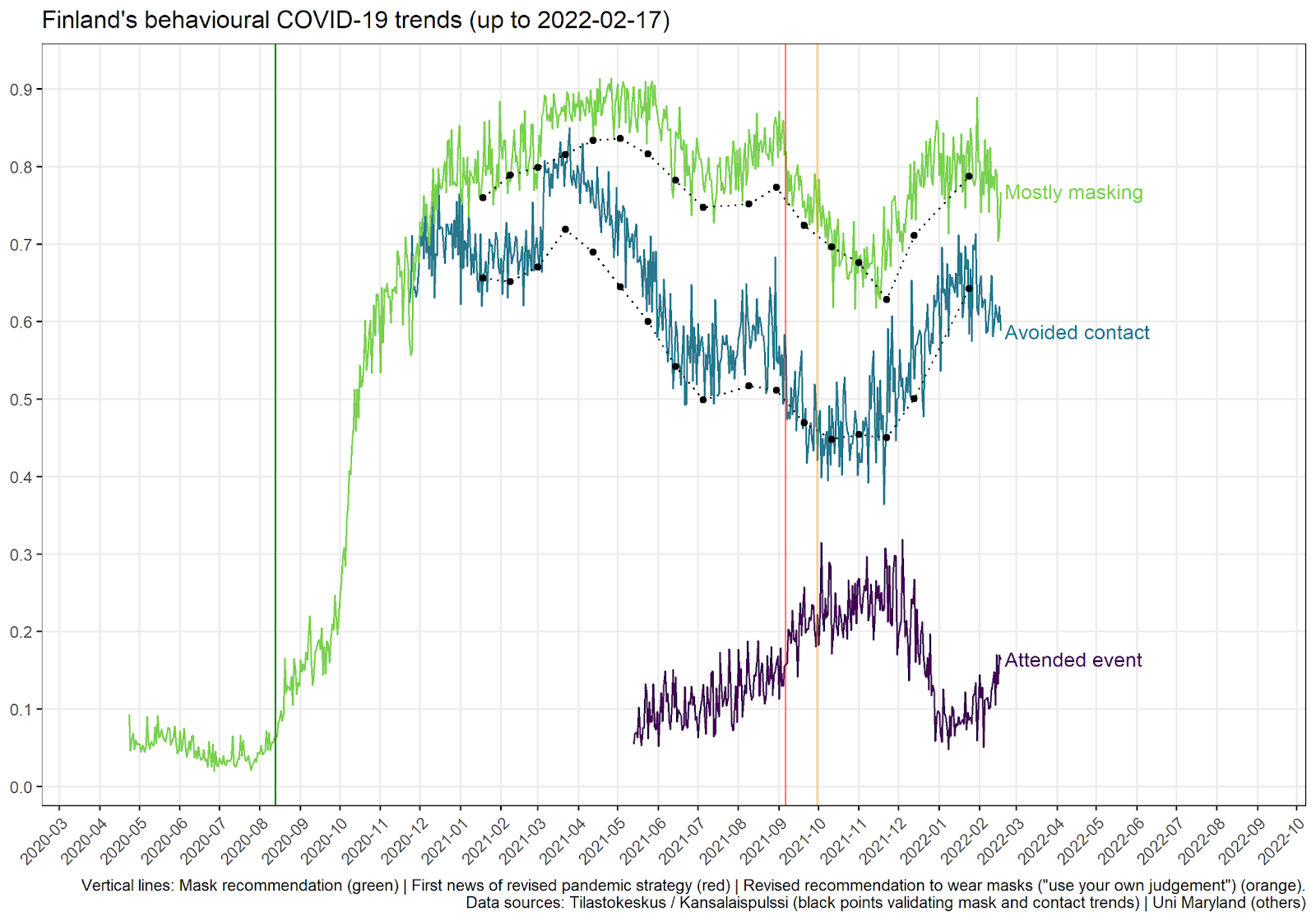
Figure 1: Despite the late adoption of masks, Finns rapidly increased their uptake in Fall 2020. Precautions decline during Fall 2021, under heavy mainstream media pressure to return to normal, and go up again as the situation worsens rapidly.

Major news media seemed convinced not only that the pandemic was over (again), but that they needed to perform psychological interventions to reduce the public’s risk perception – despite rising case numbers. Reporters were calling me on the phone: “You’re a social psychologist; how can we make people go back to normal?”. Chief editors of the largest newspapers made flashy statements such as “COVID is over when everyone stops being afraid”, and “[despite scientists who called for unnecessary suppression] Finland is nearing herd immunity, while Australia and New Zealand are in trouble” (aside: they weren’t, but we were).

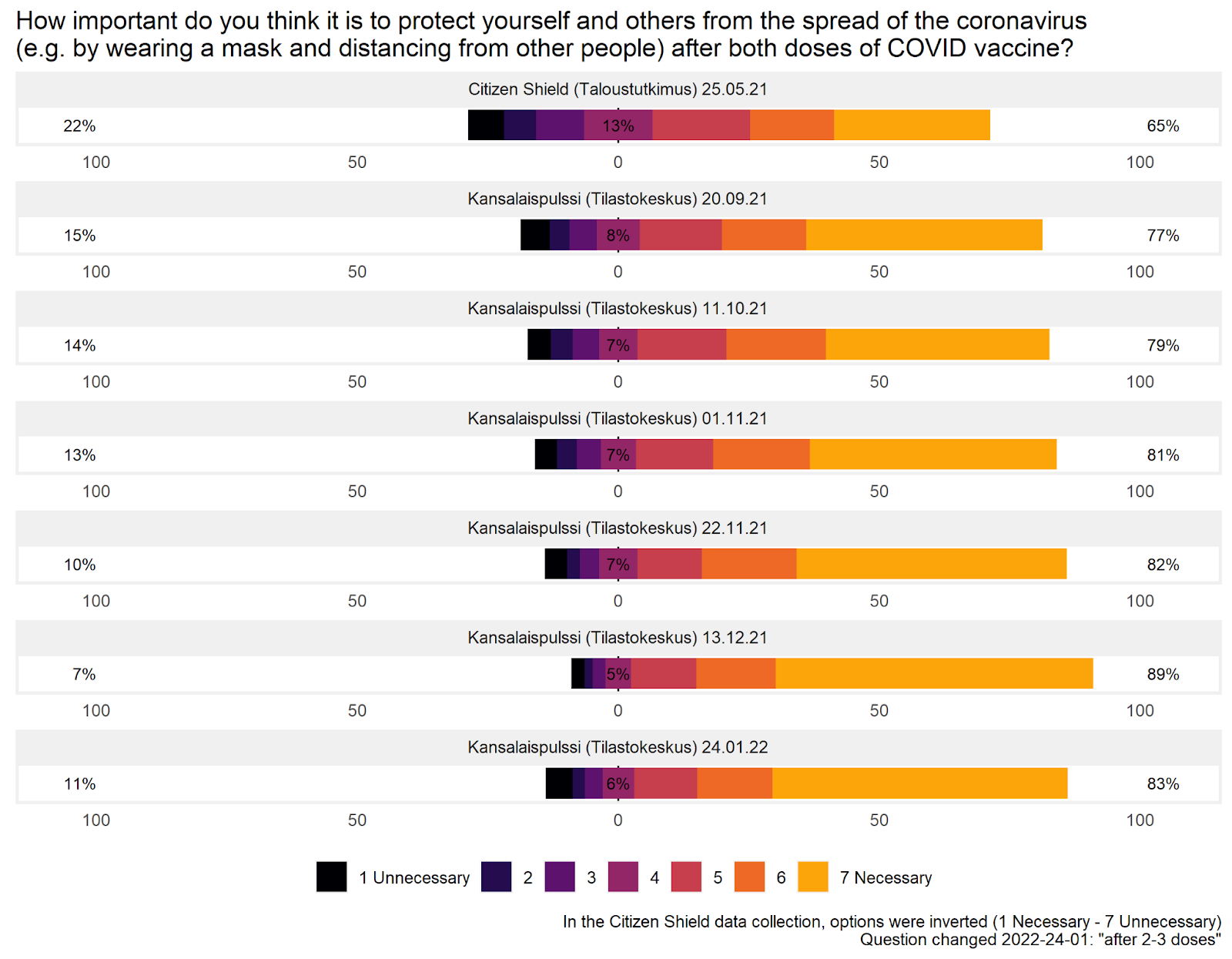
The need to go back to normal was couched in statements about the people being tired of protective actions. This was curious, because all the while surveys indicated that people actually thought it was pretty important to continue exercising precaution, even after vaccinations:

Figure 2. Rising trend in stated need to continue precautions from mid-2021 to early 2022 – meanwhile, officials repeat the statement that people are very tired. Note: the behavioural science advisory group combined survey and interview data, concluding in a report in December, that people (mostly younger age groups) are mostly annoyed of restricting close contacts, while e.g. masks in public spaces remained highly acceptable.

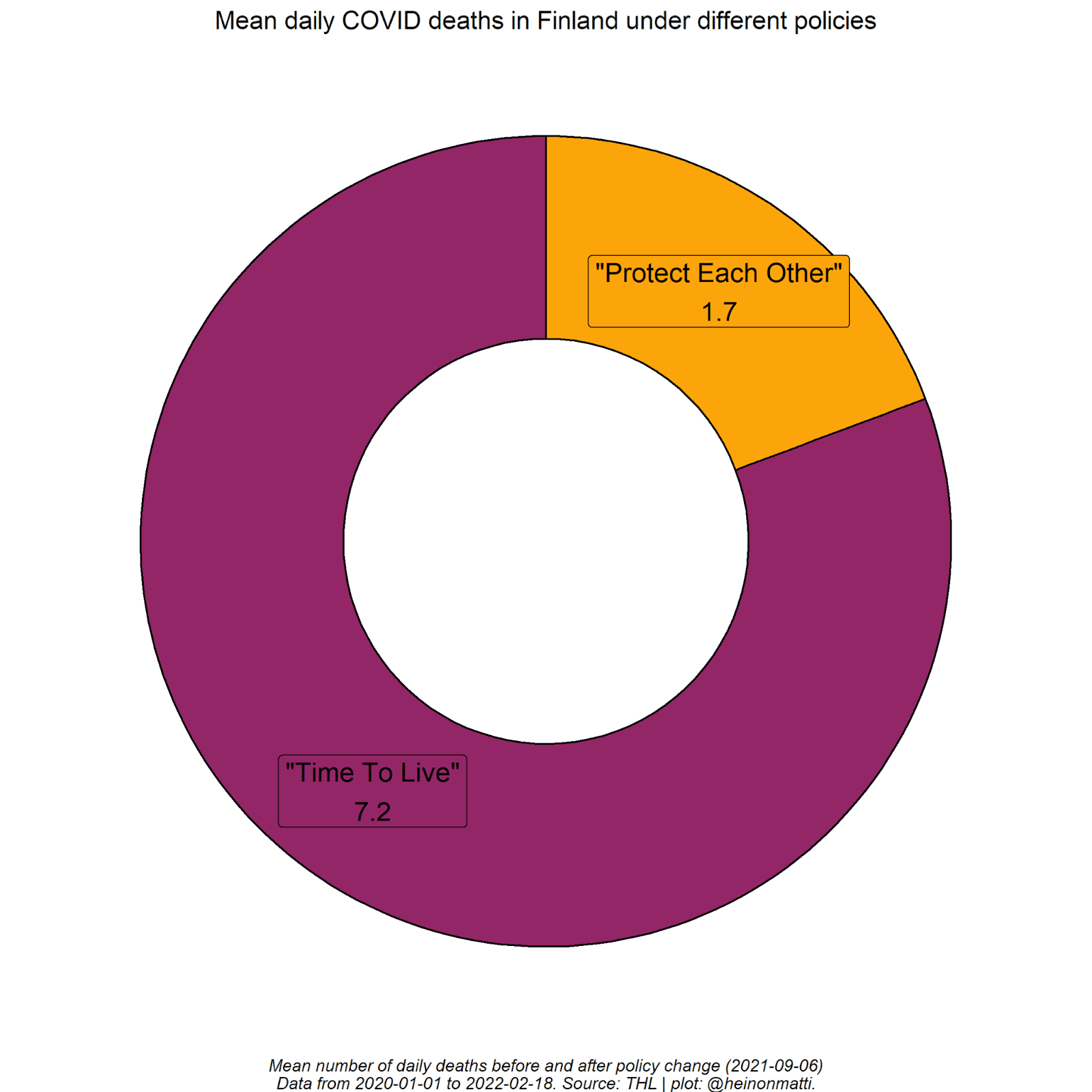
In the end of November 2021, Omicron caught us in the midst of an exponentially worsening delta epidemic, and by the time of writing (February 2022), we are waiting for BA2 close to the worst situation of the pandemic’s history. Here’s a summary of what happened when the pandemic management strategy was changed in September 2021, to cater the people’s supposed need to go back to 2019 ASAP:

Figure 3. After Finland switched its pandemic management approach (less testing, never mind total case numbers, aim to go back to normal), things went somewhat awry. [UPDATE 10/23: by this date, the numbers have not got better; on the contrary]

What are we doing currently, to remedy the situation? Surely not repeating any past mistakes? Memorable bits of recent news: Our aim should be to open up quickly, COVID will be just like the flu by summer 2022Vaccinations and a weakening virus are making the epidemic lose its edge. Central assumptions – I repeat, assumptions – include that everyone will get sick, the population becomes stronger with better immunity, and after some time (One year? Ten years? Hundreds / thousands of years?), we don’t need to mind the virus any longer. Seeing our new director of the Ministry of Social Affairs and Health cite the inevitability of getting ill, it just makes me wonder: What none of this is true, who has a Plan B? To a non-doctor, long term neurological and cardiovascular damage does not look like something to aim for, in order to gain short-lived immunity. Also, many public officials in Southern Finland have ignored the law which says you should not let dangerous infectious diseases run amok – does this mean they now have a mental investment in the nothing-could-nor-can-be-done narrative?

If you’re Finnish, you may be suprised that many countries around the world are way better vaccinated than us, and are doing quite a good job in pushing down Omicron with vaccines and protective public health measures. The situation reflects the WHO Director General’s statement calling for a “vaccines-plus” -strategy:

I need to be very clear: vaccines alone will not get any country out of this crisis. Countries can and must prevent the spread of Omicron with measures that work today. It’s not vaccines instead of masks, it’s not vaccines instead of distancing, it’s not vaccines instead of ventilation or hand hygiene. Do it all. Do it consistently. Do it well.

– Director General of the WHO, Tedros Adhanom Ghebreyesus, as quoted in Covid-19: An urgent call for global “vaccines-plus” action 

I end with two long-term scenarios, just to record what I considered the most important at the time of writing:

An optimistic scenario. There’s some critical threshold of disability caused by the pandemic, as well as global supply chain malfunctions from the ever-increasing pace of immunity evading variants. Upon crossing this threshold, health officials, the business sector and/or government representatives understand, that the only way out is to go for the exit – i.e. an elimination strategy, or other such coherent response. It can be done, but not if you insist traditional epidemiological models are the reality, instead of just ways to simplify some part of it. Note that it is clearly disinformation to state, that talking about elimination means advocating for an eternal lockdown; see e.g. how it can be achieved with mass testing. Depending on your belief structure, the elimination strategy may seem far-fetched right now, but nonlinear impacts of not doing it can accumulate fast, if and when the pandemic continues its course instead of going away. [See here for a Finnish post on driving down infections.]

A pessimistic scenario. Finnish Health officials await for a scientific consensus, which keeps proceeding at the pace of Planck’s principle (i.e. every step forward requires the funeral of an influential person keen on retaining the status quo). People “Swedify” and grow complacent, quick to normalise every new turn to the worse. We go back to accepting mortality rates of the pre-antibiotic era, until a new type of vaccine is created, which handles all potential variants. The vaccine is refused by some 5-50% of the population, from which forms the basis of a polarised societal system. In this system, some official services which refuse the unvaccinated, are replaced by underground / black market equivalents catering to their needs. The default option for countering the next pandemic becomes wait for the vaccine because we learned that anything else is ridiculous and a conspiracy theory. Then, while twiddling our thumbs, the next pandemic kills a billion people, which due to global interconnectedness, permanently changes the lives of several generations.

Tell me I’m wrong.

[with thanks to Kaisa Saurio for helpful comments]